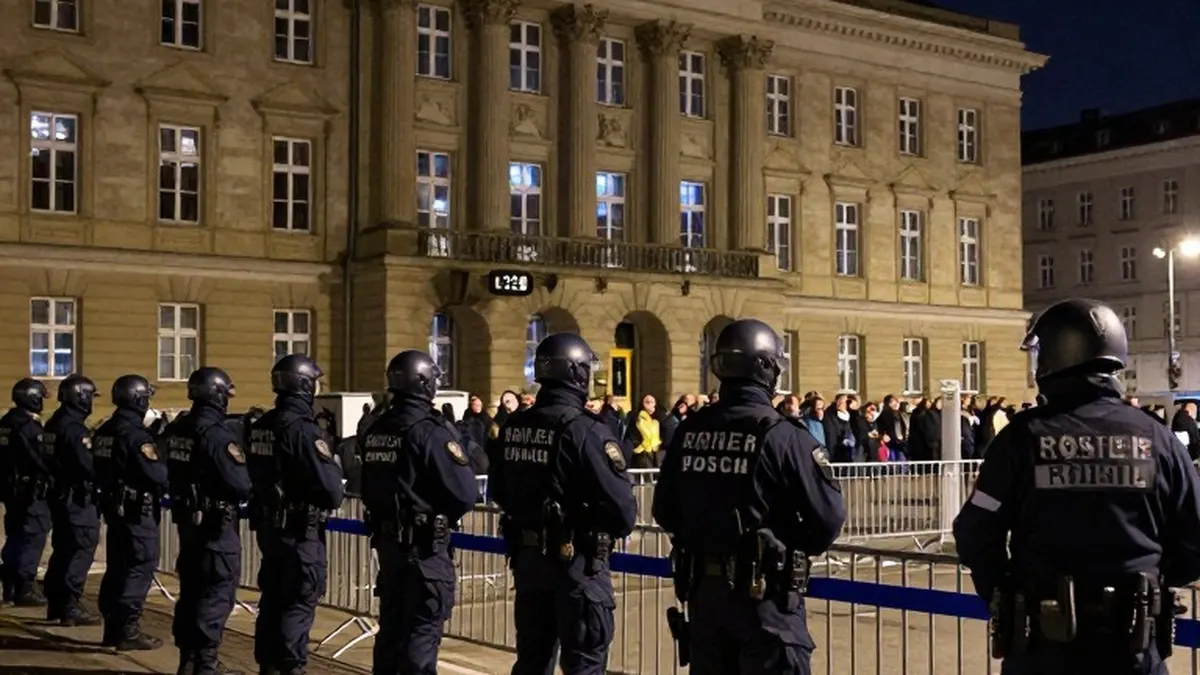
Riot police confronted protesters outside Poland’s constitutional court on Friday night after judges appointed by the governing majority suspended its disputed president, Bogdan Święczkowski, and his deputy, Bartłomiej Sochański. The confrontation intensified a conflict over the court’s legitimacy that has divided Polish politics for a decade.
President Karol Nawrocki, a conservative backed by the opposition Law and Justice party, known as PiS, turned his plane around while travelling to Senegal for a state visit. Hundreds of demonstrators, including opposition MPs, gathered at the court in support of the suspended judges. Three people were reportedly arrested after attempting to push through the police presence and enter the building. PiS leader Jarosław Kaczyński denounced the suspensions as an attack on the institution.
Nawrocki arrived shortly before 1am on Saturday and passed through the police cordon. Video showed him struggling with security personnel and other judges as he sought entry. He remained inside at 4am. In footage shared online, he rejected the government appointees’ status as constitutional court judges. A statement delivered on his behalf at 5am accused those involved of forcibly taking over a constitutional institution and called for security forces to withdraw.
The confrontation followed a decision by judges elected by the current parliamentary majority to suspend the court’s leaders and take procedural control. Anna Korwin-Piotrowska said she had assumed the presidency because she had the longest judicial experience. She is among five judges elected by parliament whom Nawrocki refused to swear in this year. Earlier in October, the Venice Commission, the Council of Europe’s advisory body on the rule of law, said that refusal should not stop them taking office.
Legal specialists differed sharply over whether Święczkowski’s suspension was lawful. Marcin Matczak, a prominent legal expert and critic of PiS, said he believed it had no legal foundation, despite his opposition to the former PiS minister. Separately, justice minister Waldemar Żurek said he had requested the removal of immunity from Święczkowski and Sochański so they could face prosecution for obstructing the court’s work.
The dispute began in 2015, when an outgoing centrist government and its incoming rightwing successor made successive, legally questionable efforts to install judges. The resulting appointment conflict paralysed the court, with further attempts to weaken it during PiS’s eight years in government. The court often favoured Polish legislation over EU law, while the European Union accused it of excessive closeness to the nationalist authorities.
Since returning to government in 2023, prime minister Donald Tusk has promised to undo disputed reforms and improve relations with Brussels, while declining to recognise the court’s current legitimacy. Presidents aligned with the opposition have blocked his efforts through vetoes and broad interpretations of their authority. Nawrocki unexpectedly defeated Tusk’s candidate in last year’s presidential election. The latest conflict could deepen divisions before next year’s parliamentary vote, with polls suggesting the populist right could regain power.
Tusk defended decisive measures as necessary to restore the rule of law after PiS’s years in office. Earlier in October, he had pledged that the court would resume constitutionally compliant work regardless of opposition. Foreign minister Radosław Sikorski, speaking during a G20 meeting in Atlanta, said the previous government had politicised the tribunal and that the changes were intended to let a majority of properly elected judges restore its functioning.
Opposition leaders and the court’s social media account characterised the intervention as a judicial coup. Nigel Farage, Liz Truss and Geert Wilders also condemned it. US ambassador Tom Rose described the situation as serious, acknowledged conflicting accounts and warned that the gathering outside the tribunal risked escalating an already dangerous confrontation.