Serhii Sternenko has gone from civic activist and popular blogger to one of Ukraine's best-known volunteers since Russia's full-scale invasion, and spent six months as an adviser in Defence Minister Mykhailo Fedorov's team. In 2025 he founded the Sternenko Community, a foundation that supplies drones to Ukraine's defence forces and, backed by his YouTube audience of over 2 million subscribers, raised UAH 3.1 billion (about US$68 million) in donations last year alone.
In an interview with Ukrainska Pravda, Sternenko said Ukraine had not been caught off guard by Russia's jet-powered Shahed drones. Kyiv knew as early as the second half of last year that production had begun, and manufacturers were already working on new interceptors then, with his foundation involved. "I don't think we completely missed the emergence and scaling up of Russia's jet-powered Shaheds," he said, noting that offensive weapons always emerge before defences. "The sword comes before the shield, so to speak."
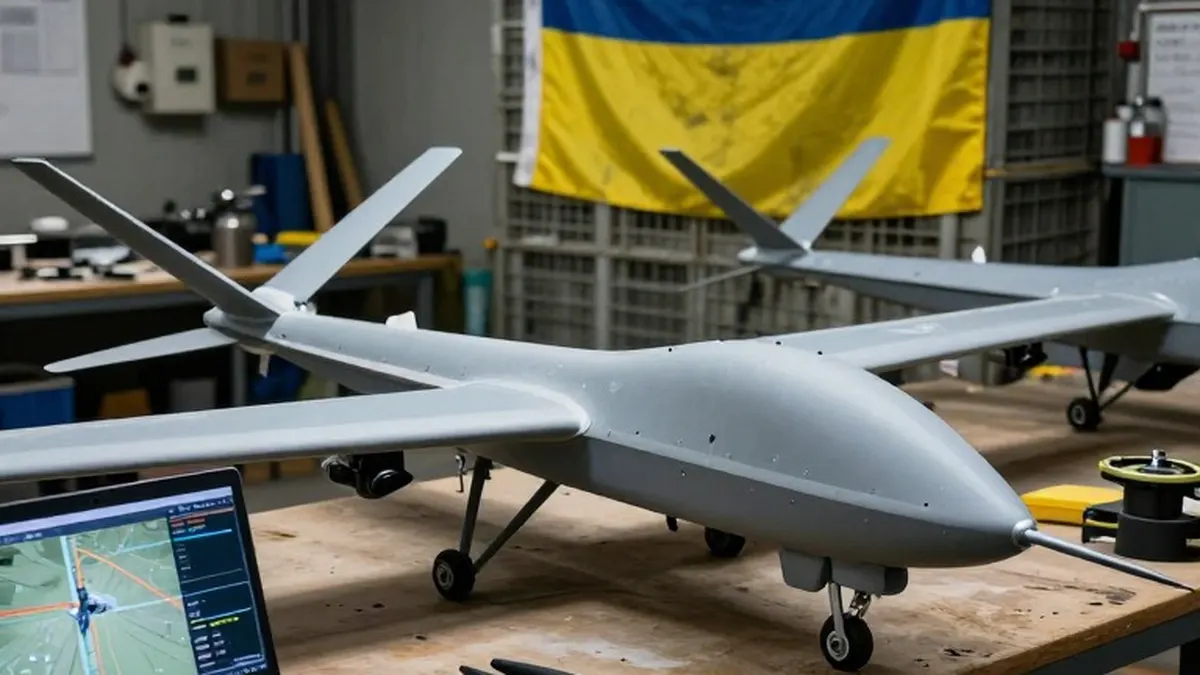
There are now three types of jet-powered Shaheds, he said. The Geran-3 is the slowest and can be shot down with conventional interceptors, the Geran-4 flies at 400 km/h or faster, and the Geran-5 is more like a missile than a drone. The main difficulties concern the last two. Approaching a mass-produced solution near the end of 2026, he said, actually represents very rapid progress.
Ukraine has several interceptor types in development, from prototypes to small and medium batches. Electric models are the most advanced but, in his view, the least promising due to speed limits: they are expected to reach 550 to 600 km/h and sustain that speed for a few minutes. Turbojet interceptors are more promising but far more complex and expensive, and a recent government decision to ease domestic turbojet engine production will not yield quick results.
For now, Ukraine is moving toward mass production of electric interceptors and small-scale output of jet-powered ones, including the Bars missile-drone adapted for interception, the systems Ukraine's leadership meant when it said restrictions on Starshield, the military version of Starlink, had reduced effectiveness against jet-powered Shaheds. The future, he believes, is a multirole platform: a large turbojet drone the size of a Geran or Gerbera carrying machine guns, interceptors and small surface-to-air missiles.
Sternenko said Ukraine still leads Russia in heavy multi-rotor bomber drones and some tactical communications and relay systems, while Russia is well ahead in fitting them into Geran-class drones and large attack UAVs, with mesh networks extending 200 km or more. Communications, he stressed, are "the backbone, the bedrock, the foundation". If Elon Musk ever cut Starlink for Ukraine, Russian advances would become easier and air defence less effective, though not necessarily a catastrophe. His foundation helped field a system on FPV drones this year that could partially replace Starlink for medium-range strikes.
He recalled that in January, after Russia began using Starlink on its Italmas drones, Fedorov gathered defence officials to brainstorm solutions. Once Starlink was disabled for the Russians, remotely guided Italmas attacks stopped, their drones could only follow pre-programmed coordinates, and their frontline command and control was seriously disrupted. That allowed Ukrainian counteroffensive operations with fewer losses, particularly on the Zaporizhzhia front, he said.
Asked what most holds back Ukraine's defence tech sector, Sternenko said technological limitations ultimately outweigh government management. Russia is already scaling up production of small cruise missiles, he warned, firing dozens of Banderol-class missiles each month from Orion drones or helicopters, alongside a new system called Filin and a rarely detected one known as Dan-T. Such missiles can reach 600 to 700 km/h, speeds at which interceptors become less effective.
Countering them will require homing seekers on surface-to-air missiles or drones, and Ukraine is far from making such systems at industrial scale. Partners could share the technology or produce it themselves but have not, he said, adding that Kyiv keeps pressing the issue. Air defence, he stressed, can never rest on a single weapon.