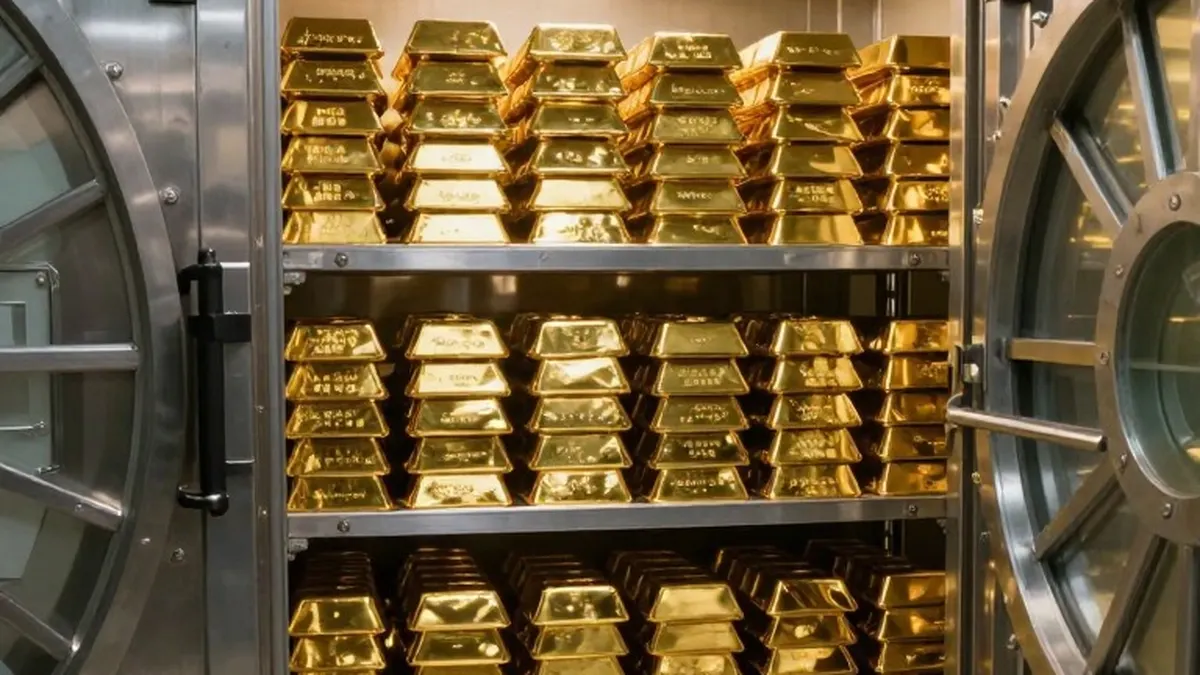
Singapore is seeking a larger role in the global gold trade through new storage facilities and planned tax incentives, as bullion activity increasingly shifts toward Asia. Its ambitions face competition from established centers such as London and Switzerland, as well as Hong Kong, which is expanding its own gold infrastructure.
The Monetary Authority of Singapore launched a vaulting service on Tuesday for foreign central banks and sovereign entities, with an initial capacity of 500 metric tons. Singapore also plans tax exemptions for selected wholesale gold services, including vaulting, refining, recasting, testing and broking. A physical gold clearing system announced in June is expected to begin operating in the first quarter of 2027 to support settlement of bullion transactions.
The scale of existing hubs illustrates the challenge. London vaults contained roughly 9,850 metric tons of gold at the end of October across commercial and central bank storage. Hong Kong, meanwhile, is developing storage and clearing facilities with the advantage of close links to China, the world's largest gold market.
Juerg Kiener, chief investment officer at Swiss Asia Capital, told CNBC that Singapore's late entry and the importance of trading volume would make building a physical hub difficult. He said Hong Kong's role as China's connection to international markets left Singapore poorly positioned to compete in gold-backed trade. Storage for financial institutions could offer Singapore a niche, although commercial vaulting already exists there, including at the high-security freeport near Changi Airport.
The new service differs from those commercial facilities because Singapore's central bank will operate it, giving foreign monetary authorities another sovereign custodian. Shaokai Fan, global head of central banks at the World Gold Council, said such arrangements were uncommon. He linked the initiative to central banks reconsidering storage locations amid geopolitical tensions. A council report published in September found that several countries had diversified storage over the preceding 12 months, with many planning similar changes.
Fan said Singapore's political stability, legal framework and air connections could help attract reserves away from traditional storage locations. Nikolas Kavalis, managing director at Metals Focus, described the sovereign service as a significant addition to the country's infrastructure, while cautioning that vault space alone could not create a fully functioning bullion market. Competing with London's dominant global over-the-counter gold market would require sufficient liquidity and trading activity.
Kavalis said Singapore and Hong Kong were both still building local clearing infrastructure and neither yet possessed London's deep trading ecosystem. Central bank holdings could support liquidity in Singapore, particularly if stored bullion could be used in transactions. He also noted that expanding Asian refining capacity and regional demand had increasingly enabled direct gold flows between Asian markets over the past decade, reducing reliance on London and Switzerland.
The two Asian centers could attract different participants, Kavalis said. Hong Kong may be better placed to serve institutions closely connected to China, while Singapore could draw those already involved in its banking and financial markets. Fan likewise saw their development as complementary. Singapore's Deputy Prime Minister Gan Kim Yong said Tuesday, "It's not a zero-sum game," describing the vaulting service as another diversification option for central banks. Singapore's remaining challenge is to turn that appeal into the volumes and liquidity needed to sustain a larger bullion market.