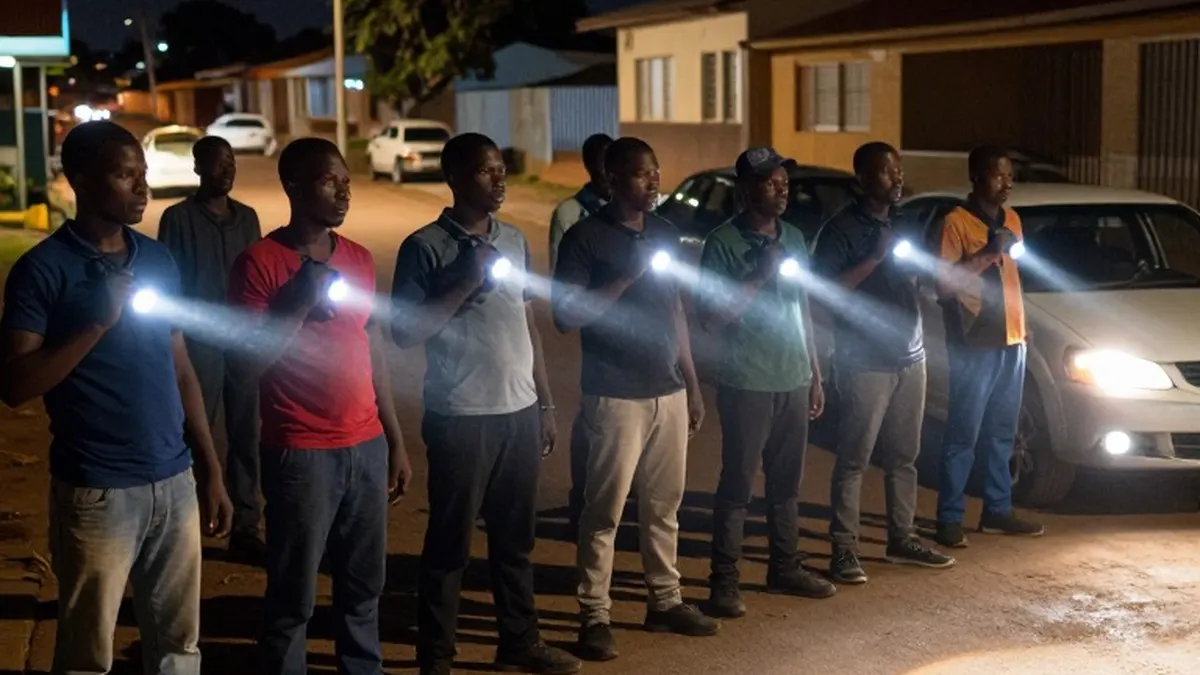
In the eastern town of Kokstad, residents have taken matters into their own hands to protect women and children following a series of violent deaths. The community recently established night-time curfews and street patrols in response to a surge in femicide cases. Since June, local guidelines have asked children to be indoors by sunset and women by 21:00. This voluntary measure is intended to provide safety until police can arrest the perpetrators of recent crimes.
The initiative is led by Kamvalethu Cetywayo, a member of a local neighborhood watch group. He coordinates a team of approximately 15 men who patrol high-crime areas, particularly on weekends when alcohol consumption is higher. Most patrol members carry torches, sticks, and whips, while Cetywayo carries a licensed firearm. The group collaborates with local police, calling for backup when necessary, though Cetywayo notes that the curfew is a temporary solution to address the immediate need for safety.
The renewed national outcry stems from the discovery of 12 women's bodies in public areas of Ekurhuleni, a district east of Johannesburg, earlier this year. President Cyril Ramaphosa responded by promising safety audits in municipalities and an increased police presence. He stated that the government would allocate additional funds in the upcoming February budget to combat gender-based violence and has noted that police numbers have risen over the past three years.
Despite these promises, many residents feel overlooked. Tuku Nkosiyaphantsi, whose daughter Okuhle was murdered in August, expressed frustration with the lack of progress in her case. Okuhle, a 27-year-old civil engineering student with two children, was found dead near a river in Kokstad. Her body showed signs of mutilation and severe facial injuries. Nkosiyaphantsi believes that crucial CCTV footage from a local government building was lost because it is wiped every seven days, and no one has been arrested months after the killing.
Statistics from the South African Police Service indicate that 581 women were killed between July and September. While the total number of murders decreased to 5,590, this is the first time the police have broken down data by gender. Consequently, it remains unclear if the number of female victims is rising or falling compared to previous years. In Kokstad alone, the bodies of five women and three young children were found between January and October, with arrests made in only two of those cases.
The violence is not limited to nighttime or public streets. Kgothatso Mojela, now 35, was kidnapped by a taxi driver in Kempton Park in 2018. She was punched and slapped before forcing open the door and jumping from the moving vehicle, which resulted in a badly injured knee and nerve damage to her eyes. Although her attacker was eventually jailed, he was released last year, leaving Mojela to live in fear. She has since changed her lifestyle, buying an imitation gun and avoiding running alone.
Another high-profile case occurred in September when Elizabeth Moselakgomo, a 38-year-old mother, disappeared while running in Kempton Park. Her body was found three days later near a busy motorway. The incident resonated with the local running community, leading to protests and increased safety measures. Zonke and Zama Mthethwa, who founded a women's running group in Johannesburg, have since incorporated pepper spray, whistles, and car escorts into their routines. They also offer self-defense coaching to members.
According to a 2024 report by the South African Medical Research Council, the number of unsolved femicide cases is growing. Additionally, Amnesty International has criticized the police service as being under-resourced and insufficiently trained to handle gender-based violence. In 2020 and 2021, 60% of murdered women were killed by an intimate partner. As the government continues to address these challenges, communities remain vigilant, organizing prayer marches and support networks for survivors.