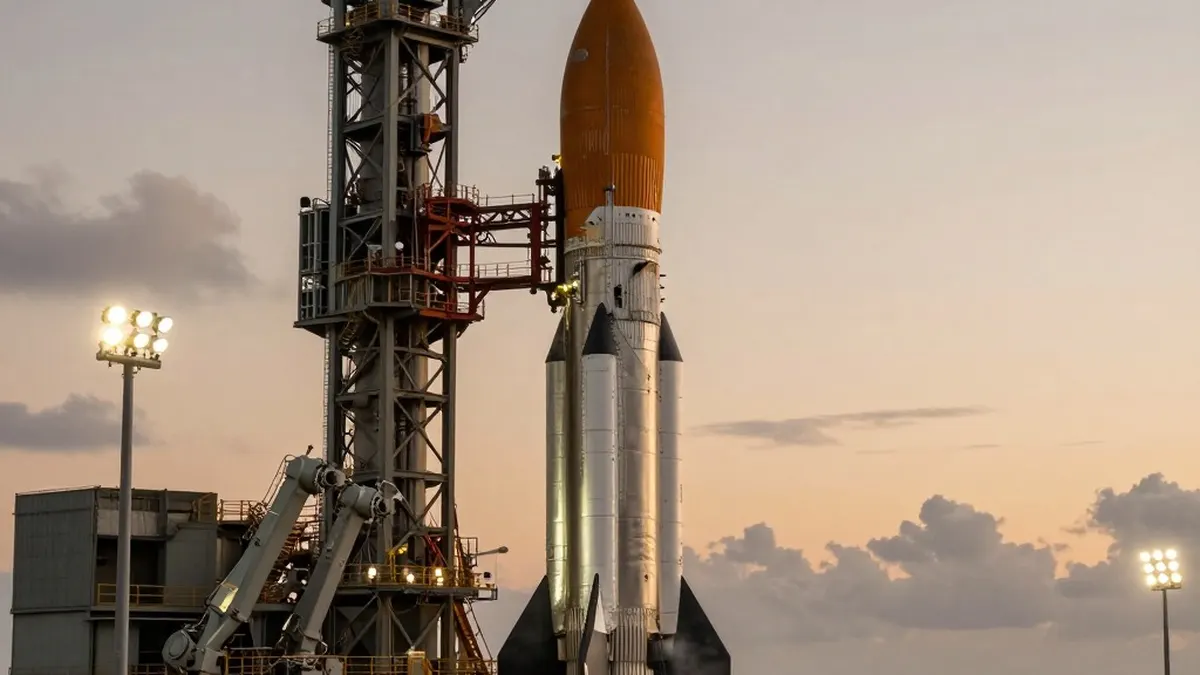
SpaceX intends to try catching both stages of its Starship megarocket on the vehicle's next test flight, founder and CEO Elon Musk announced during the company's third-quarter earnings call on Oct. 20. The flight is targeted for next month, though Musk did not give a specific date for Flight 15.
If the attempt succeeds, Musk said, it "will be the first time that an orbital launch vehicle has been fully recovered." He called a fully reusable orbital launch vehicle the only way to "extend consciousness beyond Earth on a sustained basis," describing the feat as "a profound technology milestone in the history of civilization and consciousness."
Starship is the largest and most powerful rocket ever built, standing more than 400 feet (122 meters) tall when fully stacked. Both of its stages, the Super Heavy booster and the Ship spacecraft, are designed to be fully and rapidly reusable. SpaceX believes that capability will make Mars settlement and other ambitious exploration goals economically feasible.
The recovery method differs from that used for the company's Falcon 9 and Falcon Heavy rockets, which are only partially reusable because their upper stages are expendable. Those rockets' boosters return to landing pads near the launch site or to ships at sea. Super Heavy and Ship, by contrast, are meant to steer themselves back to the launch tower, where its "chopstick" arms capture each vehicle. SpaceX hopes this will let it inspect, refurbish and refly Starship quickly. Musk has said he envisions more than 10,000 Starship launches per year by 2030.
Starship has flown 14 test flights so far, and SpaceX has caught the Super Heavy booster with the chopsticks on three of them. It has not yet tried to catch Ship, which is harder because the upper stage travels higher, farther and faster than the booster. Even so, Musk expressed confidence. "I'd say it's more likely than not that this succeeds next flight," he said. If it does not, he added, SpaceX has "a steady stream of Starship flight attempts through the end of this year, and then accelerating next year."
A successful Flight 15 would follow another major milestone. On Flight 14, on Sept. 28, Ship reached orbit for the first time and deployed 26 Starlink Version 3 satellites. They are the first members of a next-generation broadband constellation in low Earth orbit that is expected to eventually include about 100,000 spacecraft.
The Starship preview was something of an aside during the call, which mainly covered SpaceX's financial results for the quarter ended Sept. 30. Company representatives described the performance as strong. Revenue reached $14.6 billion, up 161% from $5.6 billion in the third quarter of 2025. Net income was $4.4 billion, which was $5.5 billion better than the same period last year, when SpaceX lost $1.1 billion.
Only $1.8 billion of the quarter's revenue came from the launch division. Most came from the connectivity segment, which covers services from the Starlink megaconstellation, and from artificial intelligence, a field the Trump administration has recently rebranded as "superintelligence."
SpaceX expects those two segments to keep growing, which is why it is building infrastructure to support thousands of Starship launches per year to place Starlink satellites and AI data centers in Earth orbit. Musk said the company expects strong revenue gains beginning as soon as next year. "In a nutshell, what this implies for SpaceX annual recurring revenue by the end of '27 is somewhere between 500 billion [dollars] and a trillion," he said.