In Khartoum, a four-year-old girl named Muzan Abdelrahman faces a significant barrier to her education due to a hearing impairment. Although she is of an age to begin her learning journey, the specialized support required for her attendance is largely unavailable in a country currently devastated by conflict. The war between the Sudanese army and the paramilitary Rapid Support Forces began in April 2023, when Muzan was only a few months old. Many had hoped the fighting would have ended by now, allowing her to grow up in a stable environment where she could receive the necessary assistance. Instead, the conflict has persisted with no clear end in sight, leading to a deepening humanitarian crisis that has forced many specialized education and rehabilitation centers to close.
Muzan’s mother, Abeer Osman, expressed her concern about the critical developmental years slipping away. She explained that her daughter requires continuous training and follow-up, which she attempts to provide at home despite not being a specialist. Osman stated that she fears her daughter will miss the opportunity to learn how to communicate and express herself because the family lacks access to professional rehabilitation sessions and educational tools.
This situation is not unique to Muzan. Across Sudan, children with disabilities encounter numerous obstacles as institutions are destroyed and families are displaced. Mohammed Ahmed, a 14-year-old student with a physical disability, described the daily challenges of attending school. He noted that inaccessible entrances and staircases make him dependent on others for movement. Ahmed said he wants to learn like his classmates, but the school environment often prevents him from doing so independently and with dignity. He emphasized that he does not want his disability to limit his future opportunities.
According to data from the United Nations Children’s Fund, at least eight million school-age children in Sudan lack access to formal education. As of August, roughly 30 percent of the country’s schools were not operational, with about one percent being used as shelters for displaced people. The crisis is particularly severe for children with disabilities. Before the war began, Sudan had more than 230 schools dedicated to disabled children. Many of these institutions have since closed, though the exact number is uncertain due to a lack of up-to-date information. The Sudanese government had not responded to requests for comment by the time of publication.
Aisha Abbo, mother of eight-year-old Ali Hassan who has Down’s syndrome, recalled the services her son previously received. Ali attended a specialized school where he developed academic, communication, and social skills with government support. Now that those facilities are shut and private centers are too expensive, the family can no longer afford his education. Abbo appealed to the government to reopen specialized centers and provide the necessary staff and programs, noting that every day without education affects the children’s development.
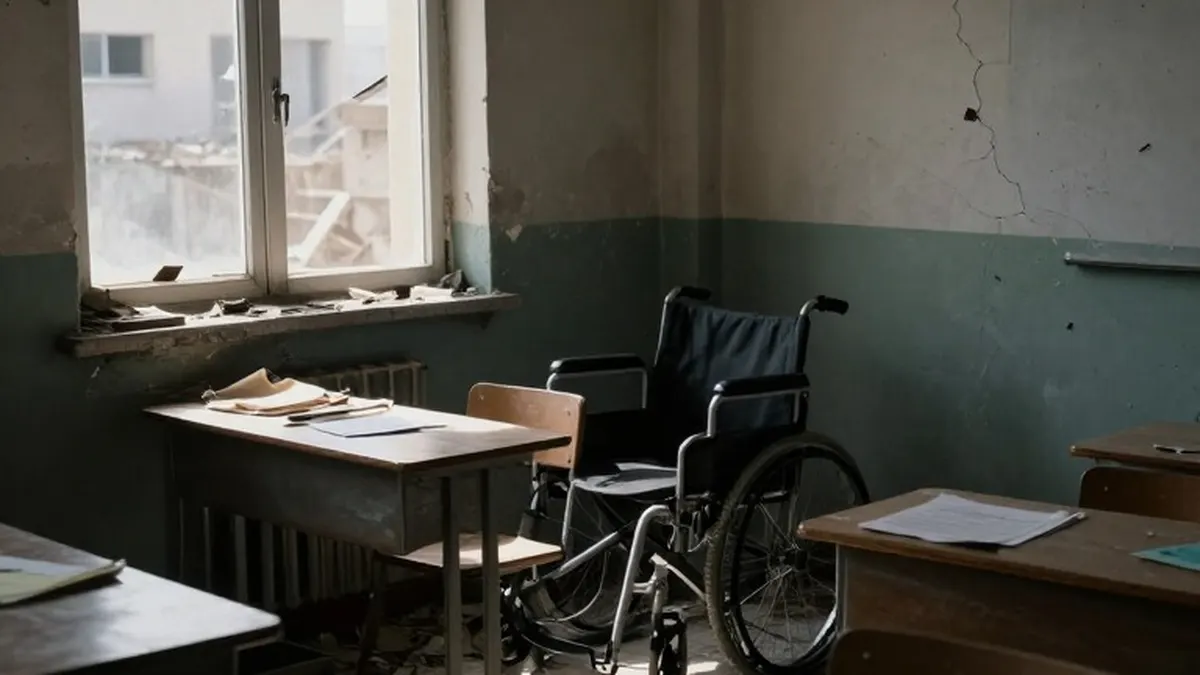
The impact is evident at the Usratuna Sudanese Association for Children with Disabilities in Khartoum. Its facilities were damaged by shelling in the early stages of the war, with a projectile striking the classrooms. Badr al-Din Tawfiq, the association’s project manager, said that most rehabilitation services have stopped due to funding shortages and facility damage. Although the group has registered over 100 children for physiotherapy, speech therapy, and other support, they cannot provide the services because they lack the necessary equipment and safe premises.
Some activities that do not require significant funding, such as psychosocial support and advocacy, continue to operate. An inclusive kindergarten in Omdurman remains open, but most other activities in Khartoum have halted, and branches in central Darfur and Blue Nile state are no longer operating. Nagi Mansour, director-general of the Sudanese Coalition for Education for All, noted that challenges existed before the war, including poor infrastructure and a shortage of qualified teachers and adaptive materials. He argued that the war has compounded these issues by destroying institutions and displacing families.
Mansour called for a national survey to identify children who have dropped out and to assess their specific needs. He urged for the rehabilitation of special education centers and the provision of resources such as Braille materials and sign-language interpreters. He emphasized that children with disabilities have an inherent right to education and should not be viewed solely as recipients of humanitarian aid. He stated that rebuilding the education system must be based on justice, equity, and inclusion to ensure no child is left behind due to their needs or the circumstances of war.