Japanese Prime Minister Sanae Takaichi received a muted welcome during her first visit to China as premier, a move that signals Beijing’s limited desire to repair diplomatic ties strained by a persistent dispute over Taiwan. The reception occurred during the Asia-Pacific Economic Cooperation summit held in Shenzhen this week, where protocol details such as airport greetings and positioning in official photographs often convey significant political messages.
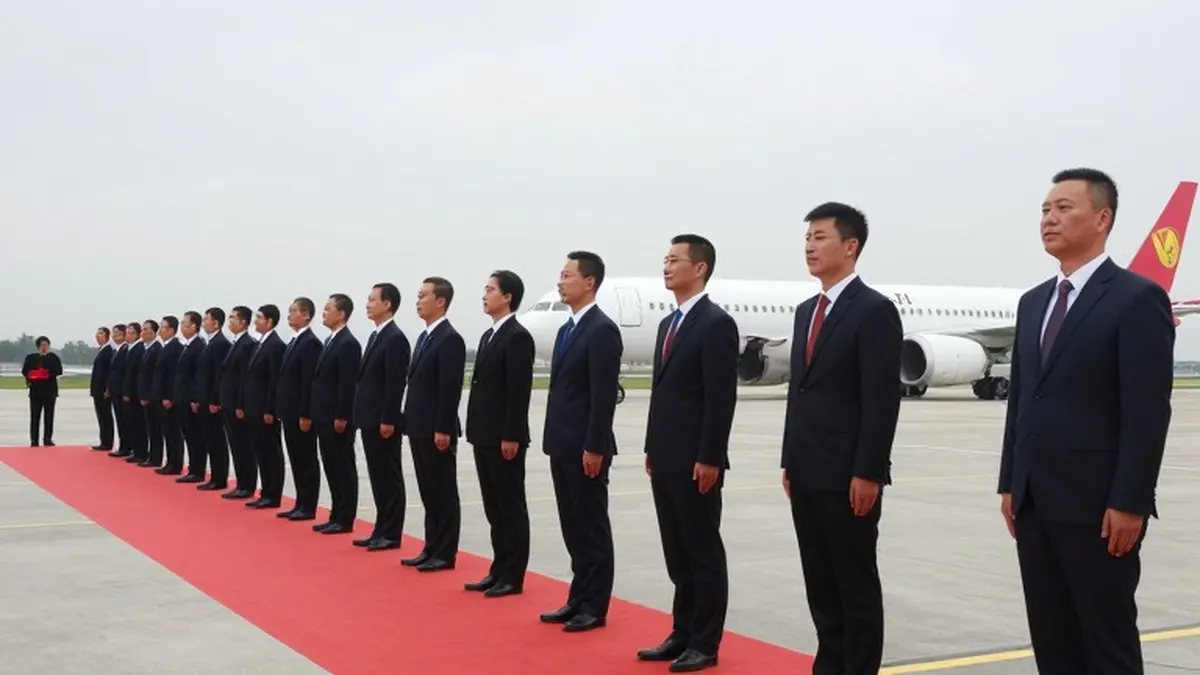
On Wednesday, Takaichi was greeted on the tarmac by a retired Chinese diplomat and Kenji Kanasugi, Japan’s ambassador to China. This low-key arrival stood in sharp contrast to the warmer welcomes extended to other visiting dignitaries, including South Korean President Lee Jae Myung. U.S. President Donald Trump received a personal greeting from Chinese President Xi Jinping, further highlighting the disparity in treatment.
In the official group photograph, Takaichi was positioned in the back row, several places away from Xi. The Chinese leader stood alongside Trump and Russian President Vladimir Putin. Jeremy Chan, a senior analyst at Eurasia Group, noted that Beijing sought to downgrade her official status to that of a head of government rather than a head of state.
During a greeting line on Thursday morning, Takaichi spent several minutes attempting to converse with the Chinese leader without an interpreter present. Most other leaders exchanged brief handshakes and continued walking. Kei Koga, an associate professor at Nanyang Technological University in Singapore, observed that it has become increasingly difficult for Takaichi to engage in formal or informal discussions with Xi. He suggested that her actions were an effort to project an image of continued communication despite the ongoing tensions.
At a press briefing later on Thursday, Takaichi reaffirmed that Japan’s position on Taiwan remains unchanged, citing the 1972 Japan-China Communique. She added that her administration has been in contact with Chinese counterparts regarding rare earth export controls.
Analysts believe the subdued reception indicates that Beijing is not yet ready to fully reconcile with Tokyo. This stance may prolong China’s curbs on critical mineral exports, which have impacted Japanese industries for the past year. Chan stated that the frosty welcome clearly shows Beijing is not ready to forgive Takaichi for her remarks about Taiwan and expects the bilateral relationship to remain strained until she leaves office.
Tianchen Xu, a senior economist at the Economist Intelligence Unit, warned that Japan could continue to grapple with restrictions on rare earth supplies from China next year. The deterioration in relations began in November 2025 when Takaichi stated that a Taiwan Strait crisis could constitute a situation threatening Japan’s survival, warranting a self-defense response. While this aligned with existing security policy, previous prime ministers had generally avoided such explicit statements in this context.
China reacted angrily to the remarks, demanding their retraction, but Takaichi has not done so. Instead, she stated that the door to dialogue remains open, though high-level contact has been minimal over the past year. In response, China tightened restrictions on dual-use and rare earth exports with potential military uses, discouraged its citizens from traveling to Japan, and halted Japanese seafood imports.
Takaichi’s visit marks the first trip to China by a Japanese prime minister since Shinzo Abe traveled to Chengdu in December 2019 for a trilateral summit. No formal meeting between Takaichi and Xi has been publicly scheduled. Meanwhile, Xi is expected to join Trump and Putin for a historic trilateral gathering on Thursday, along with a bilateral meeting with Trump.
Huiyao Wang, founder of the Beijing-based Center for China and Globalization, argued that Takaichi needs to show a reflection of her earlier statements. He suggested that Tokyo should demonstrate greater flexibility, pointing to U.S. comments about avoiding involvement in the Taiwan issue. Wang contended that Japan holding firm on the issue would not help improve relations with Beijing.