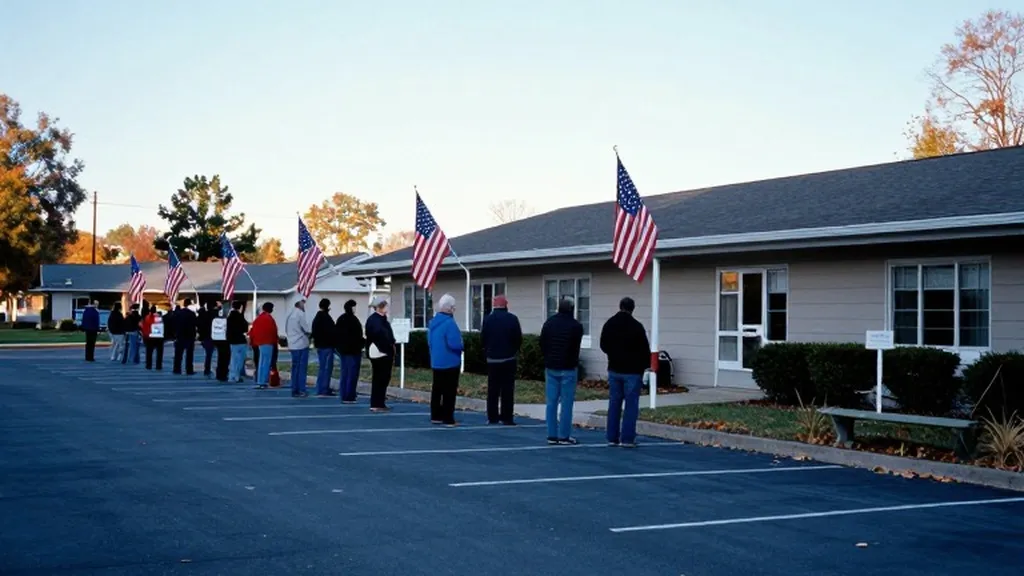
American voters are casting ballots in thirty-six governor races today, a subset of the broader midterm elections that determines the balance of power in the executive branch. Republicans currently hold twenty-six governorships while Democrats hold twenty-four, according to Ballotpedia. For Democrats to achieve a nationwide majority of governorships for the first time in two decades, they need a net gain of two seats. This goal is particularly challenging because Republicans have held this executive majority since 2010.
Nineteen of the races on the ballot do not feature an incumbent, creating open seats that often attract diverse candidates. Fifteen governors are term limited, while others chose not to run or lost their primaries. Iowa’s Governor Kim Reynolds and Minnesota’s Governor Tim Walz are among those who are not seeking reelection, alongside Wisconsin’s Governor Tony Evers. Rhode Island’s Governor Daniel McKee is also absent after losing his primary contest. These vacancies allow political parties to test new leadership without the baggage of incumbent approval ratings.
In Georgia, Republican health care executive Rick Jackson faces Democratic former Atlanta Mayor Keisha Lance Bottoms. They are competing to succeed Governor Brian Kemp in a state that Donald Trump won by a margin of 2.2 percent in 2024. The Associated Press notes that this race is part of a broader struggle for control, with both parties viewing the governor’s office as a critical component of state leadership.
Nevada presents another key contest where Republican Governor Joe Lombardo is defending his seat against Democratic Attorney General Aaron Ford. The state uses a new congressional map after mid-decade redistricting, which may influence voter behavior. Polls in Nevada are largely conducted by mail, with voting hours from 7 a.m. to 7 p.m. local time. The outcome here will contribute to the overall tally of executive offices controlled by each party.
Ohio features a high-profile matchup between Republican Vivek Ramaswamy and Democrat Amy Acton. Ramaswamy’s campaign faced recent attention over an advertisement featuring Acton’s estranged mother, a detail that has drawn national attention to the race. The state is also using a new congressional map, which Ballotpedia identifies as a factor in the competitive landscape. Voters in Ohio will cast ballots between 6:30 a.m. and 7:30 p.m.
Arizona is one of five states where Democrats are defending governorships in regions Trump won in 2024. Democratic Governor Katie Hobbs is seeking reelection in a state with a history of shifting political dynamics. The Associated Press highlights Arizona as a battleground where both parties have invested significant resources. The race is seen as a bellwether for Democratic performance in traditionally Republican-leaning areas.
Michigan offers a test for Democratic strength in the Midwest, with the state having voted for Kamala Harris in 2024. Democrats are defending their governorship in a region where economic strain and tariffs have become prominent issues. The Associated Press reports that the state’s competitive nature has drawn significant attention from national parties. Voting in Michigan runs from 7 a.m. to 8 p.m., and the outcome will influence the overall balance of power.
Kansas is another state where Democrats are defending a governorship in a region Trump won by a wide margin in 2024. The state has become central to the fight for Senate control, with the governor’s office playing a supporting role in the broader electoral strategy. The Associated Press notes that the race in Kansas is closely watched as an indicator of Republican resilience in the Midwest.
New Hampshire and Vermont represent the other side of the map, where Republicans are defending governorships in states that voted for Kamala Harris in 2024. In New Hampshire, Republican Governor Kelly Ayotte is facing a competitive race. In Vermont, Republican Governor Phil Scott is seeking reelection. These races are significant because they test Republican strength in traditionally Democratic-leaning New England states.
Voters in Pennsylvania, Wisconsin, and other states are also deciding their governors in a complex landscape. The Associated Press describes the election as a referendum on the current administration’s second term, with many voters expressing frustration over high prices. Polls are open in all states, and the final results will determine which party controls the majority of governorships. The outcome of these ten named races will shape the political map for the next two years, influencing policy and leadership across the country.