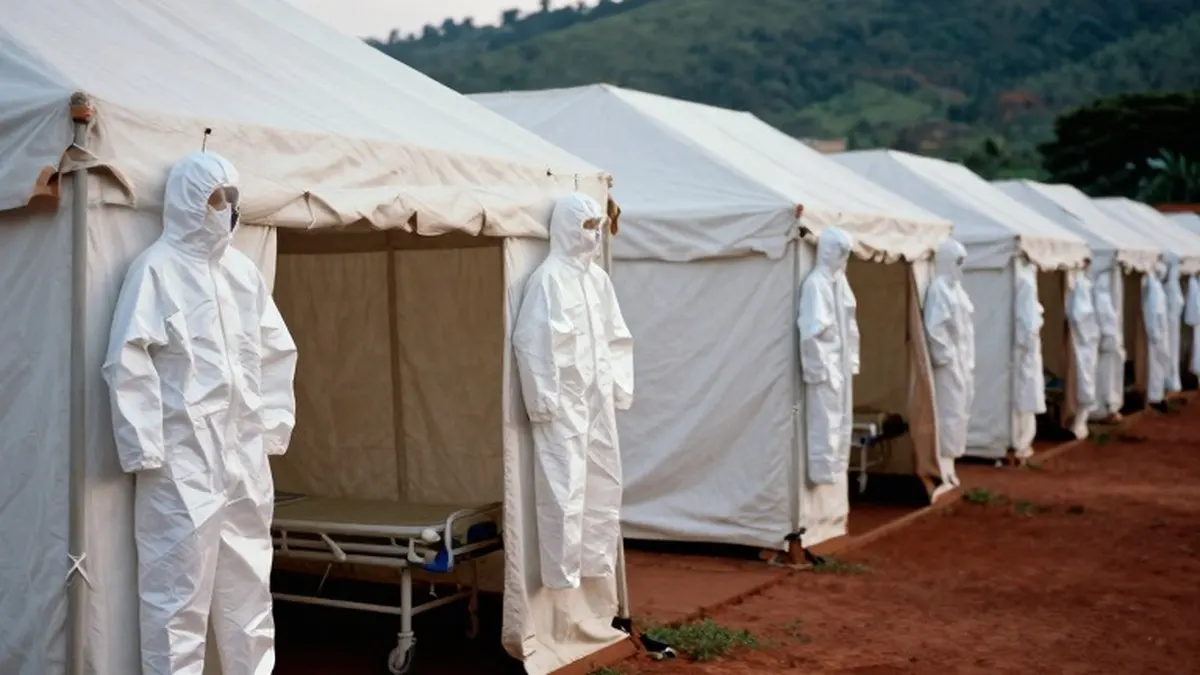
The fastest spreading Ebola outbreak on record has now infected more than 10,000 people since it was declared in May, according to the latest figures from the Democratic Republic of Congo's government.
Katie Thomas-Canfield, interim Ebola response director for the International Rescue Committee, said aid workers are surprised by how quickly the count has climbed. "10,000 people affected by Ebola in such a short period is really staggering," she said. At the same stage of the West Africa outbreak of 2014 to 2016, only about 4,000 people had been infected, though that earlier outbreak still holds the highest total, at more than 28,000 cases.
The current outbreak is also the largest ever by geographic reach, stretching from Nigeria to Kenya. With nearly 5,000 deaths, it ranks second in fatalities, behind the previous toll of more than 11,000. About a third of the dead have been children. Those under 5 have been hit especially hard, with roughly three out of four infected children dying.
Part of the explanation lies in a late start. Although the outbreak was declared in May, newer evidence suggests the virus was likely spreading in February or March. The strain responsible, Bundibugyo, is a rarer species of Ebola, and existing tests were not calibrated for it. The affected region of northeastern Congo is remote and troubled by conflict, and Nahid Bhadelia, an infectious disease physician at Boston University, said U.S. cuts to foreign aid may have slowed disease surveillance.
International help has also arrived more slowly than in past outbreaks. Bhadelia said fewer American and other foreign health workers are traveling to Congo, partly because of U.S. policy under which Americans may not be allowed back even if they fall ill. As a result, much of the burden is falling on Congolese and regional workers. Pledges include more than $880 million from the U.S., but some responders say money is slow to arrive. Thomas-Canfield said available financing is "a fraction of what it was in our previous response."
The response has improved in recent months, with about two dozen diagnostic labs and more than 50 treatment centers now operating. UNICEF's Douglas Noble said nearly 2,000 treatment beds are available. Still, roughly two-thirds of deaths occur in the community rather than in treatment centers, a figure that has barely moved for months. Early symptoms such as fever, headache and body ache resemble common, treatable local illnesses, which may delay people from seeking care.
Distrust may be a bigger obstacle. An October International Rescue Committee survey found that 85% of respondents in North Kivu, a current hotspot, said distrust of community responders keeps them from seeking care. Responders contend with rumors and misinformation, including claims that Ebola is not real or that teams are in it for money. Roughly 80% of new cases come from people not already known to health officials, and Bhadelia pointed to recent cases in Nigeria and Kenya as a sign of growth inside Congo. Even if daily counts appear to be leveling off, she said, "It's so far out of control."
No vaccine or treatment is licensed for Bundibugyo. Ervebo, an existing vaccine, targets a different species, but health workers began receiving it in late August, and researchers have started a clinical trial named Tumaini, the Swahili word for hope, to test it against Bundibugyo. Bhadelia cautioned that such tools are "necessary, but they are not sufficient" without contact tracing, isolation and treatment.
Her biggest worry, she said, is that the world will look away. "I am worried the funding will dry out, that we will not keep paying attention to a public health disaster that is much deeper and bigger in this moment than people realize."