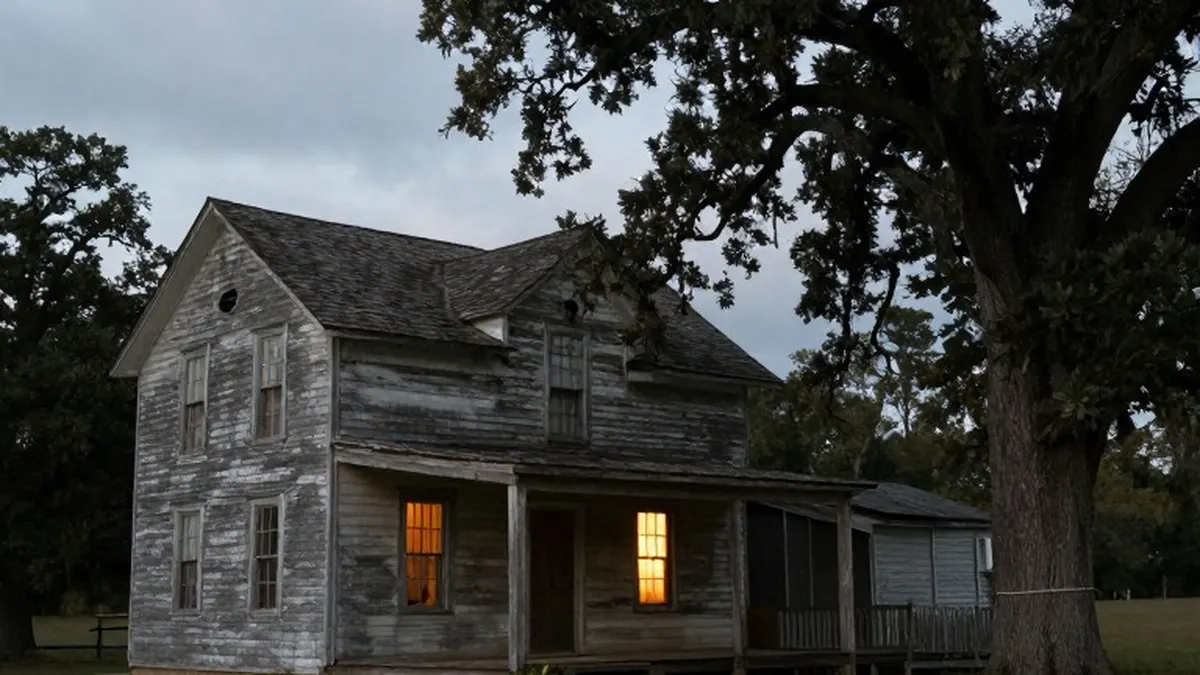
Warning: this story contains major spoilers for "The Good Daughter," now streaming on Peacock. The six-episode series, adapted by author Karin Slaughter from her own bestselling novel, follows Sam and Charlie Quinn, estranged sisters played by Rose Byrne and Meghann Fahy, whose lives were shattered more than 20 years earlier when two masked gunmen broke into the family's rural Georgia home. The attack killed their mother, Gamma, played by Olivia Williams, and left both girls with life-altering injuries, a tragedy that drove them apart rather than binding them together.
In the present day, Sam has built a lucrative patent law career in New York City, while Charlie stayed in their fictional hometown of Pikeville, practicing criminal defense in the footsteps of their father Rusty, played by Brendan Gleeson. When Charlie witnesses a school shooting that leaves principal Douglas Pinkman and a young student dead, and Rusty is badly injured after taking the suspect's case, Sam is pulled back home. Despite limited defense experience, she reluctantly agrees to represent Kelly Wilson, the pregnant teenager who allegedly confessed to the killings.
Over the course of the season, Sam, Charlie and Charlie's estranged husband Ben uncover that Kelly was merely a pawn of Judith, the kind teacher who once looked after Charlie after Gamma's death. Judith had learned that her husband Douglas abused and impregnated the teen and expected them all to raise the child together, so she manipulated the unstable girl into bringing a gun to school, intending to kill Douglas and pin the crime on Kelly. When Kelly hesitated to shoot, Judith seized the weapon, executed her husband and accidentally killed another student in the struggle.
The case also forces the sisters to confront the original crime that defined their lives. Charlie had been sexually assaulted by Zach Culpepper, one of Rusty's most dangerous clients, and the home invasion was orchestrated by Mason "Huck" Huckabee, a man Charlie had a one-night stand with shortly before the school shooting. Huck confessed that he recruited Culpepper to attack Rusty in retaliation for Rusty defending the man accused of raping Huck's sister. Charlie, who had made her father keep her assault a secret for decades, must also reckon with having identified the wrong man, Culpepper's brother Daniel, who was later killed.
"It's always really hard when we have things that we don't like about ourselves, or things that we haven't confronted about ourselves," Fahy told Variety in one of two separate interviews. "When you operate out of a place of hurt, you do close yourself off from the people that you actually want to be closest to." She said that dynamic defines the sisters at the start of the series, with the payoff coming as viewers watch them come out the other side and reunite.
Byrne, who is also an executive producer on the series, said Sam fled Pikeville because of her mother's insistence that the town was corrupt, rigged and run by people the girls had to escape. Sam, she said, is extremely bright and ambitious, drawn to patent law precisely because it is dry, unemotional and specific. Fahy said Charlie stayed because she did not want to leave her father and hoped to rewrite a story she had felt powerless in, adding that for all of Rusty's faults, he protected her by keeping the secret she asked him to keep.
On why both daughters entered the legal profession despite what it cost the family, the actors pointed to an intellectually driven upbringing and a shared respect for what they watched their father achieve. Fahy said both sisters ultimately love helping people, and that Charlie's favorite part of the job is defending kids who have no one else willing to fight for them. Byrne invoked a Ram Dass line to explain the pull of family: "If you think you're enlightened, then go and spend a weekend with your parents."
Fahy also recorded a stripped-down cover of Guns N' Roses' "Sweet Child O' Mine" for the fifth episode, in which the sisters grieve Rusty's death and uncover evidence of Huck's involvement in Gamma's murder while searching one of his old properties. Director Steph Green proposed the song, feeling parts of the first verse could play as Charlie singing to Sam, and Fahy said she liked that the finished version is "a little bit haunting." She noted the episode ends with Charlie in a doorway calling for her sister, a callback to where she stood as a child just before the home invasion.
As for the finale's revelations, Byrne said she discussed with Slaughter how Sam is often piecing the mystery together faster than the audience, intuitively ahead of everyone else. Fahy said the show stays nuanced about who is guilty of what, noting that Charlie was a confused kid working only with the information in front of her. "Sometimes, it's really hard to zoom out and look at things from a different point of view when all you can feel is the trauma that your body is still in fight or flight," she said. Whether the cathartic ending marks the last time viewers will see the Quinn sisters together remains an open question.