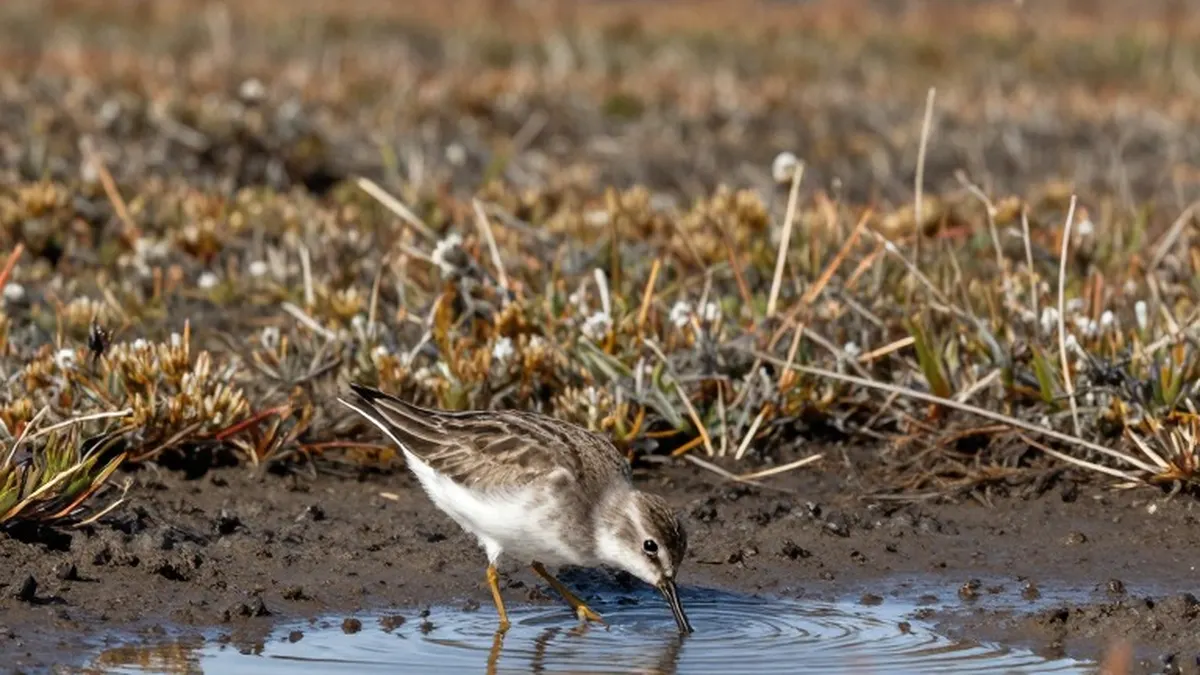
Pectoral sandpipers travel more than 17,000 miles each year between Alaska and Argentina, powering the journey with continuous wingbeats. The birds, roughly the size of a robin and weighing about three ounces, face growing challenges as warming temperatures alter their food supply and habitats disappear along their migration routes.
More than 12 million shorebirds travel to Alaska annually to breed. Almost half of the 41 shorebird species that breed there are declining, and some have lost more than half their populations over the past 30 years. Rick Lanctot, a wildlife biologist with the U.S. Fish and Wildlife Service, and fellow researchers have spent 24 years monitoring shorebirds returning to northern Alaska.
Near Utqiaġvik, researchers attach miniature tracking devices to learn where the birds travel and stop. One backpack-style tag records a bird's GPS location every 15 minutes and uploads its stored information when it passes a cell tower. Smaller tags worn on the leg weigh about as much as a grain of rice. Tracking devices have become small enough for these birds only within the past 15 years, revealing journeys more demanding than scientists previously understood.
Preparing for migration requires remarkable physical changes. Some shorebirds double their weight by accumulating fat, while organs including the digestive system shrink before nonstop flights. Pectoral sandpipers spend about six weeks in the Arctic, where they must replenish their reserves, lay eggs and raise young. Their chicks have roughly a month after hatching to grow enough to undertake migration.
That tight schedule depends on food being available at the right moment. Arctic temperatures have increased four times faster than those elsewhere on the globe. Earlier spring warmth can bring insects out sooner, potentially leaving chicks to hatch after the peak food supply has passed. Research shows that fewer chicks survive when they hatch late. Some shorebirds can advance egg laying slightly during early springs, but those adjustments have not been enough to match the changes.
University of Texas at Austin researchers Amanda Koltz and Julia Berliner are collecting insects to examine both their abundance and nutritional value. Different insects appear at different times and provide different nutrients, including calcium needed for egg production. Changes in the timing of insect emergence could therefore alter both the amount and quality of food available to birds.
The changes are also apparent to residents of Utqiaġvik. Wildlife guide Robin Mongoyak, who grew up there, describes returning birds as an important part of Inupiat life after the long winter. He recalls sea ice that persisted for multiple years, something he says is becoming rare as spring breakup comes earlier. He also reports seeing fewer birds than he once did.
Beyond the Arctic, development is removing wetlands and grasslands used as migration stops, while climate change is intensifying drought. Some birds use agricultural fields and ponds, although those habitats may be available only briefly. Conservation efforts in some locations include paying California farmers to leave rice fields flooded longer for migrating birds.
Scientists are still investigating how much birds can adjust their travel schedules and what signals guide those decisions. Cues from distant locations, or seasonal changes in daylight, may not reflect conditions in the Arctic. Nathan Senner, a shorebird researcher at the University of Massachusetts Amherst, says continued declines could put many species at risk of extinction. Understanding their capacity to adapt could help researchers determine how to manage habitats to support their survival.