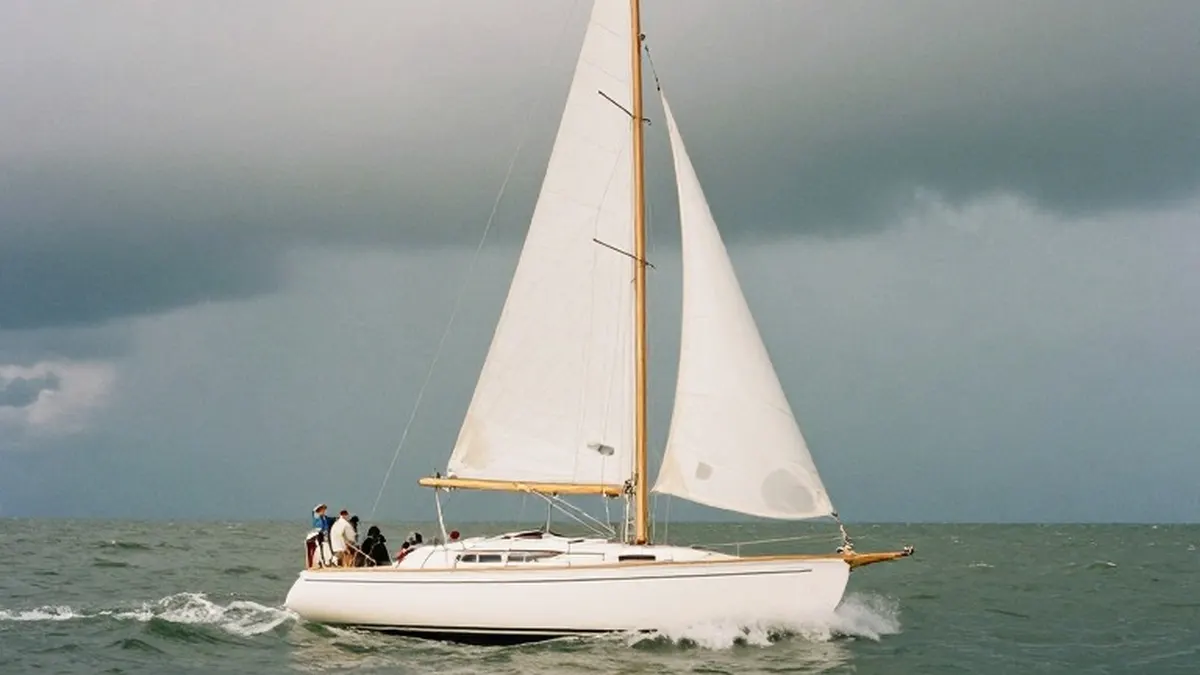
Somewhere in the Southern Pacific Ocean, sailor Kirsten Neuschafer is alone aboard her boat, Minnehaha, trying to steer clear of another storm as she nears Cape Horn. Instead of heading straight for the tip of South America, she has spent the past day sailing north to avoid the worst of the weather, which threatens gusts of up to 55 miles per hour and seas of 25 feet.
Speaking over a crackling satellite phone line, Neuschafer said she wants to get away from the storm's eye. "The closer I get to the Horn," she said, "the more serious things become, the windier it becomes." There is no option to turn back, because she is leading the Golden Globe Race, which many consider the toughest contest in sailing.
Neuschafer, the only woman in the field, left France in September. Of the 16 entrants who set out five months ago, only four remain, and for now she is in front. The race is a solo, nonstop, unassisted trip around the world, a feat first achieved in 1969, the same year Neil Armstrong and Buzz Aldrin walked on the moon. More people have been to space than have completed such a voyage.
The event is deliberately old-fashioned. Unlike the Vendée Globe, which features purpose-built fast boats, Golden Globe sailors use ordinary-looking vessels with no laptops, electronic charts, radar or sophisticated weather routing. They find their position using the sun, the stars and simple speed calculations. Satellite phones are allowed only for contact with race officials and occasional interviews. Each boat carries a GPS tracker, but sailors cannot see the data, and a sealed emergency GPS can lead to disqualification if used.
The prize is 5,000 pounds, about $6,045, the same as in the 1960s and less than the entry fees. The draw is the challenge. Neuschafer, who is from South Africa, said the solo element appealed to her, along with sailing by celestial navigation and wondering what it was like before modern technology. The race motto is "Sailing like it's 1968," a nod to the first such contest, run by the British Sunday Times. Of nine starters that year, only Robin Knox-Johnston of Britain finished, in 312 days. Organizer Don McIntyre, an Australian, revived the race in 2018 and calls it "an absolute extreme mind game."
Neuschafer, 40, has worked as a charter skipper in Patagonia, the Falkland Islands, South Georgia and Antarctica, and has rounded Cape Horn before. This time, with limited weather information and no choice of conditions, she described it as "a notch up on anxiety," comparing it to trying to reach the peak of Everest.
The most harrowing moment came in November, when she sailed 100 miles through the night to rescue Finland's Tapio Lehtinen, a 2018 finisher, from a life raft about 24 hours after his boat, Asteria, sank in the southern Indian Ocean. Officials let her use GPS and gave her a time credit. She later transferred him to a freighter. The episode, she said, showed that "a large component of it is luck."
Quieter days begin before sunrise with a radio time signal to set her watches, then coffee, cereal and a sextant sight once the sun is high enough. She checks her position again at noon, walks the deck, reads and listens to cassettes, mostly 1980s music. American Elliott Smith, 27, the youngest entrant, dropped out in Australia after a rigging failure and said he had stopped enjoying the sailing. He has put his boat, Second Wind, up for sale.
Neuschafer has had her own setbacks, including a broken spinnaker pole that limits how she sails downwind on the 36-foot Minnehaha. She expects to finish in early spring, after crossing the entire Atlantic from south to north. Her first wish on landing: "the first thing I'd like to do is eat ice cream."