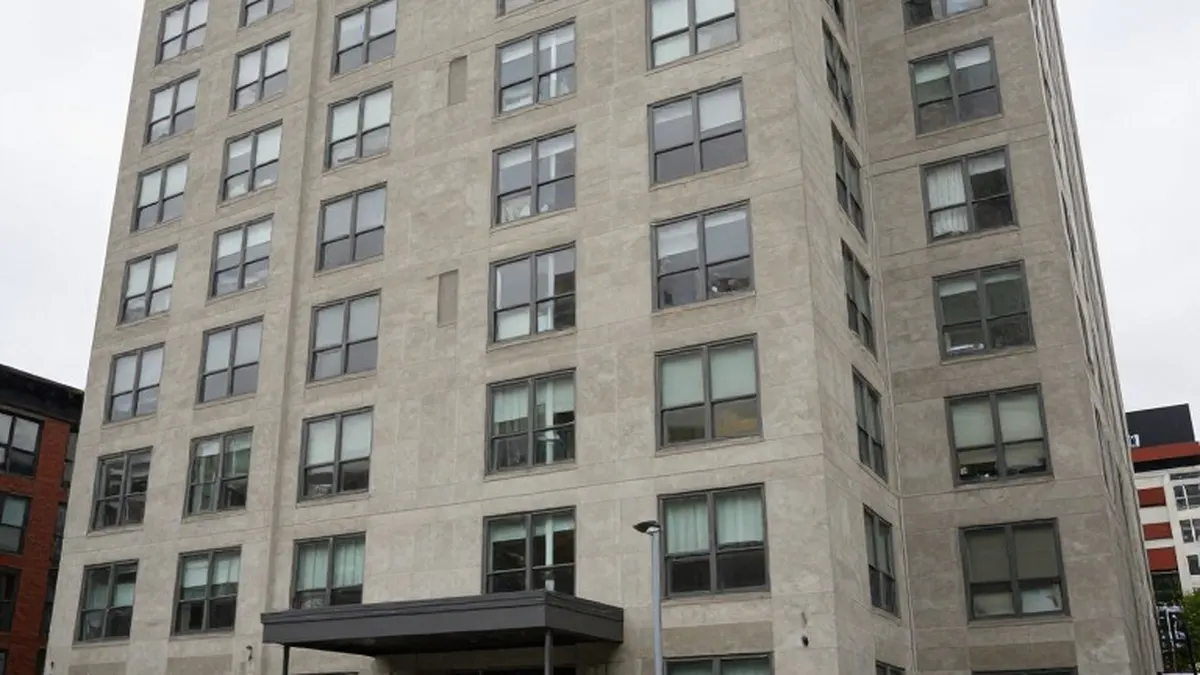
A Washington appeals court ruled Monday that the company behind Seattle's Addison on Fourth affordable housing development can pursue claims that city rental regulations amounted to an unconstitutional taking of private property. The ruling allows GRE Downtowner LLC to continue seeking compensation over restrictions it alleges undermined a $39 million investment.
The 254-unit property served lower-income residents through the federal Low-Income Housing Tax Credit program, which provides tax incentives to private investors for offering rent-restricted apartments. According to court filings, the development produced positive cash flow from 2015 through 2018. A federal judge appointed a receiver to take control of the property in January 2026 after a mortgage default.
GRE alleges that a succession of Seattle ordinances contributed to a steep decline in rental payments and nearly $5.8 million in cumulative operating losses. Its rent collection rate fell from 93.9% in 2018 to 44.1% in 2023, according to its allegations. The challenged rules address criminal-background screening, additional apartment occupants, certain evictions and relocation assistance after qualifying rent increases.
The lawsuit seeks payment through inverse condemnation, a legal avenue for owners who contend government actions have effectively taken or damaged their property without just compensation. GRE argues that the ordinances restricted its property rights so extensively, both separately and together, that Seattle should bear financial responsibility for the losses.
Sean Flynn, executive director of the Rental Housing Association of Washington, is working with GRE on the case. He told Fox News Digital that tax credits help attract private investment to affordable housing developments despite their typically modest profits. Flynn argued that Seattle's restrictions discouraged housing investment and ultimately harmed renters by reducing their options and increasing costs.
Ilya Somin, a George Mason University law professor specializing in constitutional law and property rights, told Fox News Digital that the decision could matter beyond the parties involved, though he cautioned against overstating its significance. Courts in other states could consider the ruling in similar cases, he said. He described a possible appeal to the U.S. Supreme Court as fairly unlikely.
Somin identified Seattle's requirement that landlords accommodate certain additional occupants as a particularly strong basis for GRE's challenge. He drew a comparison with the Supreme Court's 6-3 ruling in Cedar Point Nursery v. Hassid, which held that a California requirement allowing union organizers onto agricultural employers' private property constituted a physical taking. In Somin's view, requiring owners to accept occupants with whom they have no rental agreement raises a similar constitutional issue.
The dispute comes as other cities enforce protections that property owners have criticized. San Francisco has longstanding rent controls and eviction limits. New York City expanded eviction protections in 2024 under the state's Good Cause Eviction law. Portland, Oregon, restricts the use of criminal histories in tenant screening and requires relocation payments after certain rent increases of at least 10%. Philadelphia also has criminal-history screening restrictions.
Seattle officials are reviewing the appellate decision and considering how to proceed, the City Attorney's Office told Fox News Digital. Chief of Staff Dan Nolte said in an email Thursday that the office had not yet decided whether to appeal.