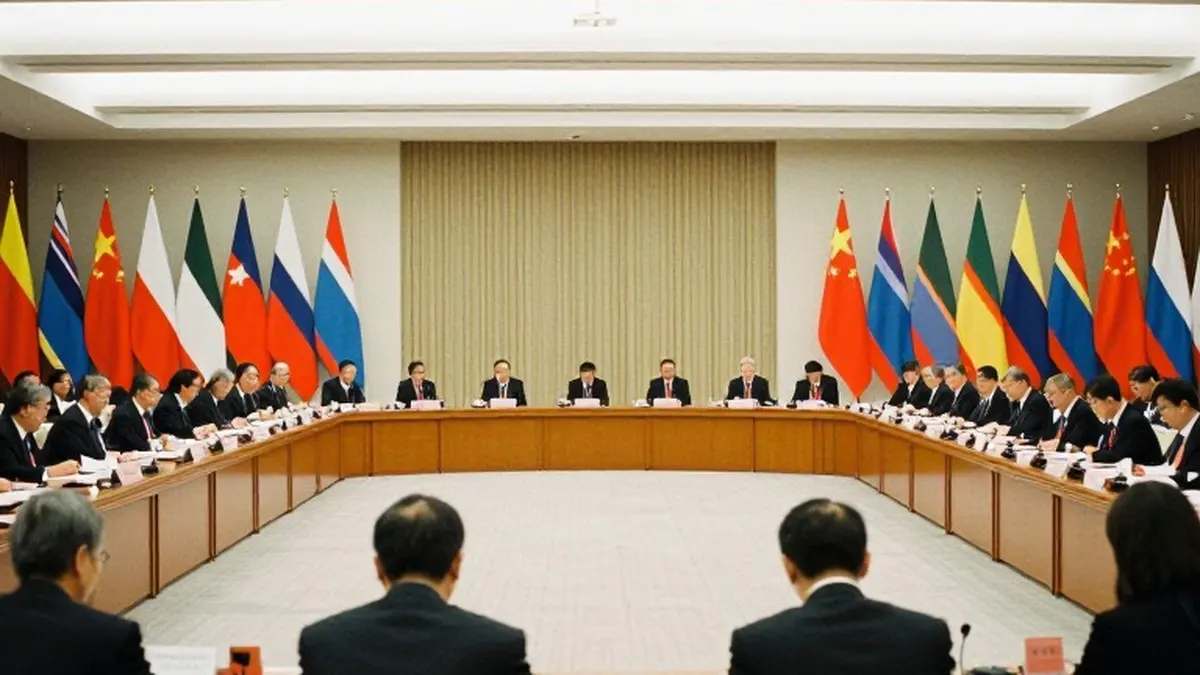
President Donald Trump declared Russian President Vladimir Putin to be 'my friend' during the Asia-Pacific Economic Cooperation summit in China on Thursday. The remark, made while pointing to Putin, drew immediate reactions of alarm and disbelief from several of America's closest European allies. Many of these nations view Putin with deep suspicion due to his leadership of the full-scale invasion of Ukraine, his status as a wanted person at the International Criminal Court for alleged war crimes, and accusations of years-long interference in Western elections and cyberattacks.
Polish officials were among the most vocal in their criticism. Prime Minister Donald Tusk posted on the social media platform X, writing, 'God, protect us from such friends.' Foreign Minister Radosław Sikorski expressed concern over the optics of the embrace, questioning whether Trump viewed Putin as a closer ally than Poland and which friend the president would choose in a crisis. These comments came shortly before Poland's defense minister accused Russia of violating the country's airspace with three objects, likely including two missiles and a drone. Estonia also announced it would close road border crossings with Russia for at least six months for security reasons.
The reaction has been particularly strong in Poland, a nation bordering Ukraine, Russia, and Belarus that relies heavily on the United States and NATO for its security strategy. Broader concerns among European governments center on the idea that elevating Putin alongside Trump and Chinese President Xi Jinping legitimizes a leader whom Western nations have sought to isolate over human rights abuses and aggression. The joint declaration issued by the three leaders after their meeting condemned the International Criminal Court but made no mention of Ukraine.
Other European leaders expressed varying degrees of concern. Danish Prime Minister Mette Frederiksen called the meeting 'very incomprehensible,' while German Chancellor Friedrich Merz warned against the gathering becoming a rerun of the 1945 Yalta Conference, where major powers effectively divided occupied Europe. British Prime Minister Andy Burnham offered a more restrained defense, stating that Trump had passionately discussed the loss of life in the war, including that of young Russians, rather than falling for a charm offensive. NATO Secretary-General Mark Rutte also supported the principle of nuclear powers meeting for diplomacy.
During a call with European leaders and Ukrainian President Volodymyr Zelenskyy on Thursday, Trump reportedly stated that Putin was ready to end the war. He also encouraged European nations to reach a deal to reduce their financial support for Ukraine so they could spend more on their own countries. Trump's son-in-law Jared Kushner, who attended the meeting in Berlin with U.S. envoy Steve Witkoff, emphasized on X that any deal would be made in close consultation with Europe and Ukraine. Kushner noted that Trump aims to work with Europe rather than impose terms unilaterally.
Trump defended his choice of words in an interview with Reuters, arguing that it is preferable to have a friend with 4,000 nuclear weapons than an enemy. This is not the first time the president has spoken warmly of Putin, having previously called him a 'new best friend' in 2013 and described his early moves against Ukraine as 'genius' in 2022. However, this week marked the first time Trump made the declaration to Putin's face in front of television cameras. Jonathan Eyal, international director of the Royal United Services Institute, noted that seeing Trump cross the room with an effusive smile made the friendship feel more real and natural than previous comments.
In the United States, Democratic leaders were openly critical. Senate Minority Leader Chuck Schumer called the words 'embarrassing, despicable, and quite frankly pathetic.' Senator Jeanne Shaheen referred to Putin as a 'murderous war criminal,' while Senator Mark Kelly argued that calling Putin a friend emboldens him. Republican Senator Rick Scott described Putin as a 'thug' but acknowledged the need for cooperation. Bill Browder, a prominent critic of Putin, expressed revulsion at the gesture, stating that a geopolitical menace should not receive such respect from the American head of state. When asked about the comment at a press conference in Berlin, President Zelenskyy shrugged and left the stage.
The White House did not immediately respond to requests for comment regarding the criticism. The 'Coalition of the Willing' meeting in Berlin, which included nearly 40 countries working to support Ukraine, served as the backdrop for these discussions. The event highlighted the ongoing diplomatic efforts to secure peace guarantees while navigating the complex relationship between the U.S., Europe, and Russia.