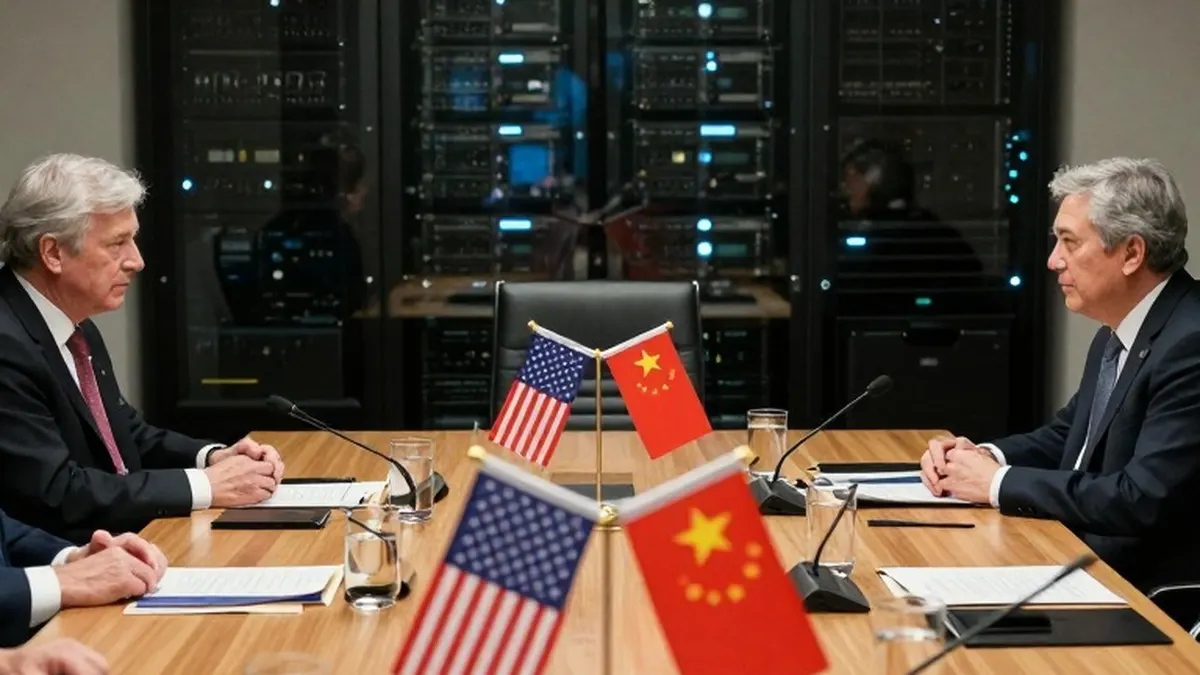
The United States and China must remain clear about their differences while working together to manage the dangers of artificial intelligence, Treasury Secretary Scott Bessent said in remarks prepared for a Tuesday event in New York. He said the countries should “harbor no illusions” as they pursue cooperation alongside their competition for leadership in the technology.
Addressing the National Committee on U.S.-China Relations, Bessent described a newly established dialogue focused on super intelligence, or SI. The initiative is intended to address risks facing both countries and prevent misunderstandings between their systems. It would involve sharing practices for evaluating advanced models before release, maintaining human judgment over the technology and, Bessent said he expected, notifying one another about serious incidents involving SI models.
Bessent offered no commitment to slow technological development as Washington and Beijing compete for global AI dominance. The Trump administration has generally opposed wider restrictions on development out of concern that they could give China an advantage. In a CBS interview released Sunday, however, Trump expressed some willingness to consider safeguards, saying, “I don't mind guardrails.” He also said he did not want regulation to leave the United States far behind China, which he said lacked such restrictions.
Beijing has also pushed back against proposals to curb development. China's foreign ministry rejected calls in September to slow frontier models, arguing that fearmongering and confrontation would interfere with global AI governance. Last month, Huiyao Wang, founder of the Center for China and Globalization, a think tank closely aligned with Beijing's thinking, called for bilateral discussions to address and jointly manage AI risks.
Washington and Beijing agreed during Xi's September visit to establish an AI dialogue that includes a communications channel for easing serious incidents. The two leaders are expected to hold their third meeting next week alongside the Asia-Pacific Economic Cooperation Leaders' Meeting, scheduled for Nov. 18 to 19. Bessent is also expected to participate.
The cooperation effort comes amid continuing disputes over access to American technology. Washington temporarily halted foreign nationals' access to Anthropic's Mythos and Fable 5 models in June, restoring it several weeks later. It has also limited exports of the most advanced chips to Beijing and accused Chinese developers of copying U.S. models through industrial-scale distillation.
Bessent said technological progress would require both governments to balance competitive pressures with their responsibilities as leaders, even when their interests and approaches diverge. At the same gala, China's ambassador to the United States, Xie Feng, described both countries' participation as essential to tackling global flashpoints and improving AI governance. Cooperation, he said, “may not resolve every challenge,” but “none can be resolved without it.”