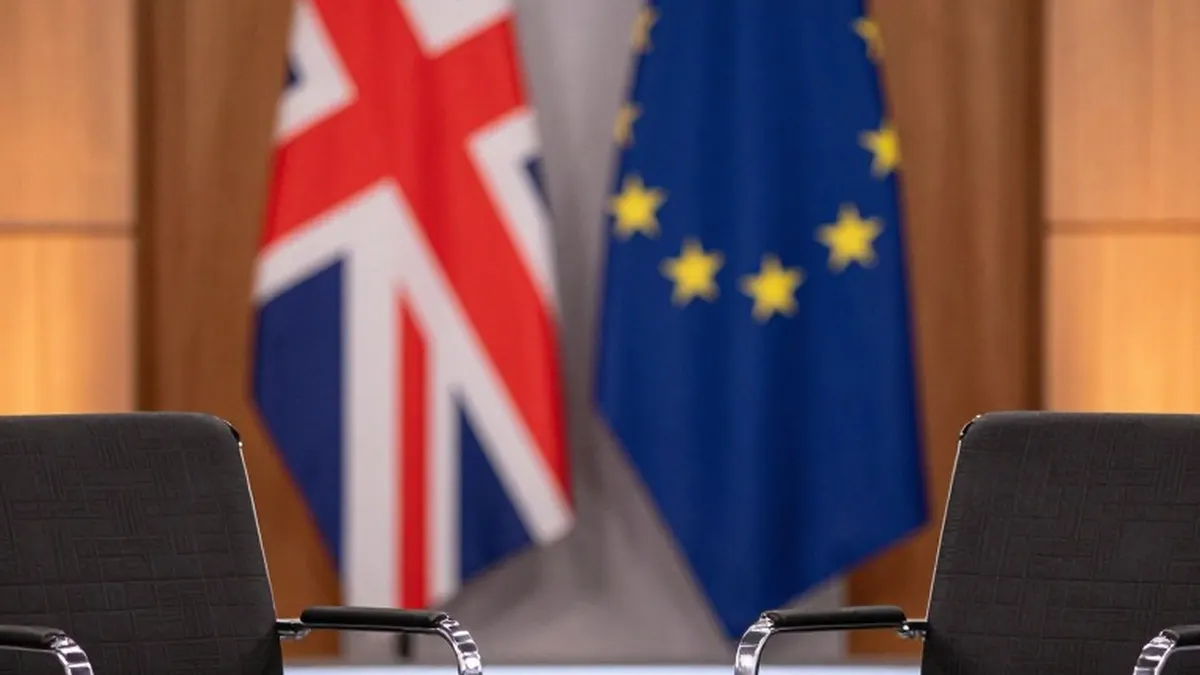
Michel Barnier, the EU's former Brexit negotiator, has warned that Britain cannot select only the parts of the single market it likes, after Prime Minister Andy Burnham said he wanted to explore closer economic ties with Europe.
Burnham has suggested that rejoining the bloc's internal market is among the options he could pursue as part of a reshaping of relations since the UK's exit from the EU nearly six years ago. But Barnier told the BBC's Sunday with Laura Kuenssberg that EU members would insist Britain readopt certain conditions, including the free movement of people, in exchange for access.
There is no "single market a la carte" from which the UK could pick and choose, Barnier said. He stressed that rejoining the market, which allows goods to be traded freely without border controls, would mean accepting the same terms as other members, including the rules governing the movement of goods, services, capital and people, known in EU institutions as the four freedoms. "There will be no possibility to have one freedom and not the other. The four freedoms are clearly the four conditions to be inside a single market," he said.
Barnier, who led the EU delegation during Brexit talks between 2016 and 2021 and served briefly as French prime minister in 2024, added that the "door is open" within Europe to the UK rejoining as a full member.
Since taking office in July, Burnham has indicated he could commit Labour to pursuing a much closer relationship with Europe, including seeking full membership, though he has ruled out major changes before the next election. His predecessors have struck a series of agreements with Brussels on different aspects of the post-Brexit relationship, and both sides hope to use a summit in Brussels in 10 days' time to unveil deals on food standards, youth visas and re-linking British industry to the EU's carbon trading regime.
Free movement of people, which lets EU citizens live and work elsewhere in the bloc without a visa, was a central issue in the 2016 referendum. Burnham's immediate predecessor, Sir Keir Starmer, ruled out restoring it in Labour's 2024 manifesto, and advocating its return would be a dividing line with the Conservatives and Reform UK at a future election. Burnham recently said he would not bring back free movement without a referendum, prompting Downing Street to clarify he was not proposing its return at this point. He has said he wants to set out "different options" at the Brussels summit later this month before building public consensus on a new relationship.
Barnier also predicted that EU countries would reject restoring the British financial rebate, first negotiated in 1985, which lowered UK contributions to the bloc's budget. Brexit had created "a new situation", he said, meaning a new rebate would be "off the table".
The Frenchman also drew a parallel between Reform UK leader Nigel Farage and Marine Le Pen. "We have our own Farage. It is Mrs Le Pen. The same populism, the same lies, the same false promises," he said. Pressed on the accusation, Barnier pointed to the Vote Leave campaign's claim that Britain sent 350 million pounds a week to the EU: "when Mr Farage and Mr Johnson promised the UK people to get back [350] million per week, it was not true, it was not possible. It was a lie".
The 350 million pound figure, displayed on the side of the Vote Leave campaign bus alongside a pledge to fund the NHS, has long drawn criticism because it represented a gross contribution that ignored the UK's rebate, worth about 75 million pounds a week, and EU investment in Britain. Boris Johnson, a key figure in that campaign, has defended the number as based on the UK's gross contribution, arguing in his 2024 memoirs that even a net figure of 175 million pounds was "a hell of a lot of money".
Farage, who led Leave UK and was not part of Vote Leave, hit back: "It is the same old Barnier: arrogant, out of touch and a bully. He vindicates our decision to leave every time he opens his mouth."