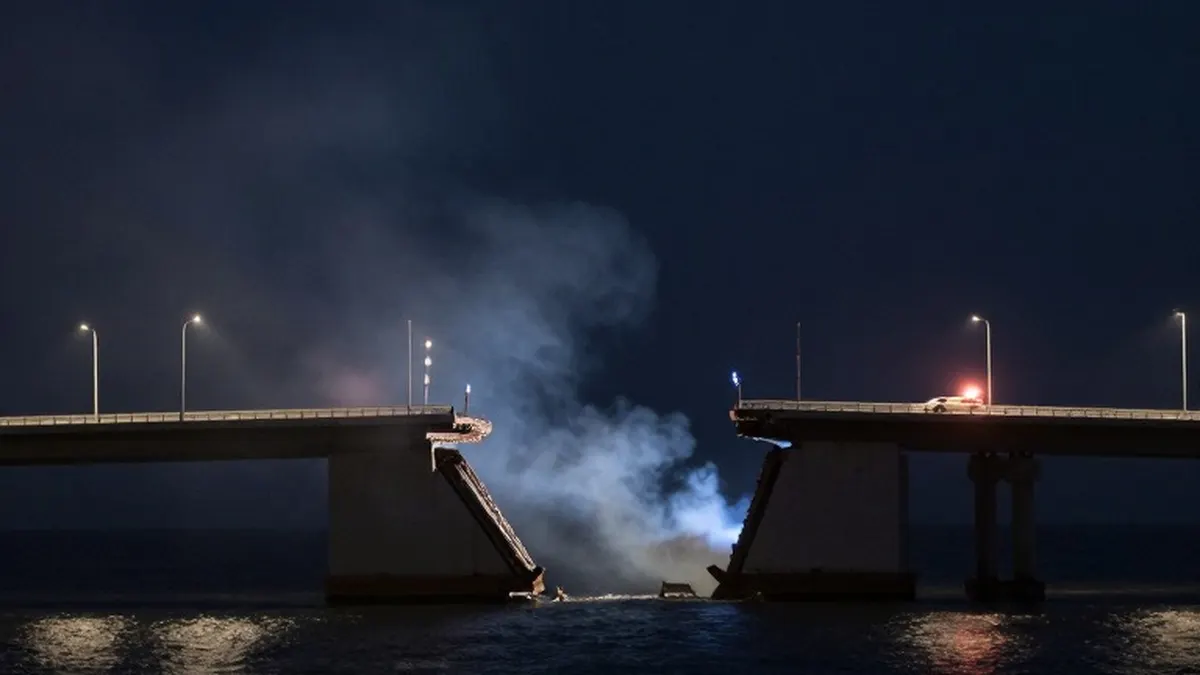
Ukrainian forces struck the Crimean bridge on Tuesday, destroying the central section of the road link that connects mainland Russia to the annexed peninsula. The attack inflicted a significant military and symbolic setback for Russian President Vladimir Putin only two days before he is scheduled to meet with U.S. President Donald Trump and Chinese President Xi Jinping.
Verified videos and images shared by Ukrainian President Volodymyr Zelenskyy on X showed the main road arch collapsing into the sea, creating a large gap in the structure. Zelenskyy stated that the strike served as a reminder that the war would always return to its origin. He noted that Russia frequently targets Ukrainian infrastructure, including bridges, in its own offensive operations.
The 19-kilometre bridge, inaugurated by Putin in 2018, has long been viewed as a symbol of Russia's control over Crimea, which Moscow captured from Ukraine in 2014. The timing of the destruction was particularly sensitive for the Kremlin, as the three leaders are expected to discuss the Ukraine conflict among other topics during their meeting in Shenzhen on Thursday.
Zelenskyy described the operation as unprecedented, claiming it methodically disabled Russian air defenses, radar systems, and electronic warfare capabilities. Sergei Aksyonov, the Russian-installed governor of Crimea, reported that two people were killed in the attack. Road traffic was suspended, while rail traffic partially resumed after a brief pause.
Kremlin spokesman Dmitry Peskov said a repair plan would be developed to make the bridge even better than before. However, Russian military bloggers and analysts suggested repairs would be difficult due to Ukraine's ongoing capacity for attacks. Finnish military analyst Emil Kastehelmi noted that the road bridge would likely remain unrepaired for the duration of the war, calling it a victory with both concrete and symbolic implications.
The bridge had previously served as a key supply route for Russian forces, though the military now relies more on a land corridor through eastern and southern Ukraine. Russian Deputy Prime Minister Marat Khusnullin stated that a government commission met to assess the damage and plan repairs, as well as to discuss alternative logistics for cargo delivery to Crimea.
The channel spanned by the bridge is used by commercial vessels accessing the Sea of Azov, making it vital for the region's grain export network. Andrey Sizov of consultancy Sovecon warned that debris in the channel could substantially delay the resumption of shipping from the Sea of Azov. While Black Sea grain shipments have stalled due to drone attacks, export infrastructure has suffered limited damage, suggesting trade could resume quickly if security improves.
The overnight strike was part of what Russian state media called Ukraine's largest drone attack to date. Russia claimed to have shot down 1,441 drones over 22 regions, surpassing a previous record set on Monday. Air defenses also repelled a major attack on the Bashkortostan region, where Ukraine said it hit a refinery and petrochemical complex in Salavat.
Moscow Mayor Sergei Sobyanin reported that around 800 drones flew toward the Moscow region, with 321 brought down. The increase in drone attacks coincides with a grinding war of attrition, where both sides target energy infrastructure and strategic assets. These strikes continued despite recent U.S.-brokered peace talks in Abu Dhabi, which resulted in a prisoner exchange but no breakthrough on territorial issues.
In Kyiv, Mayor Vitali Klitschko confirmed that Russia struck the North and South bridges and partially damaged the metro system. The attacks caused power and water outages and transport restrictions. Deputy Energy Minister Artem Nekrasov said overnight strikes on energy infrastructure left consumers without power in eight Ukrainian regions. Russia said its forces targeted transport, military, and energy facilities in several regions, as well as port infrastructure and a cargo ship.