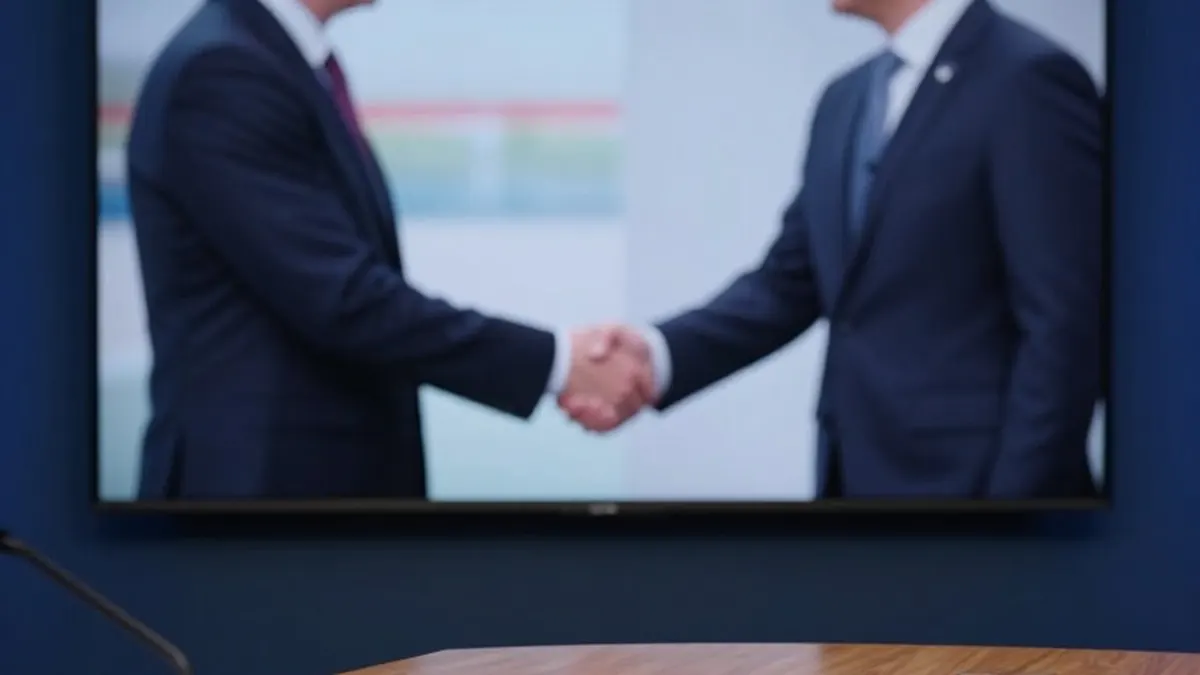
Jay Clayton, the director of national intelligence for the United States, stated on Sunday that he places complete trust in President Donald Trump regarding the latter's characterization of Russian leader Vladimir Putin as a friend. These remarks came after a recent trilateral summit in China where the US president met with both Putin and Chinese President Xi Jinping. The meeting resulted in Trump posting a photograph of himself shaking hands with the Russian president, accompanied by the caption “My Friend.”
The description sparked significant debate both within the United States and among international allies. During an appearance on CNN’s State of the Union, host Dana Bash asked Clayton whether he personally viewed Putin as a friend of the US. Clayton responded by praising the president's diplomatic efforts, describing Trump as the greatest conductor of foreign policy in a challenging era. He emphasized that bringing together the three major nuclear powers to agree on communication and avoiding escalation was a historic and remarkable achievement.
Clayton suggested that the language used by the president should be viewed within the specific context of that historic meeting. He told Bash that different words can be appropriate in different situations. He reiterated this sentiment during an interview with ABC’s This Week, where he spoke with Jonathan Karl. Clayton argued that using the term “friend” was entirely appropriate given the context of the three main nuclear powers agreeing that a nuclear incident must be avoided.
However, when pressed further on his personal opinion, Clayton drew a distinction between the diplomatic context and the broader geopolitical reality. He stated that while the term fit the summit, Vladimir Putin is not America’s friend in the context of the war in Ukraine, emphasizing that point with the words “not at all.”
President Trump had previously addressed the topic during a press briefing last week. He noted that while he could not speak for the entire nation, he maintained fantastic relationships with Putin and considered that a positive development. The president’s warm framing of the relationship has since become a focal point for political criticism.
Senate minority leader Chuck Schumer voiced strong opposition to the characterization. He posted on social media that Putin is the leader who has abducted tens of thousands of children and killed tens of thousands of civilians in Ukraine. Schumer called the description embarrassing and pathetic, asserting that Senate Democrats stand with Ukraine and against autocratic dictators.
Senator Jeanne Shaheen also expressed confusion over the president’s admiration for Putin, referring to the Russian leader as a war criminal in an interview with MS NOW. She found the cozying up to Putin difficult to understand.
Criticism was not limited to the United States. Richard Tice, the deputy leader of the Reform UK party, told Sky News that the description was a grave mistake and wrong at every level. He described Putin as a murderous dictator, a view shared by many in Europe. Polish Prime Minister Donald Tusk also weighed in, stating that Mr. Putin is not their friend and will never be.
In separate comments during the same media appearances, Clayton addressed recent technology outages affecting the US. He advised the public to expect more glitches and interruptions as companies and government agencies continue to replace aging systems. He described these disruptions as an inevitable part of the ongoing upgrade process.