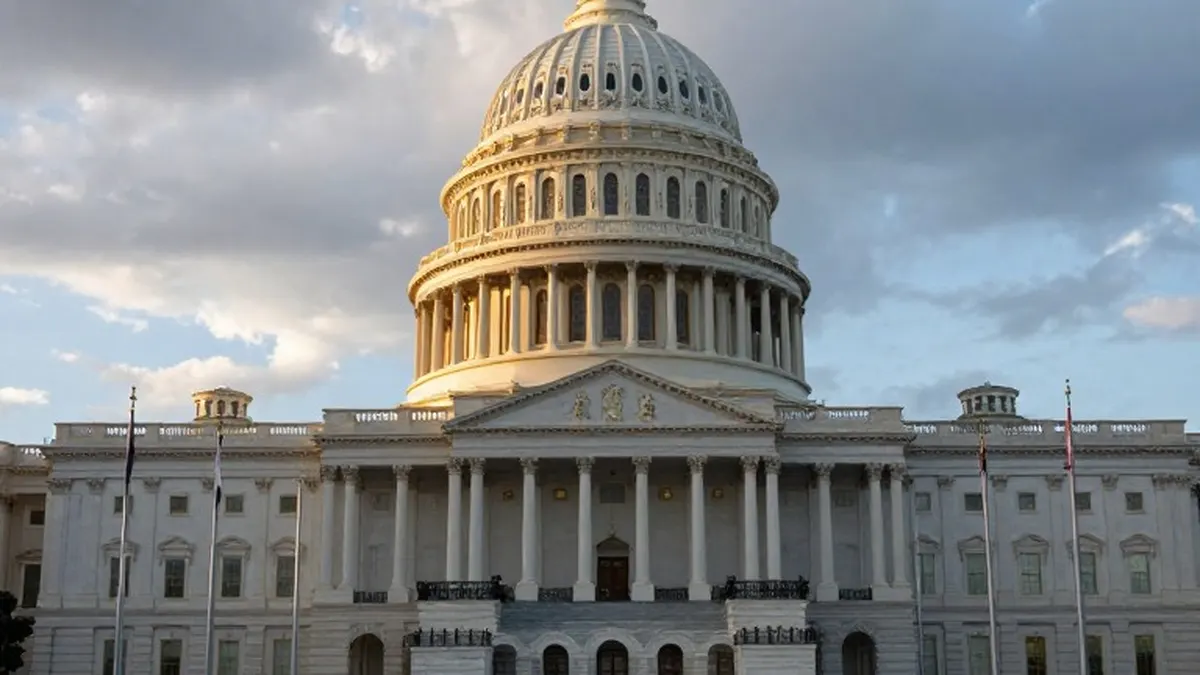
Democrats swept to control of both chambers of Congress in a blowout midterm victory on Tuesday night and will take charge in January. Now comes the harder part: governing while Republican President Donald Trump holds a veto in the White House.
'Today begins the great American comeback,' declared House Democratic leader Hakeem Jeffries after months of campaign promises to investigate corruption, lower the cost of healthcare, groceries and petrol, and curtail the Iran war. Delivering will be much harder.
Some in the party are preaching caution. US Senator Chris Coons told the BBC the result is not 'a mandate,' calling Democrats 'deeply unpopular.' 'We need to prove we can get stuff done, actually deliver answers to their concerns and questions about low wages and rising costs in particular,' he said.
The party's clearest new weapon is oversight. Congressman Robert Garcia of California is set to lead a powerful House committee and told Trump's circle to 'Lawyer up' on election night. Both chambers can investigate alleged conflicts of interest involving the president and his allies; Garcia has floated targets including Trump's family, 'corporate corruption,' alleged abuses by the Department of Homeland Security and Immigration and Customs Enforcement, and the government's handling of the Epstein files.
The Senate can confirm or block cabinet and judicial nominees, potentially decisive if a Supreme Court vacancy arises, since Democrats could reject a pick or force a more moderate choice. The House can impeach, a step taken twice in Trump's first term, though the Senate acquitted him both times and conviction requires 67 votes. Democrats are split on trying again after the 2019 impeachment let Trump cast himself as a victim of political persecution. Jeffries, who would likely have to greenlight any such effort, told CNN in August: 'We haven't ruled anything in. And we haven't ruled anything out.'
The legislative math is less forgiving. Just 14% of registered voters approved of Congress in an October Gallup poll, and divided government could deepen the deadlock. Democrats can pass bills through both chambers with relative ease, but Trump can veto any he opposes, and overriding him takes a two-thirds supermajority in each chamber, more than Democrats will have. 'If you thought legislating was hard in the last Congress with unified Republican control, that will get much more complicated,' said Casey Burgat, professor of legislative affairs at George Washington University.
Trump showed two faces as the losses mounted. 'We'll work with the Democrats, and we'll, you know, look forward to working with them. We'll probably work something out,' he told the New York Times, then minutes later posted a Truth Social picture of his red campaign hat emblazoned with 'VETO.'
Even so, Jeffries says a top priority is reversing Republican cuts to healthcare programs like Medicaid, used by low-income Americans, and the Obamacare marketplace. 'We're committed as a top priority as House democrats to reversing these Medicaid cuts and extending the Affordable Care Act tax credits,' he told healthcare workers in September.
Coons cautioned that the win was mostly about the other side. 'It is overwhelmingly a rejection of Donald Trump, and his agenda and policies,' he told the BBC, adding, 'But if we overreach, or if we fight too much internally, we could miss this moment.' Rifts over military funding for Israel could test that unity: incoming Senator Abdul El-Sayed of Michigan and some incoming House members have said they would vote to curtail aid, a stance party leaders may block.
Foreign policy could be the hardest fight. Both chambers passed a resolution in June to halt hostilities with Iran that Trump could not veto but has essentially ignored, and the White House argues he has broad powers to continue the war. Whether Congress can force his hand is an 'open legal question,' said Scott Anderson of the Brookings Institution. 'Congress can try to litigate this out, and force the courts to tell us.'