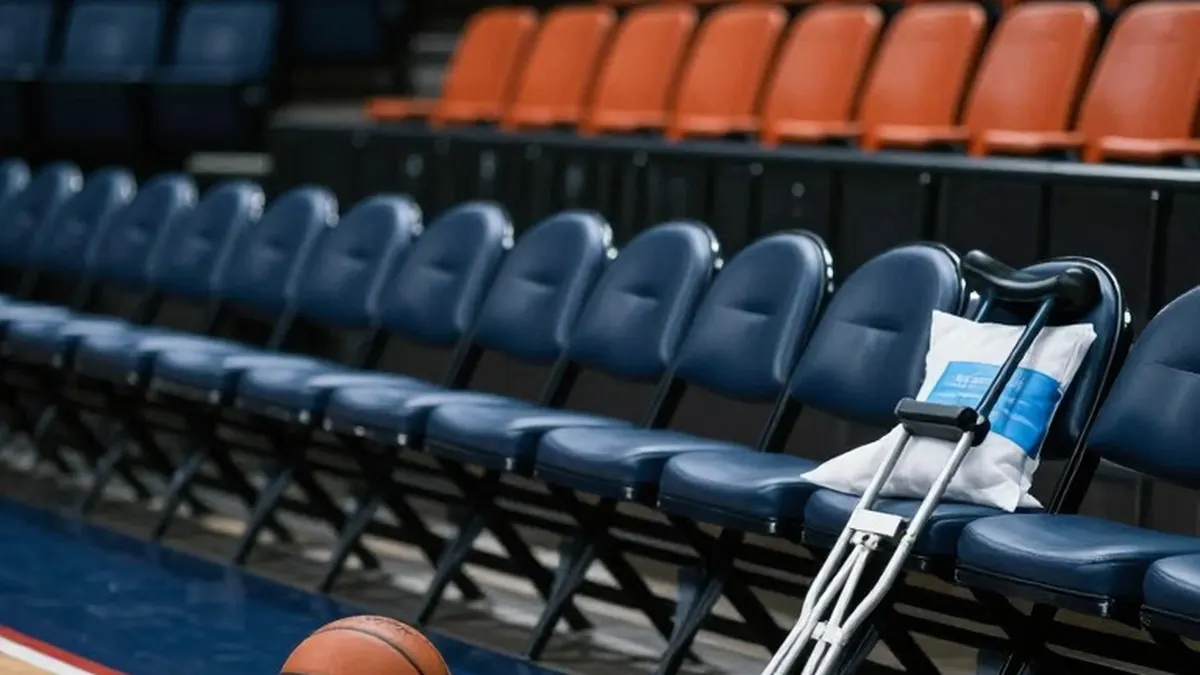
The Oklahoma City Thunder have lost two important players early in the 2026-27 season, and the damage reaches well beyond the win column. Jalen Williams suffered a dislocated left ankle and a fractured fibula on an attempted dunk Sunday against the Los Angeles Clippers. He will have surgery and is expected to miss at least several months, with the whole season possible. Starting guard Cason Wallace has a torn labrum in his left shoulder, and his outlook is similar: surgery, a long absence and perhaps a lost year.
Oklahoma City is better equipped than most teams to absorb the blow. Last season the Thunder went 39-10 without Williams, a 65-win pace, and their +10.9 net rating in those minutes would tie for 16th-best over a full season in NBA history. All four of their Williams-free lineups that played at least 50 minutes outscored opponents by 18.6 points per 100 possessions or more. With Shai Gilgeous-Alexander healthy, a high seed looks likely.
The playoffs are the bigger concern, and the San Antonio Spurs are the benchmark. Oklahoma City lost to them in last year's Western Conference Finals, a series that went to Game 7 and largely played out without Williams. Victor Wembanyama limited Gilgeous-Alexander by taking away the basket, cutting his drive-based field goals nearly in half and leaving him with mostly contested mid-range jumpers. Without Williams and Wallace, the Thunder lose their best defender against Luka Dončić and a needed athletic counter to Nikola Jokić, along with Wallace's defense against Minnesota's guards.
Rivals are taking notice. The Lakers, Rockets and Timberwolves are all undefeated, and Denver has lost only to Oklahoma City. Houston, with its deep stock of assets, is seen as especially well placed to push for a title. Home-court advantage in the West also looks more attainable, since the Spurs are focused on settling their starting lineup rather than maximizing regular-season wins. The Thunder, who traded Lu Dort, Isaiah Joe and Aaron Wiggins to avoid the second apron, now have less depth to cover further injuries.
General manager Sam Presti offered little on a possible trade at his Monday press conference. "For me, the last 24 hours or whatever it's been is all about people," he said, adding that he had not given the question much thought. About one-third of the league is currently untradable because of contract restrictions that lift in December and January, which gives Oklahoma City time to assess its position.
Modest moves look most realistic. Over the summer the Thunder tried to sign Denver's Spencer Jones to an offer sheet, but the Nuggets matched, and size on the wing remains a priority. Players in the $7 million to $10 million range, such as Derrick Jones Jr. or Herb Jones, would keep the team under the second apron. A $17.7 million trade exception could also bring in Rui Hachimura or Max Strus, though the team would need to shed salary elsewhere. Milwaukee's Jaime Jaquez and Orlando's Anthony Black are other possible targets.
A blockbuster is harder than the Thunder's pile of picks suggests. Beyond three first-rounders in the weak 2027 class, their external firsts are a 2028 swap with Dallas and a top-5 protected Denver pick in 2029. They also lack the mid-sized contracts they once used to match salaries. Three players are on max deals, Isaiah Hartenstein and Alex Caruso are essential veterans, and everyone else earns under $8 million. Someone like New Orleans' Trey Murphy, at $27 million, would be nearly impossible to fit without sending out Caruso.
That leaves only stars on very low salaries, such as Portland's Deni Avdija, who earns under $14 million, and Atlanta's Nickeil Alexander-Walker. Such players are rarely traded. Gilgeous-Alexander is untouchable, and a Chet Holmgren deal would probably have happened last summer if it were going to. The Thunder could still spend picks to rent a player for this title push, knowing they could recoup much of that capital later, a flexibility most contenders lack.