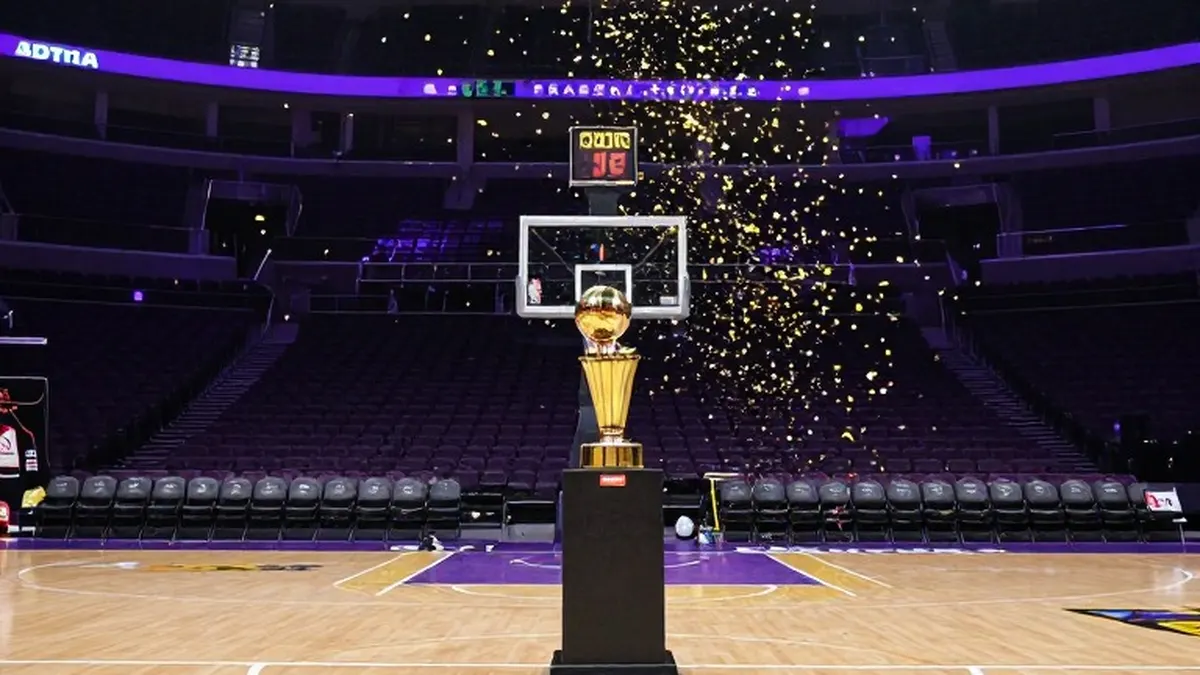
The confetti had barely settled at Ballhalla before talk turned to an encore. The Valkyries won the 2026 WNBA title in just their second season, a first in North American professional sports, and did it without a single All-WNBA player, another league first.
"All it took was good people. That's it," Finals MVP Gabby Williams said. "We built a beautiful culture here." That culture carried a team that sat at 10-7 near midseason, with a 3-6 record against eventual playoff teams, before three wins over the Atlanta Dream in 11 days sparked a nine-game winning streak. Golden State went 22-5 from there, finished 32-12 and nearly caught the Minnesota Lynx for the top seed.
The foundation was one of the best defenses the league has seen. Golden State's 99.1 defensive rating was more than four points per 100 possessions better than any other team, and opponents were held to 14 restricted-area attempts and 31.1 paint points per game, both league-leading marks. Williams, the Defensive Player of the Year runner-up to Angel Reese, headlined the All-Defensive First Team, with Veronica Burton and Kiah Stokes on the Second Team.
Scoring was another matter entirely. No Valkyrie averaged even 15 points per game, and Williams' team-high 14.4 was the second-lowest figure for any team's leading scorer. Golden State shot a league-worst 42.2 percent from the field while launching a league-record 30.3 three-pointers per game.
That weakness nearly ended their season in the first round. Golden State trailed the Dallas Wings by 16 in the second half of a winner-take-all Game 3 before rallying, then swept the reigning champion Las Vegas Aces despite shooting 36.4 percent. In the Finals against Atlanta, the Valkyries won the opener while shooting 32.1 percent, the third-lowest mark in a Finals victory, and their four wins produced totals of 68, 67, 64 and 68 points.
In the decisive Game 7, Golden State trailed by nine in the second half and was stuck on 32 points late in the third quarter before Williams took over, scoring 28 of her 30 points after halftime to tie the record for a winner-take-all Finals game and hitting the go-ahead three-pointer with just over two minutes left. "[Coach Natalie Nakase] told me to stay patient. I trust her with my life," Williams said.
Attention now turns to the winter. Kayla Thornton and Tiffany Hayes are unrestricted free agents, Cecilia Zandalasini is restricted and Kaitlyn Chen is reserved, but the bigger story is the cap room. Golden State has only $3.2 million in guaranteed money committed for 2027, and while the official salary cap is unclear under the league's new revenue-sharing model, it should top the $7 million figure from 2026.
Nyanin has said the draft-night trade of the No. 8 pick, the selection used on Flau'jae Johnson, for two second-rounders was about preserving that space. "We thought we had the opportunity to potentially sign another athlete," she said, calling such flexibility "something I hold near and dear to me." This year's free agent class includes Collier, Jackie Young, Kelsey Mitchell and Kelsey Plum.
Collier, the subject of rumors linking her to the Valkyries last season, is the natural fit: one of the league's most efficient scorers and a former Defensive Player of the Year who could lift the offense without compromising the defense. Young would bring elite offense and is no liability defensively, while Mitchell and Plum, arguably even more dangerous scorers, defend poorly enough that Golden State may pass.
One unknown is how stars will view the reigning champions; some may not join for fear of being seen as front-runners. The Valkyries also hold picks Nos. 14, 29 and 44 in the 2027 draft, and French forward Aïnhoa Risacher is a possible draft-and-stash option for a roster with three French players already. If Nyanin lands a star, the rest of the league is in trouble.