
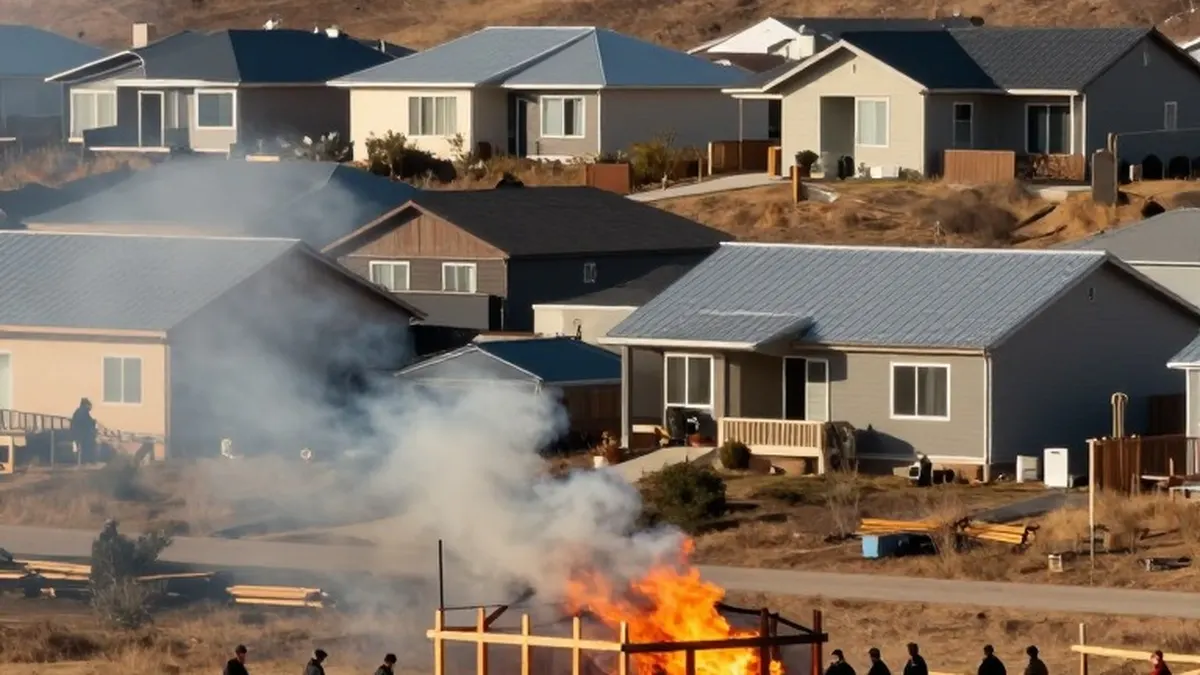
A homeowner in rural Northern California recently shared their experience with the Planet Money podcast, highlighting the growing difficulty of finding affordable and reliable home insurance. While large destructive fires are becoming more common, the insurance market has become increasingly strained, leaving many residents worried about protecting their most valuable assets. This personal account serves as a backdrop for a recent two-part series by Alexi Horowitz-Ghazi, which explores the complex economics of making communities safer from climate disasters.
The first episode of the series features a visit to a destruction lab in South Carolina, where researchers use what are described as crash-test dummies for houses. These facilities subject mock homes to hail, hurricane-force winds, and actual fires to determine which building designs limit damage. Major insurance companies fund much of this research because they need accurate data on risk levels and effective mitigation strategies to manage potential payouts.
This practice is not new. For over a century, insurers have funded experiments to reduce risk. Underwriters Laboratories tested electrical wiring and appliances in the early 20th century to prevent fires, while the Insurance Institute for Highway Safety uses crash tests to improve automotive safety. These examples illustrate how the insurance industry uses data to understand and mitigate large-scale risks.
However, the series raises a critical question regarding moral hazard, a concept where insurance coverage may reduce an individual's incentive to prevent losses. Homeowners in wildfire-prone areas may hesitate to invest in expensive upgrades, such as metal roofs or ember-resistant vents, if they believe their insurer will cover the cost of a total loss. This creates a collective action problem, as a home remains vulnerable if neighboring properties are not similarly hardened.
To counter this, insurers should theoretically offer significant discounts for risk-reducing improvements. Yet, reporting from Paradise, California, suggests that the discounts offered to residents who have worked to make their communities safer are often tiny. This discrepancy has led to questions about whether the market is failing to reflect the true reduction in risk or if the insurers' calculations are accurate.
The challenge is compounded by broader market trends. In California and other western states, insurers have increasingly declined to renew policies in fire-prone areas. Many families have been forced onto the FAIR Plan, the state's insurer of last resort. While climate change plays a role, the issue is also regulatory. UC Berkeley economist Nancy Wallace noted that Proposition 103, passed in 1988, required insurers to use historical losses rather than forward-looking catastrophe models to set rates. This kept premiums artificially low, encouraging development in risky areas until the economics became unsustainable and insurers withdrew.
Wallace argued that these regulations destroyed the market dynamics, leading to a situation where insurers now face the choice of pulling out or raising prices dramatically. UC San Diego economist Judson Boomhower suggested that while we will find ways to keep insuring high-risk areas, the sign of a healed market will likely be higher prices. This reality is difficult for millions of people who already live in wooded, fire-prone regions.
Some homeowners are turning to the non-admitted market, a more free-market sector where companies have greater freedom to set prices and shape policies. One family mentioned in the report switched to this market for better coverage but noted a significant downside: if their insurer fails, they lack the protection of the state-mandated backstop that covers claims in the standard admitted market.
In late 2024, California adopted new rules allowing insurers to use forward-looking models for future wildfire losses in exchange for writing more policies in high-risk areas. This change aims to stabilize the admitted market and make coverage easier to find. As winter approaches, residents hope for a temporary reprieve from fire worries while the insurance industry adjusts to the new regulatory and climate landscape.





