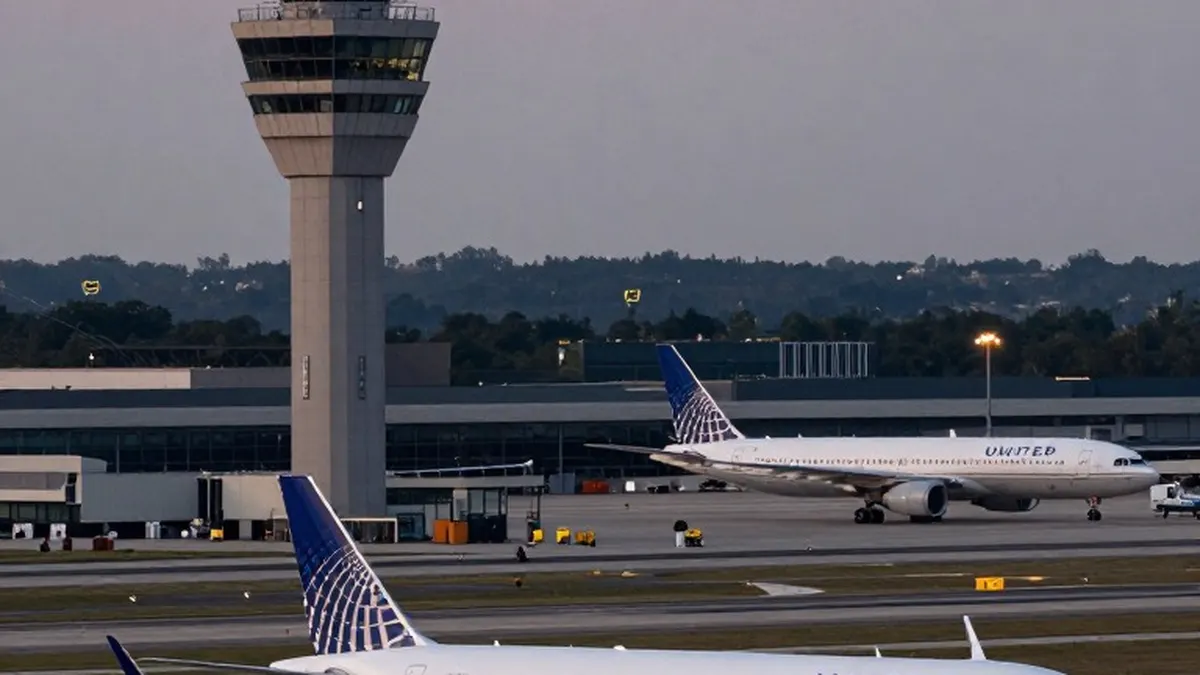
The Trump administration increased its request for air traffic control funding to $50 billion late Friday after a communications problem triggered a nationwide ground stop, halting thousands of flights for hours. The higher figure followed an earlier request that day from the White House and Transportation Secretary Sean Duffy for $30.1 billion to upgrade aging airports and the air traffic control system.
Duffy described the situation as an emergency and pressed for a functioning air traffic control network. The communications failure affected Federal Aviation Administration en route centers, which manage aircraft traveling between airports. The Republican-led Senate Commerce Committee said the disruption demonstrated why modernizing those centers should take priority over other projects. It noted that Congress had approved $1.9 billion to replace outdated centers.
The disruption adds to a series of incidents in recent years that have interrupted flights and put safety at risk in the world's most complex airspace. A January 2025 midair collision at Ronald Reagan Washington National Airport killed 67 people. In July 2025, Congress approved $12.5 billion over five years to modernize air traffic control and hire more controllers, following complaints about congestion, delays and technology failures.
The earlier $30.1 billion proposal from Duffy and White House Office of Management and Budget Director Russell Vought included $10.1 billion for air traffic control modernization. Within that amount, $7.2 billion would fund a common automation platform and controller workstations, while $2 billion would support cloud computing. Their letter urged lawmakers to act quickly, describing the investment as necessary to complete upgrades across the national airspace system.
That proposal also allocated $2 billion to replace and improve FAA control towers and $18 billion for airport projects. Of the airport funding, $10 billion would go toward modernizing or replacing aging terminals. American Airlines, Delta Air Lines, United Airlines and Southwest Airlines have expressed support for the request.
The FAA continues to use computers that are decades old and obtains some replacement parts through auction websites. Last week, the agency said it would end its use of floppy disks for weather and other critical information at more than 400 air traffic control facilities by the end of 2028. Duffy and Vought also told lawmakers that high-speed fiber infrastructure had replaced 68% of the FAA's legacy copper telecommunications network.
Other recent failures have exposed vulnerabilities in the system. In September, a circuit failure at a Philadelphia air traffic facility coincided with a construction crew accidentally cutting a fiber-optic cable in New Jersey. Thousands of flights across the densely populated Northeast were delayed or canceled.
The administration wants the Republican-led Congress to approve the funding during the final weeks of the year. Democrats are set to take control of Congress in January.