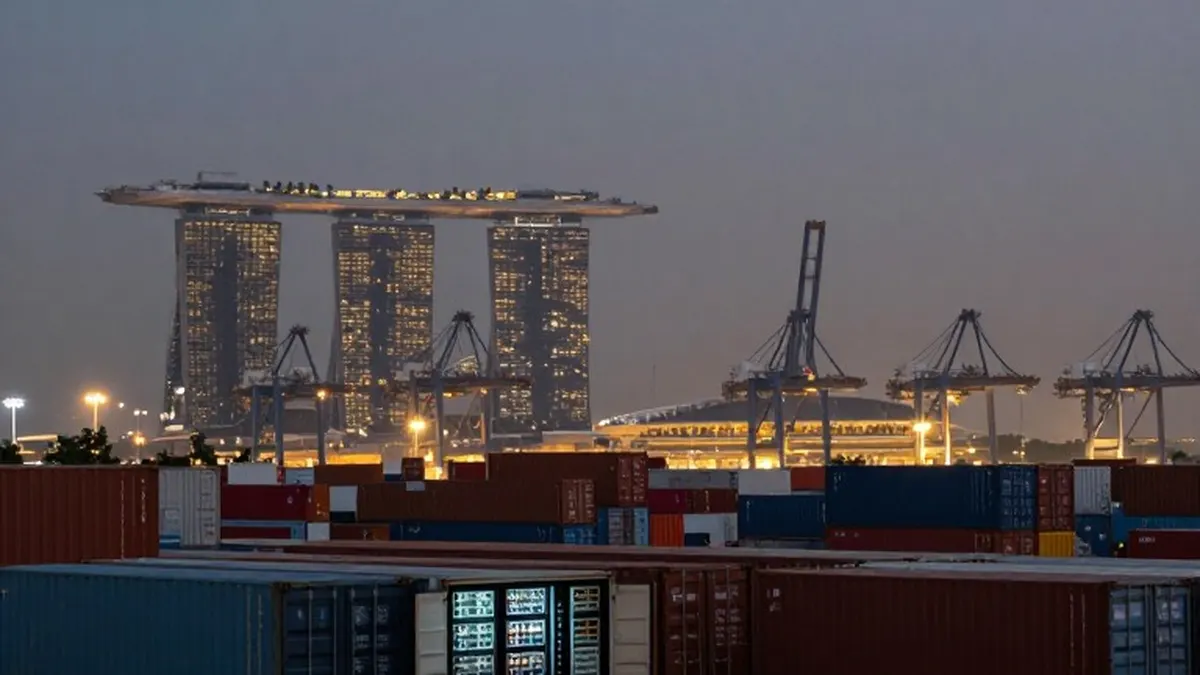
Singapore, a billing hub for billions of dollars' worth of Nvidia sales each year, has found itself increasingly in the crosshairs of Washington's push to keep advanced artificial intelligence chips out of China, with the scandal surrounding the chipmaker's departed chief executive once again putting the city-state in the spotlight.
The Southeast Asian nation said Thursday that it had barred Alice Huang, the Hong Kong businesswoman at the center of the scandal that catalyzed the end of Jensen Huang's run as Nvidia CEO, from re-entering the country. Authorities concluded in February that there was insufficient evidence she had committed offenses related to the declarations under investigation, but she was nonetheless barred after being found to have provided inaccurate information downplaying her role in Megaspeed International.
On Friday, a fifth person was handed 41 charges in a Singapore fraud case involving computer servers that might have contained Nvidia chips and were exported to Malaysia. Prosecutors said in March last year that the alleged transactions in the broader case totaled about $390 million. The investigations into several companies and key officials, including Megaspeed, began in February 2025 and remained ongoing as of Thursday.
The Ministry of Home Affairs said in a statement late Thursday that authorities have been examining whether servers exported through Singapore to Malaysia, without entering the domestic market, were subsequently rerouted to another destination, contrary to declarations made in Singapore.
The city-state has faced growing international scrutiny, particularly from the United States, over its role as a major billing and potential transit hub for Nvidia chips that U.S. officials say have reached China. Washington has restricted exports of Nvidia's most cutting-edge AI chips to China since 2022 to curb Beijing's surging AI development. Nvidia's revenue linked to Singapore rose to 22 percent in the fiscal quarter ending July 2025, up from 8 percent in 2023, though Singapore's trade ministry estimates that chips physically delivered there accounted for less than 1 percent of the chipmaker's revenue.
Experts point to gaps in the enforcement of U.S. export restrictions and in Singapore's corporate system that make it hard to trace where advanced chips ultimately end up. Nvidia chips can be legally sold to customers in countries such as Malaysia or Singapore and then illicitly resold or re-exported to China, while Chinese companies can legally gain remote access to advanced chips hosted in data centers outside China. Chris McGuire, a senior fellow at the Council on Foreign Relations and a former U.S. national security official, said Southeast Asia has become "a major hub for chip smuggling and export control circumvention," importing tens of billions of dollars' worth of AI chips per year.
Singapore has stepped up efforts to police suspected chip diversion since last year, including fraud and money laundering investigations, but authorities have acknowledged potential "blind spots between separate monitoring of trade flows and banking flows," said Alvin Camba, lead scientist and director of research at Lyvi, an Austin-based AI risk assessment firm. "Singapore's strong corporate secrecy regulations, which offer extensive protections for foreign investors, can also make it difficult to rapidly identify the true recipients of goods," Camba said, adding that such gaps can be exploited to "obfuscate financial flows and potentially circumvent global restrictions on technology transfers."
Singapore also said it received limited help from U.S. authorities in its yearlong investigation. Police sought information on Super Micro Computer Inc., a U.S. server supplier relevant to the probe, but the company provided limited cooperation. The city-state first raised the issue with U.S. authorities in July 2025 and repeated its request on several occasions since September last year. "Despite these repeated requests, Singapore has to date received limited information or assistance in respect of the company," the ministry said, adding that Singapore does not enforce "unilateral export controls" imposed by other countries, though it expects companies operating there to take foreign export rules into account.
Megaspeed, which was spun off from a Chinese gaming company, became Nvidia's largest Southeast Asian customer in less than three years and has bought more than $4.8 billion worth of its chips since June 2024, according to The New York Times, though the company has denied any wrongdoing. Alice Huang, whom U.S. intelligence identified as a Chinese intelligence asset passing information to Beijing, served as managing director at Megaspeed for eight months in 2023 and has reportedly continued to play a leading role. Police interviewed her in June 2025.
Jensen Huang resigned as Nvidia CEO on Thursday, ending 33 years at the helm after revelations that he had two extramarital affairs, plunging the chipmaker at the heart of the global AI boom into crisis. Nvidia appointed Chief Financial Officer Colette Kress as interim CEO while its board searches for a permanent successor.