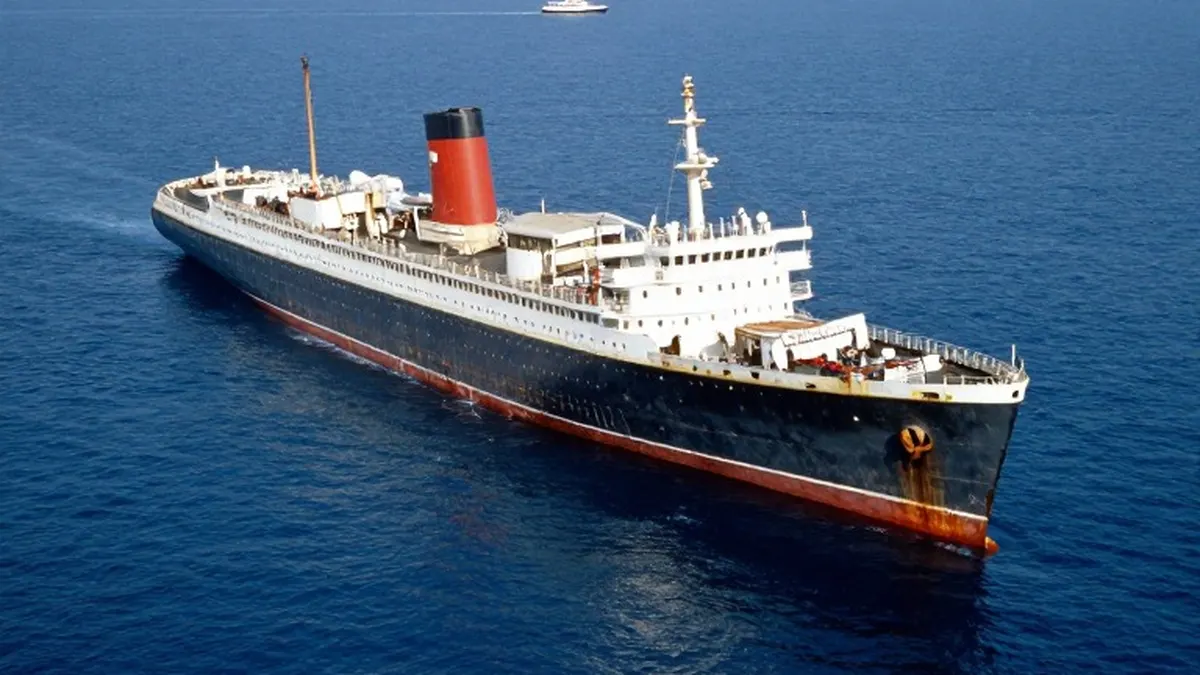
The SS United States, a vessel that holds the record for the fastest transatlantic passenger crossing, was intentionally sunk on Wednesday. The ship, which launched in 1951 and is longer than the RMS Titanic, had a storied history that included transporting four U.S. presidents, the Mona Lisa, and numerous movie stars. After spending decades rusting at a dock and facing demolition, the vessel was finally deployed off the coast of Okaloosa County, Florida, to serve as what is expected to be the world's largest artificial reef.
The sinking process took approximately five hours. Crews removed plugs from the hull, allowing seawater to fill the ship without the use of explosives. Following a period of delays, the liner tilted onto its side and submerged beneath the waves. This event marks a poignant end to the era of large, elegant ocean liners while also representing a strategic move by coastal communities to attract tourism.
Maritime enthusiasts and divers were eager to witness the event. Karen Flynn, a wreck diver with the Maryland-based Atlantic Wreck Divers, traveled to the site shortly after the date was set. She described the sight of the ship rusting at the dock as tragic and viewed the sinking as a new and unique diving opportunity for her group.
Okaloosa County officials see the SS United States as a key driver for local tourism. Jennifer Adams, the county's tourism director, noted that the vessel is the largest artificial reef the region has ever created. The ship, which is nearly 1,000 feet long, joins a collection of hundreds of other artificial reefs in the area. Adams stated that these reefs currently generate between $10 million and $12 million in annual economic benefits, a figure she expects to increase significantly with the addition of the liner.
To ensure the site was suitable for both marine life and recreational diving, the ship's hull was stripped of toxic materials and bulky components. It was placed more than 20 nautical miles from the beaches of Destin, Florida. The positioning was carefully calculated so that the upper decks would remain within the limits for recreational diving.
The SS United States now sits alongside the USS Oriskany, a 888-foot aircraft carrier sunk off Pensacola in 2006. Together, these vessels make the Florida panhome area home to the first and second largest artificial reefs in the world. According to the state fish and wildlife commission, Florida has created over 4,000 artificial reefs since 1940. Data analyzed by the National Oceanic and Atmospheric Administration indicates that diving tourism around these reefs generates nearly a billion dollars in annual economic benefits.
Andrew Ropicki, an economist at the University of Florida, suggested that the region has reached a critical mass of planned shipwrecks, allowing it to capture a larger share of tourism dollars than other areas. However, he warned that overinvestment could lead to diminishing returns if visitor interests shift or if tourists feel overwhelmed by the number of options available.
For Susan Gibbs, head of the SS United States Conservancy, the sinking evoked a complex mix of emotions. As the granddaughter of William Francis Gibbs, who designed the ship, she felt both sorrow and pride. The Conservancy sold the vessel to Okaloosa County for $1 million in 2024, a fraction of its original cost. Gibbs believed that turning the ship into a reef was a more dignified outcome than sending it to a scrapyard.
Plans are already underway to sink five or six additional artificial reefs in the region. For now, officials hope that the unique presence of the SS United States beneath the surface of the Gulf of Mexico will draw crowds and sustain the local economic boost.