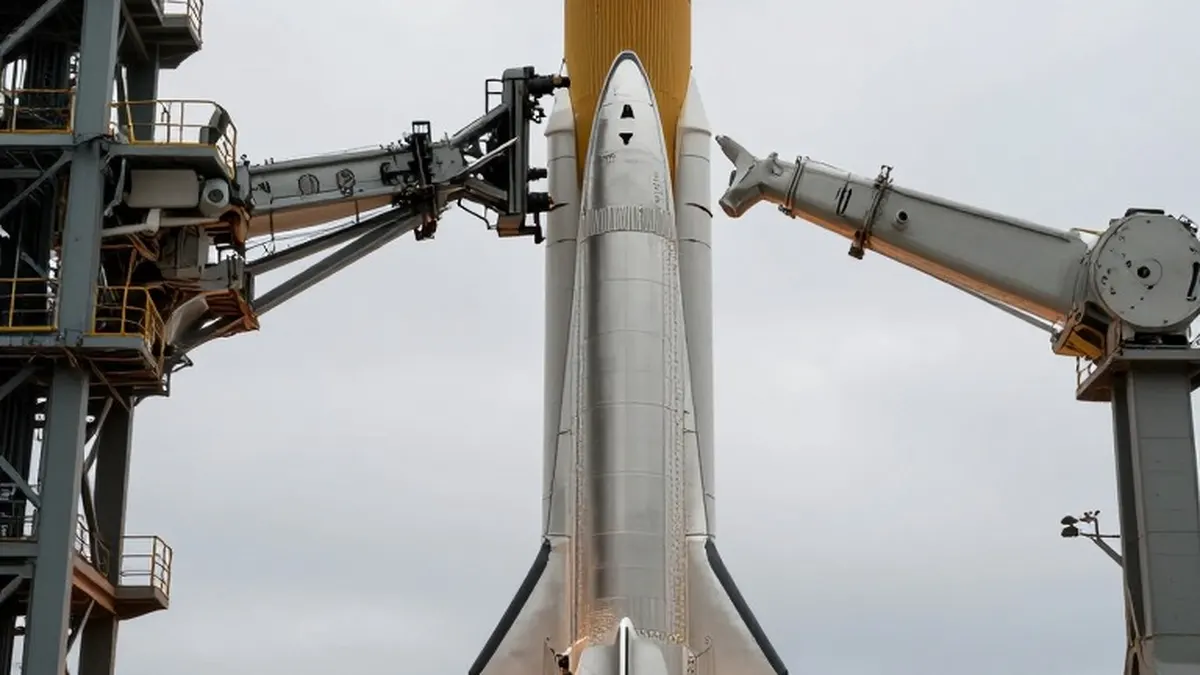
On a cloudy Saturday afternoon in Texas, two giant metallic arms reached out and plucked a returning giant out of the sky. SpaceX's Starship, the world's largest and most powerful rocket at 124 metres (407ft) tall, descended smoothly into the mechanical 'chopstick arms' above Launch Pad 2 at Starbase city, about 22 hours after blasting off on its latest flight.
The feat marks the first time the upper stage of a spacecraft has been caught in midair, and aerospace engineers around the world have hailed it as a sign that mega rockets could soon become fully reusable.
The capture followed a long journey. After orbiting Earth 14 times over 22.5 hours, Starship emerged through thick clouds above its Starbase launch site, flipped itself vertical and eased down toward the arms of the 'Mechazilla' launch tower. With its engines still firing, the arms closed around the spacecraft like oversized tweezers. The ship then latched onto the tower and shut its engines down, the roar giving way to cheers from onlookers witnessing history.
'That was the missing link, the holy grail of spaceflight,' said SpaceX mission commentator Dan Huot. 'We caught a Starship and now everything changes.' SpaceX founder and CEO Elon Musk congratulated what he called an incredible team, while NASA Administrator Jared Isaacman, whose agency is paying billions of dollars for Starship to carry astronauts to the Moon later this decade, wrote on X that the catch was 'almost magic' and that it brought the Moon one step closer.
Returning safely from space has always been perilous. Spacecraft face gravity and atmospheric conditions that are nearly impossible to predict with precision. Sputnik 1, the first artificial satellite, burned up on re-entry. In April 1967, the Soviet Soyuz 1 capsule crashed near the Ural mountains after its parachutes failed, killing cosmonaut Vladimir Komarov. Decades later, NASA's space shuttle Columbia broke apart during re-entry, killing all seven astronauts aboard. Despite major safety advances since then, many spacecraft cannot be reused after splashing down at sea or landing on ground.
SpaceX has caught returning rocket boosters three times since October 2024, but never the main spacecraft itself, until Saturday. After inspecting the vehicle, Musk reported that everything, including the critical heat shield, appeared to have performed well. 'Ship 42 looks great!' he posted on X, alongside photos and videos from the tower.
Niharika Patel, Technical Programme Manager at US-based space infrastructure company Loft Orbital, told Al Jazeera the catch was 'magical' to watch. 'Landing a rocket back on Earth is incredibly difficult and can itself be considered an engineering marvel. Now add the sheer size and weight of Starship to that equation,' she said, noting the vehicle had to hit an exact position, survive the extreme heat of re-entry and execute tightly controlled manoeuvres, all autonomously, without a pilot.
The achievement fits SpaceX's broader strategy of cutting the cost of space travel through reusability and rapid, repeat engineering. Its Falcon 9 rocket has flown 700 times since 2010 with a reusable first stage, though its second stage is discarded at sea. Patel said Falcon 9 has already made sending satellites to low Earth orbit 'super cheap and convenient,' and that Starship goes further by aiming to reuse both the booster and the upper stage of a much larger craft.
A fully reusable vehicle could be refurbished quickly and flown again, sharply raising flight frequency while lowering costs, much as commercial aviation transformed travel with reusable aircraft and fast turnarounds. 'This is essential for the next era of space exploration,' Patel said, 'from deploying large satellite constellations and building space infrastructure to enabling sustained human exploration of the Moon and Mars.'