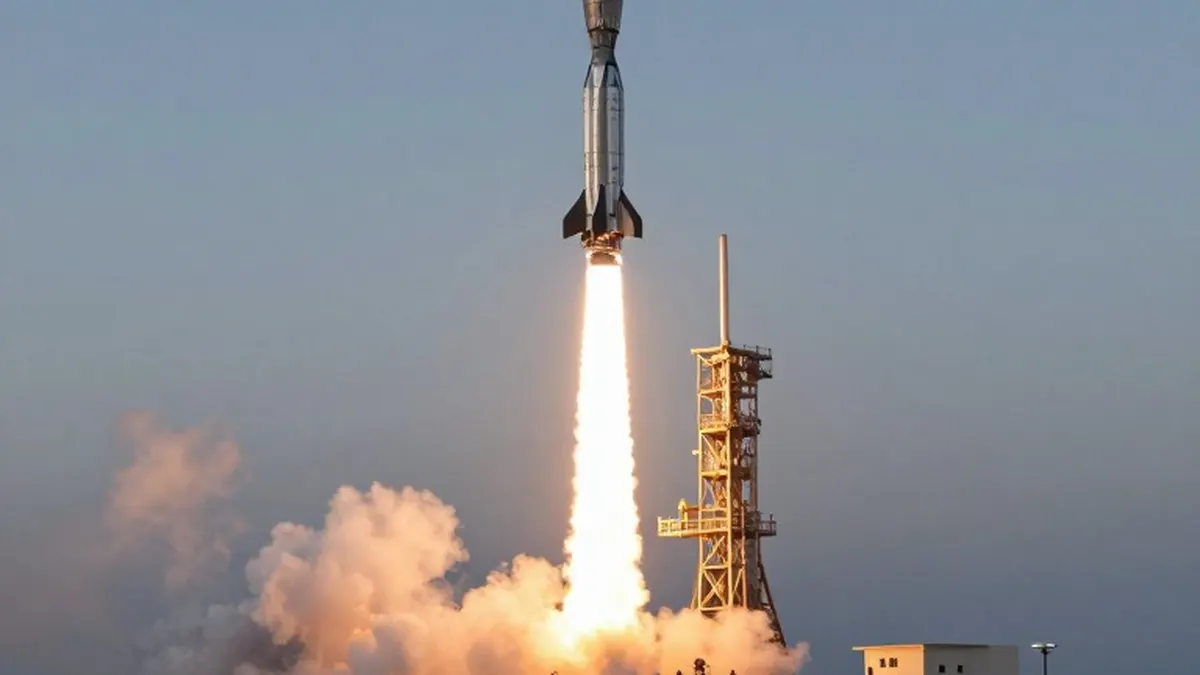
SpaceX's Starship rocket lifted off right on schedule Friday evening from the company's Starbase site in South Texas, the 15th test flight for the vehicle in a span of more than three years.
Conditions were nearly perfect for a launch. As the rocket climbed through the atmosphere in the early evening, the Sun sank toward the western horizon, and the air was so calm that the vehicle's white exhaust plume refused to dissipate for many minutes. South Texas weather is not always so kind, with long, hot summers, but Friday evening at Starbase was ideal.
The first stage performed flawlessly on the ascent, releasing the upper stage high above the Gulf of Mexico. From there, the Starship upper stage ignited its Raptor engines and powered into a nominal orbit, marking only the second time SpaceX has flown Starship into low-Earth orbit.
The return of the first stage went differently. As the booster came back toward the ground it fell abruptly, and because of an unspecified issue, flight controllers commanded the vehicle to divert into the Gulf rather than fly back to Starbase for an attempted catch by the launch tower. The resulting explosion was remarkably powerful, even for observers more than 10 miles away.
The primary goal of Friday's mission was carried out about 40 minutes after liftoff, when Starship deployed 26 Starlink V3 satellites through a narrow door at the base of the spacecraft. All 26 satellites made it safely into orbit.
The V3 satellites are large: once fully deployed, their solar panels stretch 60 meters from end to end. The satellites will now rely on onboard propulsion to raise their altitude to their operational orbits.
The successful delivery means Starship is now an operational, orbital rocket. It is the largest and most powerful machine humans have ever launched into space, and the pressing challenges for SpaceX are to make the vehicle reusable and to dramatically increase its flight rate.
On that front, the first part of Friday's mission fell short. SpaceX had hoped to bring the booster home, refurbish it and fly it again. The company has landed and reflown Starship boosters before, but it has not yet done so with version 3, the latest iteration of the vehicle.
Even with the diverted landing, the flight's orbital success sets up what could be another milestone: a possible booster catch attempt on Saturday.