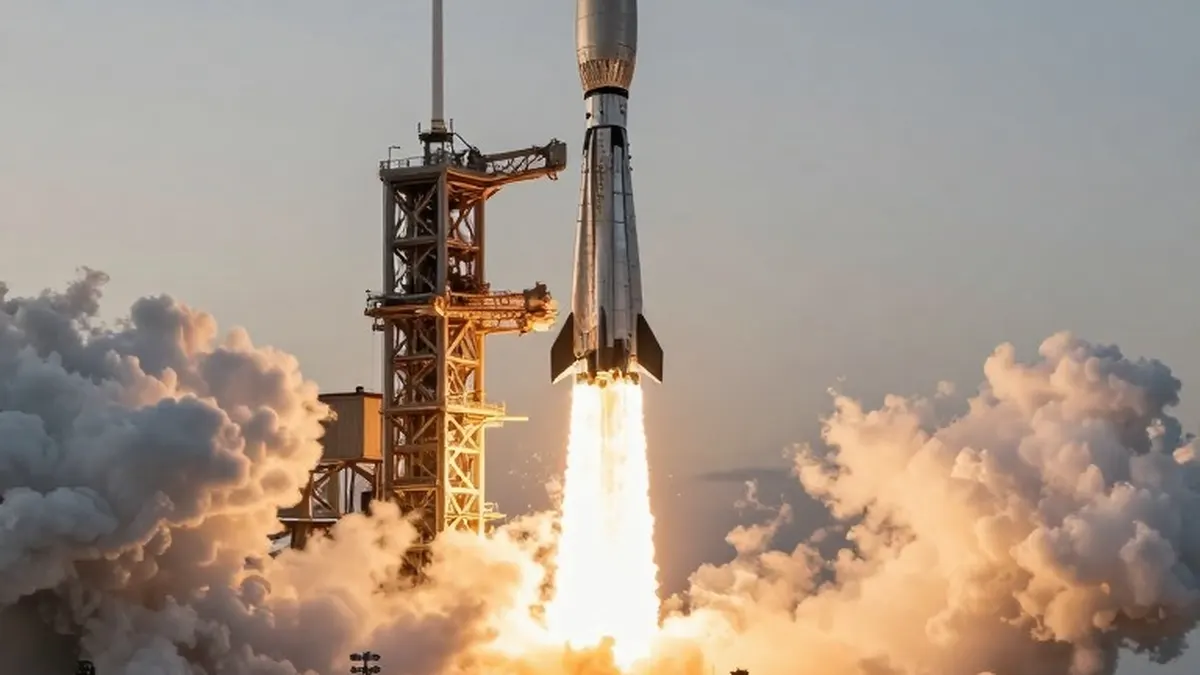
SpaceX launched its massive Starship rocket on Friday for the program's 15th test flight, a planned 22-hour mission designed to demonstrate full reusability of an orbit-class rocket through launch pad catches of both the booster and the Starship upper stage.
The Super Heavy booster sent the Starship toward orbit as planned, but a technical problem prevented its return to the launch pad for capture. Instead, the booster splashed down off the Texas Gulf Coast and burst into flames as residual propellants ignited, a disappointment for SpaceX workers who had hoped the flight would mark the first demonstration of full reusability in an orbit-class rocket.
SpaceX had previously caught a Super Heavy booster on three test flights, using giant mechanical arms on the launch gantry to snag the descending rockets as they came down tail first on the power of three of their 33 Raptor engines. The flight plan includes a splashdown option whenever an issue arises that would prevent a safe capture.
Loaded with 8 million pounds of supercold liquid oxygen and methane fuel, the 236-foot-tall first stage roared to life and lifted away from SpaceX's Starbase launch site on the Texas Gulf Coast at 5:47 p.m. EST. Arcing to the southeast, the booster pushed the rocket out of the thick lower atmosphere before separating about two minutes and 20 seconds after liftoff.
While the 171-foot-tall Starship continued climbing to space on six Raptors of its own, the booster flipped around and fired engines to reverse course. A little more than six minutes after liftoff, flight controllers ordered a diversion to a Gulf splashdown because of a technical problem, and long-range cameras showed the booster descending through steam before erupting in a fireball on the water.
The Starship, meanwhile, followed a sub-orbital trajectory that guaranteed a safe ocean splashdown in case of trouble while giving controllers time to assess its health. With no issues found, a single Raptor re-ignited after an 18-minute coast for a short 10-second burn to push the craft into its planned orbit. Eight and a half minutes later, the first of 26 upgraded version 3 Starlink internet satellites was expected to be released to fly on its own.
For the remainder of the flight, controllers planned to monitor the spacecraft closely and periodically evaluate whether it could be safely de-orbited. "During this prolonged coast phase, flight control teams have several options to end the mission early and return Starship to pre-cleared areas of the Pacific Ocean if needed," SpaceX said on its web page, noting splashdown options around Hawaii and several hundred kilometers off the coast of Chile.
The company still plans to attempt its first-ever launch pad catch of a Starship upper stage on Saturday at the conclusion of the mission. An hour after a final return check, a single Raptor is expected to fire at 3:21 p.m. to drop the far side of the orbit deep into the atmosphere for a 56-minute belly-first re-entry back to the Texas coast, weaving around major cities in the Rio Grande Valley before flipping upright and descending between the gantry's mechanical arms.
If problems develop during the descent, controllers can deliberately tumble the Starship so it breaks up in the atmosphere before reaching land, or divert it into the Gulf. SpaceX calls a fully reusable rocket "the holy grail of rocketry," one that would allow a vehicle to fly again rapidly with an airplane-like cadence.
NASA is counting on a variant of Starship to carry Artemis astronauts to the lunar surface in 2028. The rocket's development has taken longer than initially expected, however, and the space agency is now hedging its bets, saying it is open to using Blue Origin's Blue Moon Mark 2 lander depending on which spacecraft is ready first.