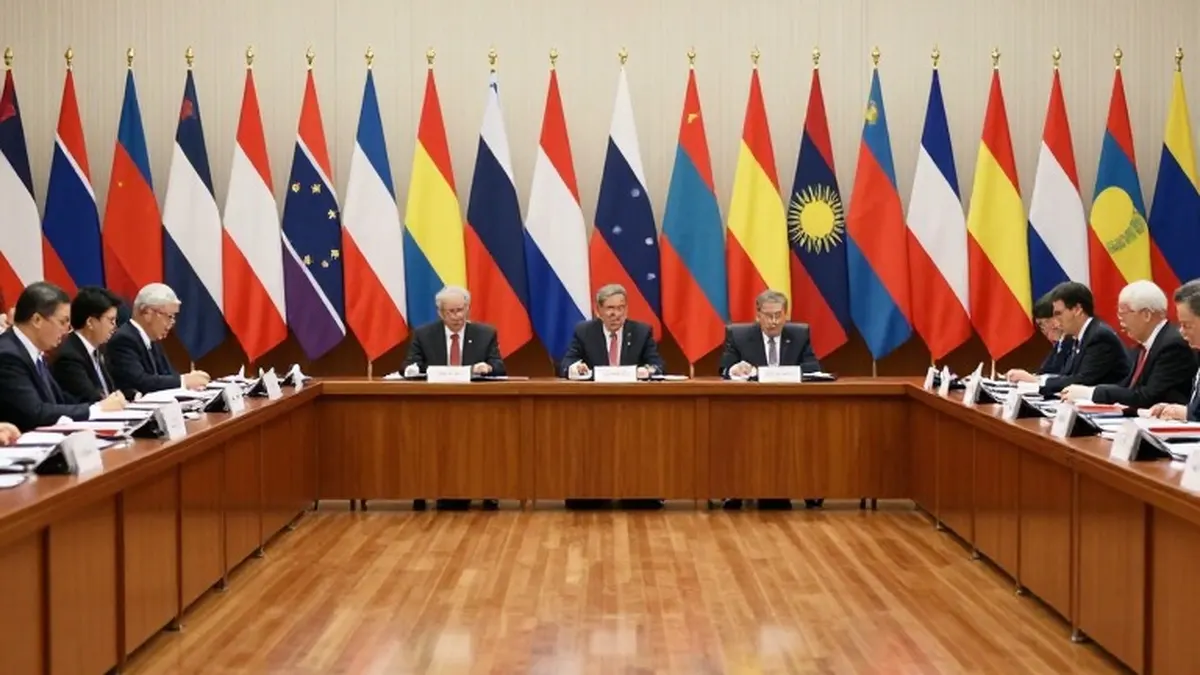
Southeast Asian leaders reached a consensus on Sunday regarding a new framework for dealing with Myanmar. The group agreed to engage the country's government in a step-by-step manner. Under this new arrangement, Myanmar's return to high-level diplomatic gatherings will depend on its ability to make meaningful advances in a regional peace initiative. This decision marks a significant shift in how the Association of Southeast Asian Nations interacts with the Southeast Asian nation.
Myanmar has remained a member of the bloc despite the political upheaval. Since October 2021, the country's political leaders have been excluded from summits and meetings of foreign ministers. This exclusion followed a military coup in which the armed forces seized power and overthrew the elected administration led by Aung San Suu Kyi. The seizure of power triggered a civil war that persists to this day, pitting the military against pro-democracy forces and various ethnic armed groups.
In a joint statement issued from Manila, the leaders called for a calibrated engagement with Myanmar. They described the approach as phased and based on progress, noting that it would take into account developments on the ground. The leaders stated that ASEAN could gradually restore Myanmar's full political representation if the country demonstrates sustained and concrete progress on the bloc's five-point peace plan. Critics have noted that the plan has produced limited results since its inception in 2021, as fighting continues across the region.
Philippine President Ferdinand Marcos Jr. addressed the leaders during their retreat in Manila. He questioned what more the bloc could do for Myanmar and urged members to find practical ways to move the peace plan forward. He emphasized the need to support an inclusive process that is led by Myanmar itself. Thailand has been a strong advocate for closer engagement since coup leader Min Aung Hlaing assumed the role of civilian president earlier this year. This transition followed elections that international monitors described as a sham.
The Manila summit agenda included several other major topics beyond the Myanmar issue. Leaders discussed trade dynamics, regional security concerns, and strategies for sharing fuel supplies. These discussions were prompted by disruptions caused by the ongoing war in Iran. During the summit, Australia and the Philippines signed a new defense agreement. Additionally, Canada and the Philippines announced on Saturday that they had concluded free trade negotiations, marking a significant step in their economic relationship.
Negotiations regarding a proposed code of conduct for the South China Sea remain a key but unresolved item. Philippine Foreign Secretary Theresa Lazaro stated that talks between ASEAN and China were eighty percent complete. However, diplomats told the Associated Press that a final deal was unlikely to be reached during the Manila meeting. Chinese Premier Li Qiang is representing Beijing at the summit as the top official from the country.
US President Donald Trump is expected to arrive in Manila on Tuesday. His visit is scheduled toward the end of the summit, where he will meet with the leaders of India, Japan, and Australia. These three nations, along with the United States, make up the Quad security partnership. This meeting is anticipated to precede his talks with Chinese President Xi Jinping and Russian President Vladimir Putin in Shenzhen on Thursday. The sequence of meetings highlights the complex diplomatic landscape in the region.
Local activists are planning to march against Trump's visit on Tuesday. The protest is aimed in part at a US-backed industrial project located north of Manila. Activists argue that the project could displace Indigenous families from their homes. As the summit concludes, the Philippines will hand over the rotating ASEAN chair to Singapore next year. Thailand is scheduled to take over the chairmanship in 2028, continuing the regular cycle of leadership within the association.