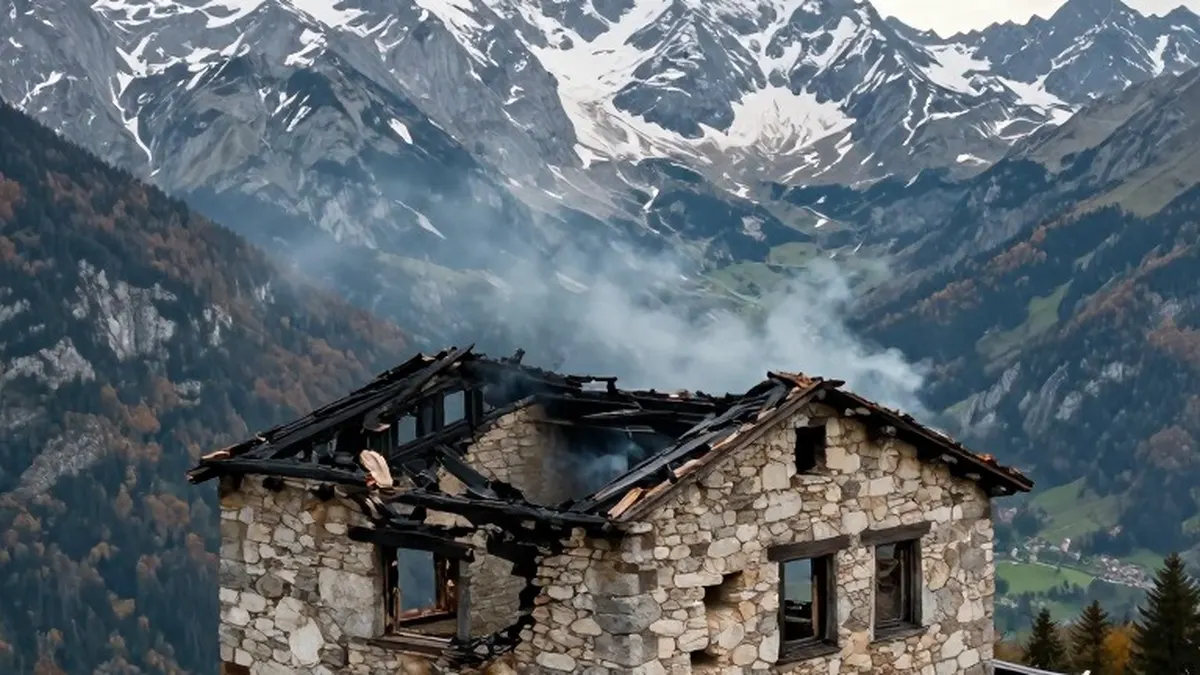
High on a ridge in the German Alps, the blackened ruins of the mountain retreat known as the Eagle's Nest have become the focus of a heated national argument about how Germany should handle the physical remnants of its Nazi past.
Built by the Nazis in 1938 and known in German as the Kehlsteinhaus, the building was used by Adolf Hitler and other senior figures of the regime, and was classed as a historical monument after World War Two. Owned by the state of Bavaria, it operated for many years as a restaurant. Tourists arrived by bus and then rode the original brass and mirror-panelled lift up through the mountain, taking in views over Berchtesgaden from 1,834m (6,017ft) above sea level, and tens of thousands visited each season, providing an important source of income for the region.
On the evening of 23 October, the building was gutted by fire in what police suspect was an arson attack. Authorities have not discussed a possible motive, but a 33-year-old man with a history of mental illness has been detained in a secure psychiatric hospital. Police say the Eagle's Nest itself was largely destroyed, although the nearby Obersalzberg Documentation Centre, a museum opened in the 1990s to confront the crimes of the Nazi era, escaped unharmed. A photo exhibition about the building's history had been on display inside the Kehlsteinhaus for around 15 years.
Some historians argue the fire is an opportunity to let the site disappear. "It's been torched now. It's been destroyed. I think they should just clear away the rubble and leave the mountain as it should be in its natural state," said Prof Sir Richard J. Evans, a specialist in Nazi Germany at the University of Cambridge. He pointed to other Nazi sites treated that way, including the Berlin bunker where Hitler killed himself: "The bunker was filled in with concrete and a children's playground put on the top of it on the ground." The Kehlsteinhaus, he said, was "a Nazi vanity project" later romanticised by the name Eagle's Nest.
Bavaria's political leaders disagree. Interior minister Joachim Herrmann and arts minister Markus Blume have both spoken in favour of rebuilding, with Herrmann saying: "We can hardly leave a ruin standing there." Blume has stressed on Bavarian radio that any project "should not and must not cost the taxpayer anything", and Herrmann said a sensible solution would be sought in consultation with historians.
Sven Keller, head of the Obersalzberg Documentation Centre, warns that abandoning the ruins could attract neo-Nazi pilgrims able to hike up undisturbed. "We have quite some experience at Obersalzberg with what happens if we clear those sites. Hitler's Berghof was demolished in the 1950s, and in our experience, this does not remove such sites from the mental maps of people," he told the BBC's Today programme. Hitler's nearby Berghof residence was bombed during the war and demolished in 1952, while the Eagle's Nest survived. Keller also doubts "a one-on-one reconstruction" is achievable.
Isabel Heinemann, professor of contemporary history at Munich's Ludwig-Maximilians-Universität and head of the Leibniz Institute for Contemporary History, said Germany has an "everlasting responsibility to communicate, to deal with our Nazi past". But a full rebuild, she argued, should be "out of the question" because it would restore "highly ideologised or highly ideological architecture". Instead she favours documenting the fire damage and surviving remains, then reconstructing parts in a modern design so the different layers of time remain visible.
The dispute lands at a sensitive moment. With the far-right AfD rising in Germany and the Freedom Party gaining ground in Austria, the debate over Erinnerungskultur, or culture of remembrance, has taken on fresh urgency. Councillors from the AfD and the conservative CDU in a town in Saxony recently moved to ban the small brass "stumbling stones" plaques set into streets to commemorate Nazi victims, and in Austria a police station opened over the summer in the house where Hitler was born in Braunau am Inn, a step the government said would deter neo-Nazi pilgrims but which critics felt fell short of actively confronting the past.
For many in Germany and Austria, the fate of the Eagle's Nest distils a question that has lingered for decades. As one resident of Braunau am Inn put it, the challenge is a delicate balance between how much to remember and how much to forget.