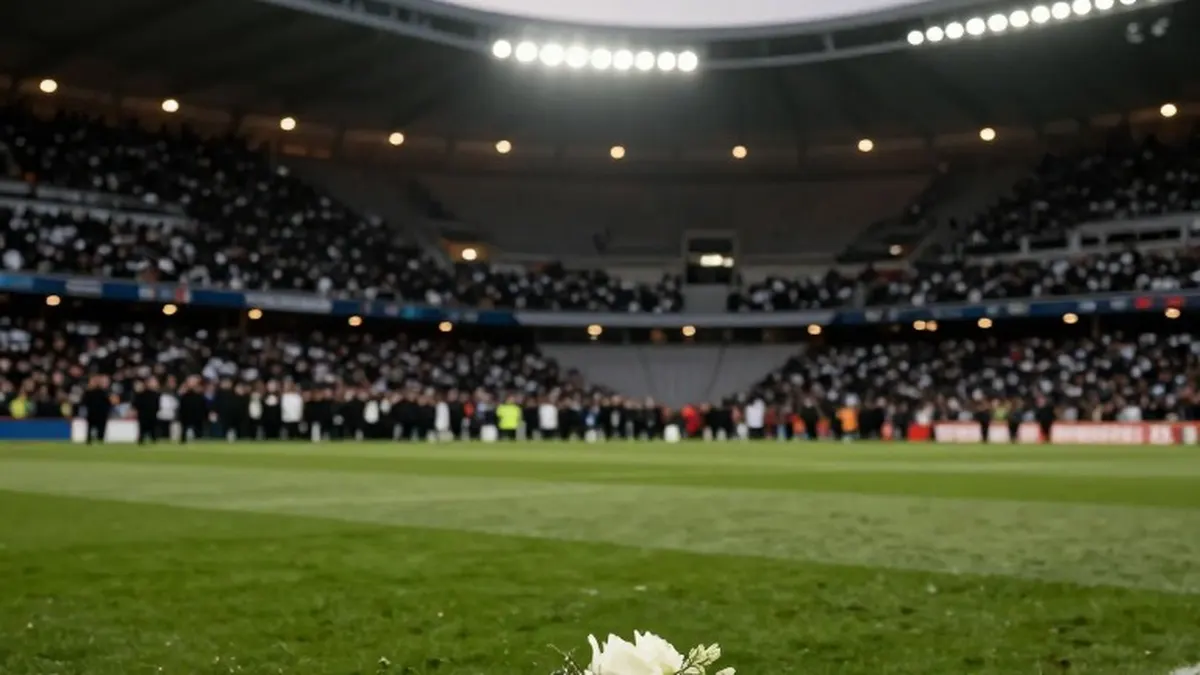
Thousands of supporters filled the Heliodoro Rodriguez Lopez stadium in Santa Cruz, the capital of Tenerife in the Spanish Canary Islands, on Saturday as CD Tenerife held a moving tribute to forward Jesus De Miguel, who died following a collision during a second division match five days earlier.
A bouquet of flowers marked the spot on the pitch where the striker fell in Monday's match. His teammates returned to the stadium dressed in black, beneath a banner reading "Eterno Demi 9", a reference to the nickname of the club's number nine. Supporters who once chanted his name to celebrate goals now called it out in mourning, and silence in the stands gave way to applause before the club's centenary anthem was played.
On a makeshift stage, captain Enric Gallego struggled through his farewell speech, recalling a teammate so reluctant to inconvenience others that he once walked home after his car broke down rather than ask for help. "To speak of you in the past tense is tremendously unfair," Gallego said, pausing to regain his composure. "It's still hard to believe that this has happened to us, Demi, you'll always be one of us. We're still struggling to come to terms with the fact that you won't be with us again."
De Miguel's parents, sister, wife and daughter were met with thundering applause as they mourned publicly alongside the crowd. Addressing the family, Gallego promised that the player's 18-month-old daughter Carla would grow up knowing what her father meant to those around him, and the club has pledged to support her financially until she turns 18. In a sign that the loss crossed rivalries, Ultra Naciente, a supporters' group from UD Las Palmas, placed a wreath on the pitch before the ceremony.
For Jose Diaz Muros, president of Tenerife supporters' group Pena Iberica, the grief felt personal. "When a player becomes part of your team, he also becomes part of your life: the conversations at home, the weekends and the memories you share with your family," he told Al Jazeera. "That is why a loss like this feels so close, even if you did not know him personally."
De Miguel's death was confirmed on Tuesday, hours after he was taken to hospital following a collision with Andorra goalkeeper Jesus Owono. The tragedy has raised questions about how Spanish football authorities responded to players' requests for a grieving period. The players' union AFE said footballers consulted across the categories unanimously favoured postponement because they did not feel emotionally ready to compete, and Las Palmas defender Alex Suarez voiced that distress publicly: "My head is not in football."
Three Segunda fixtures were postponed along with a women's match involving Costa Adeje Tenerife, but there was no blanket suspension. The federation's competition judge ruled AFE's request inadmissible, saying the decision belonged to La Liga, and the top division did not postpone its fixtures. Governing bodies instead organised commemorative shirts, floral offerings, pre-match silence and pauses from the ninth minute, honouring De Miguel's shirt number, presenting the tributes as a way to remember him with dignity and respect.
"There was recognition of the grief, but the collective request was not met in full," Spanish football expert Albert Ortega told Al Jazeera. Ortega believes players' emotional wellbeing still has less power to alter the calendar than institutional statements suggest, though he cautioned against assuming commercial interests alone explained the decision. "We cannot demonstrate that money was the only reason for the decision. We can demand transparency about the criteria and the weight given to their views." Diaz Muros put it more simply: "Minutes of silence are important, but so is giving people space to grieve."
The case has also put medical provision under scrutiny. Santa Cruz de Tenerife chief prosecutor Jose Luis Sanchez-Jauregui told news agency EFE that criminal proceedings over the collision appeared unlikely, citing the distinction between injuries arising during sporting play and deliberate aggression, while an investigation into the collision and emergency response continues. The federation's disciplinary committee has deferred its decision on Owono, with EFE reporting a potential suspension of up to 12 matches. After Colindres goalkeeper Raul Ramirez suffered a fatal injury in the fifth division in September last year at a ground that had a defibrillator but no doctor or ambulance, AFE challenged provisions in the lower tiers, and president David Aganzo has now renewed calls for medical professionals and ambulances across national categories.
Ortega argued that prevention requires more than individual responsibility: "Having a written protocol is the starting point. Its effectiveness is demonstrated when the people who must implement it know their roles and can act in a coordinated way." He proposed independent reviews, regular emergency drills and checks on each stadium's capacity to respond, as well as a bereavement procedure agreed with players and psychological support extending beyond the first week. As the Catholic prayer song Ave Maria played at the Estadio Heliodoro, those gathered stood for a final round of applause beneath a monochrome image of Tenerife's number nine, frozen in celebration, while tears streamed down the faces of teammates and loved ones. For Diaz Muros, the focus must stay on the family: "After the tributes, when the attention disappears, they will still be living with that absence. I would like the support to continue then."