Artificial intelligence is reshaping the use of drones in the war in Ukraine, according to Yaroslav Azhnyuk, a Ukrainian tech entrepreneur who moved into weapons development after Russia's 2022 invasion. He argues that AI makes drones faster and more capable, and that the gap it creates can be enormous. "It can make you 10,000 times more effective," he says.
Azhnyuk runs two Ukraine-based defense firms, The Fourth Law and Odd Systems, which are among the country's leading producers of AI-powered drones. Dozens of Ukrainian military units already use their autonomous drone, the Lupynis-10-TFL-1. Russia is also fielding AI-enabled drones against Ukraine, feeding a high-tech arms race that worries many people, including President Volodymyr Zelenskyy, who has warned that AI could be making decisions on the battlefield as soon as next year.
Azhnyuk, 37, is a computer scientist who spent years in Silicon Valley and founded several companies. One of them, Petcube, sold a million smartphone-connected cameras that use AI to watch pets and toss them treats. He says his current work is a direct outgrowth of that experience: the image recognition used in the drones is a cousin of the technology in the pet cameras, except that now the devices deliver explosives.
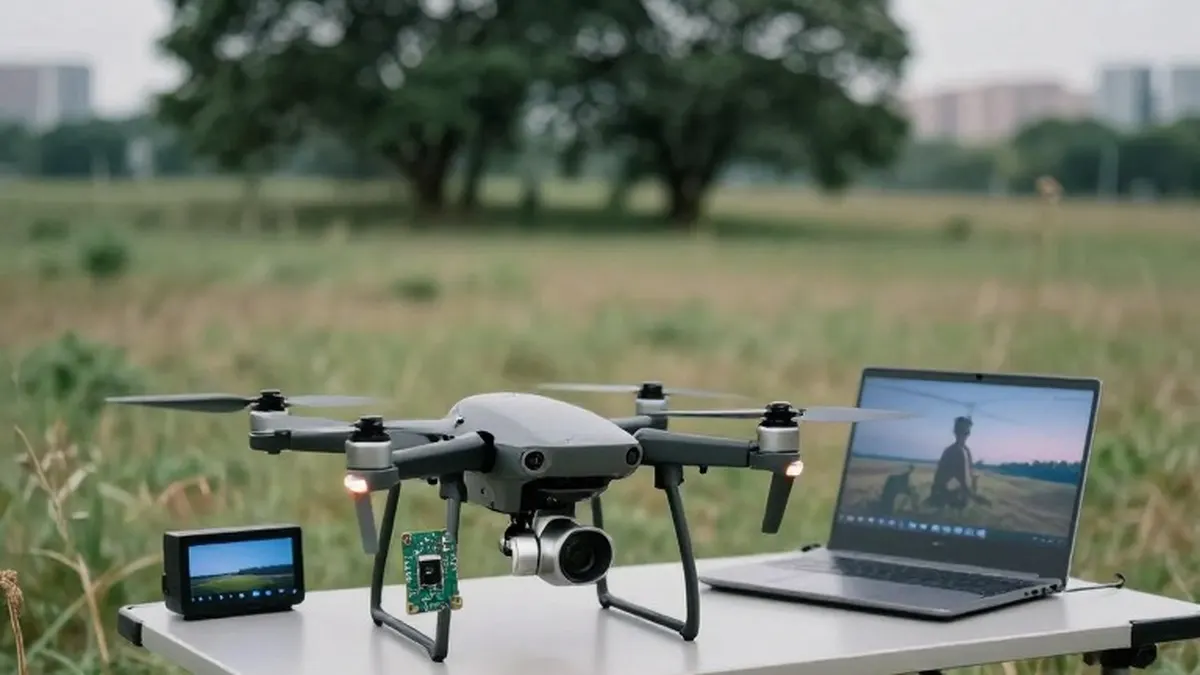
The Lupynis TFL-1 pairs a small, affordable first-person-view drone with an autonomous terminal guidance unit. An onboard computer takes control for the final 500 meters, or about 0.3 miles, of the flight. Azhnyuk stresses that this is far simpler than the AI behind large data centers or self-driving cars. It relies on basic image recognition tools that let a drone navigate, pick a target or fly toward one without a human steering it.
The drone is named for Anatoliy Lupynis, a 20th century Ukrainian poet and political activist who endured decades of Soviet imprisonment and psychiatric torture. The company names all its weapons after Ukrainian intellectuals and artists killed or persecuted by Russians over the past century. "Their ideas are still with us. And now they're fighting back," Azhnyuk says.
The company tests the drones daily. NPR watched one team at an overgrown field outside Kyiv, where the head of the test and integration team, who uses the call sign Stab, explained that a microcomputer inside the drone runs a deep-learning neural network trained on hours of combat footage. It is designed to recognize vehicles, light-armored vehicles, tanks and flying objects.
In the demonstration, a pilot with the call sign Professor guided the drone with a control stick, selected a target and checked a video monitor. A red flash signaled that the drone had locked on, in this case to an old car driven along a dirt road by an employee. Professor released the stick, and the drone flew itself to the car. The test drone carried no explosive. Stab says such drones are hard to jam and that safeguards keep them from going rogue, because humans select the targets.
Azhnyuk rejects the idea that the drones are killer robots, calling them "just sort of calculators." He concedes that AI is advancing quickly and that drones able to designate targets on their own are conceivable within some years. For now, he says, survival drives the choices. If adversaries use AI for offensive decisions and Ukraine refuses to do so in defense, "we've lost," he argues, because machines decide in microseconds while human control can take minutes, hours or days. If Ukraine loses, he says, there is no way to debate the ethics of AI. The most important thing, in his words, is don't die.