Israel's election remained too close to call on Tuesday night after the highest turnout in 50 years, in a vote some described as the most consequential in the country's history. Participation among Israeli Arab voters also reached a record.
Exit polls published in the evening suggested the opposition bloc led by Gadi Eisenkot, a former chief of staff of the Israel Defense Forces, would win slightly more Knesset seats than Benjamin Netanyahu's right and far-right coalition. Netanyahu's Likud was still projected to be the largest single party.
The outcome is likely to trigger weeks of bargaining over who can assemble a coalition, before either a prime minister is named or another round of elections is called. Neither Likud nor Eisenkot's Yashar party appeared to have an easy route to a majority in the 120-seat Knesset. The polls pointed to Netanyahu's continued hold on a large core of Likud voters, even though many Israelis have rejected him.
Israeli Arab parties were projected to win up to 18 seats, which could make them kingmakers in what looks set to be protracted coalition talks. Netanyahu appeared likely to fall short of the support needed to form a new government.
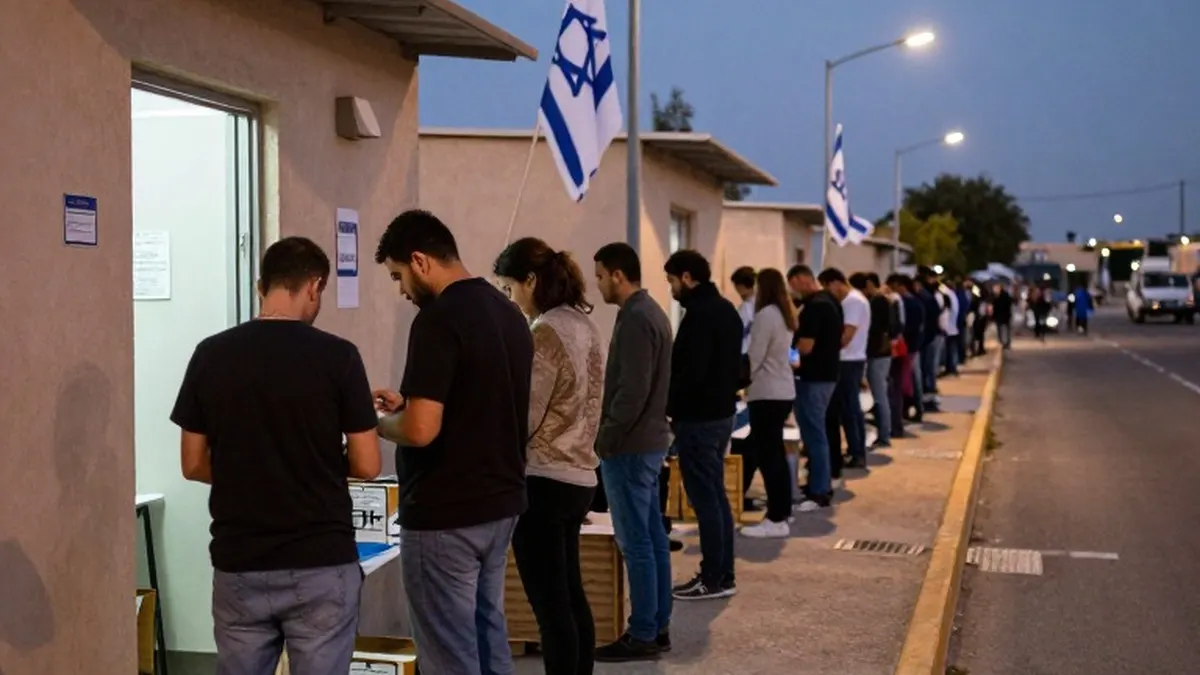
Turnout was 74.3% by 6pm among more than 7 million eligible voters, about 9% higher than at the previous election. More serving military members voted, and there were reports of tens of thousands of Israelis living abroad flying in to cast ballots, some still arriving at Ben Gurion airport on Tuesday. Queues were long in major cities such as Tel Aviv and Haifa, and the same was seen in Israeli Arab towns, many of which have a long history of boycotting elections.
The day was marked by sharp rhetoric. Netanyahu, who is on trial for corruption, suggested in a recorded message that the left and Arabs were trying to steal the election, and Likud claimed suspected irregularities at hundreds of polling stations used by Israeli Arabs. Netanyahu and several other parties also sought to keep polling stations open past the 10pm deadline. The Central Elections Committee rejected the request and said it had seen no evidence of systematic tampering. Critics condemned the messaging as a scare campaign, noting that Netanyahu made a similar claim in 2015. Israeli citizens of Palestinian origin make up about 20% of the population.
Eisenkot said Netanyahu was laying the ground to challenge the result. "Netanyahu has returned to his familiar tricks, lies and fearmongering to mobilise voters," he said. Netanyahu had also posted an image of a nuclear explosion over Tel Aviv on the eve of the vote and told ultra-Orthodox voters that "the Jewish state is on the brink of ruin."
The election was framed as a referendum on nearly 17 years of unbroken rule by Netanyahu, whose recent years have featured conflict, instability and growing international isolation. Since the Hamas attack of 7 October 2023, Israel has devastated Gaza, where more than 74,000 Palestinians have been killed, fought Hezbollah in Lebanon, occupied new territory in Syria and launched a war with the US against Iran. Israel has also drawn international criticism over the occupied West Bank, where violent settlers have been accused of attacks on Palestinians.
Mansour Abbas, head of the Islamist Ra'am party, said while voting that "our vote will change the government." Far-right national security minister Itamar Ben-Gvir said that if Netanyahu and his allies lose, "it will be Mansour Abbas's government." Netanyahu called it "a very moving and fateful moment" after casting his ballot. The left-leaning Haaretz had urged Israelis to vote, writing that the country "cannot afford another four years under Netanyahu."