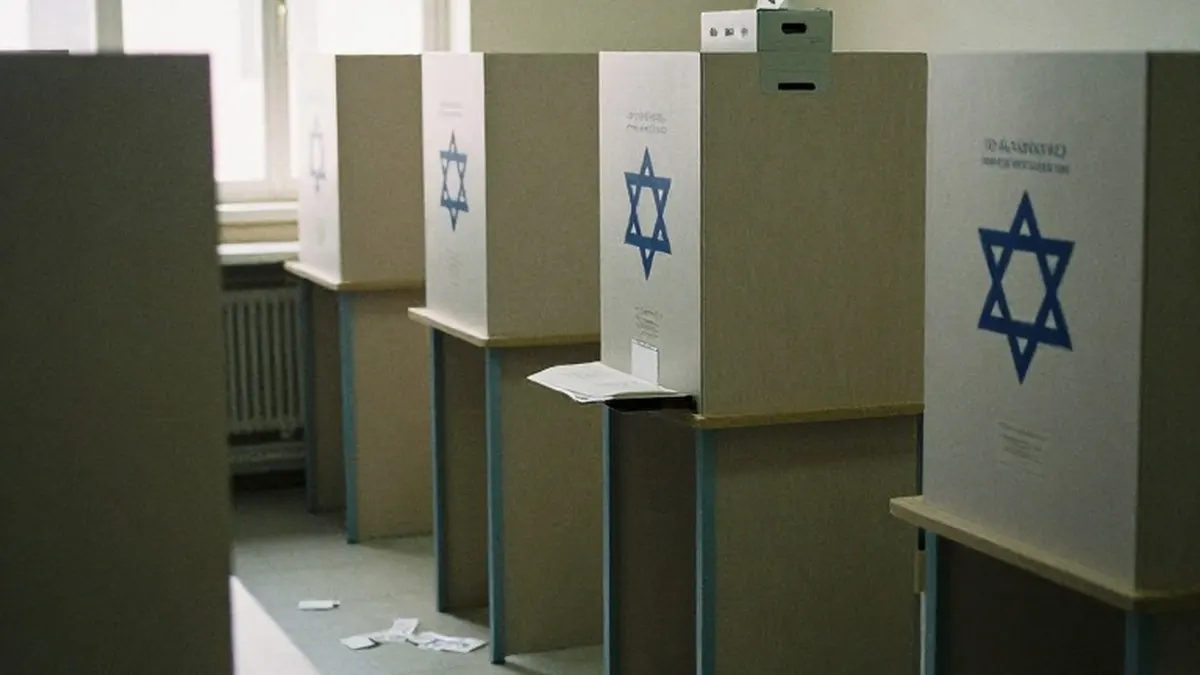
Israelis voted in large numbers on Tuesday, but the message they sent was muddled enough that both major blocs, and several parties within them, found grounds to declare victory.
The trick, in most cases, was to change the yardstick. Each leader claimed a win among the segment of the public that, by their own political logic, counts. With neither bloc commanding a clear majority in parliament, each could point to a constituency in which the result looked favorable.
For Prime Minister Benjamin Netanyahu, that constituency was those who back Israel as a Jewish state. In his election-night speech he said Likud is the biggest party in Israel and that the right-wing bloc has "a clear, decisive majority among the Zionist public, among the Jewish public and all those who support the Jewish state." That framing takes in his haredi and far-right partners, including Shas and United Torah Judaism, along with the Jewish parties of the change bloc. Arab parties fall outside it. The haredi parties resist conscription but support Israel's Jewish character, so their votes count toward the majority he claimed.
Naftali Bennett measured the outcome differently. "The alliance of those who serve defeated the alliance of draft evaders," he declared, and he pledged a "Zionist government of the alliance of those who serve." Where Netanyahu stressed support for the Jewish state, Bennett stressed sharing the burden of defending it. The haredi parties fit comfortably in Netanyahu's definition yet land on the losing side of Bennett's.
Gadi Eisenkot offered a closely related reading. He said Netanyahu faced a larger and stronger Zionist majority and promised to form a Zionist government committed to conscription. Like Bennett, he cast the result as a win for the public demanding that military service be shared more equally.
Avigdor Liberman's speech fit the pattern less neatly. He made no comparable claim of victory among a particular public. Instead he appealed to a tradition he argued Netanyahu had betrayed, urging "those loyal to the path of Trumpeldor, Jabotinsky and Herzl" to "raise the banner of revolt within Likud." His message sought to separate Likud voters' Zionist loyalties from their loyalty to the prime minister.
Yair Golan took the broadest view of the electorate. On election night he invoked "the Israeli, democratic majority," and by Wednesday morning he had spelled out the arithmetic, counting the Arab parties alongside the Jewish opposition parties. He argued that Arab votes carry the same weight as Jewish votes, so if the parties opposing the outgoing coalition together hold a majority, that is the majority by which the result should be judged.
That stands in the sharpest contrast to Netanyahu, who left Arab parties out of his calculation while Golan included them and reached the opposite conclusion. Golan also pushed back on the framing of his prospective partners: where Bennett and Eisenkot emphasized service and Zionism, he emphasized equal citizenship, saying Arab voters need not pass any extra test for their votes to count.
Israelis cast ballots in the same election, yet their leaders emerged claiming victory among different electorates. The open question now is how, and whether, those competing definitions of victory can be turned into a working government.