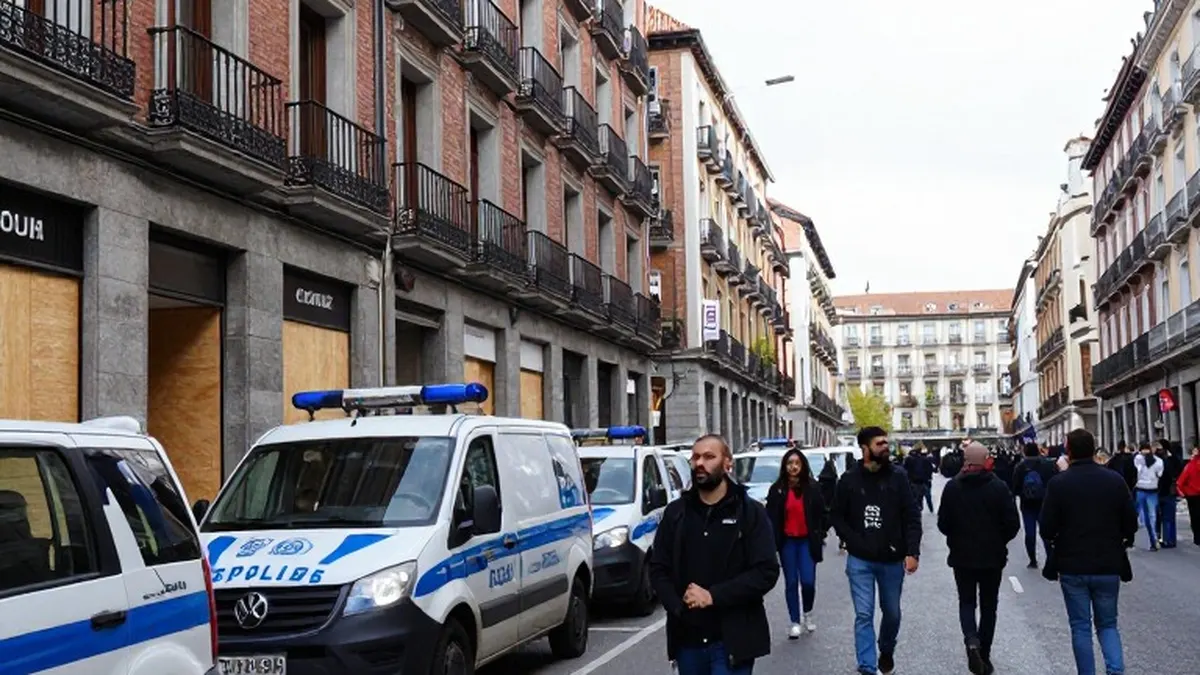
Business owners in central Madrid have taken visible precautions amid a nationwide strike, with many shop windows boarded up in anticipation of unrest. This defensive posture follows riots that erupted in Paris last month. Police are deployed in heavy numbers, lining up in front of major department stores and using vans to protect entrances at others. The current event marks the first national general strike in Spain in fourteen years, driven primarily by a severe shortage of affordable housing.
Protesters have gathered on the city's central Gran Via, expressing deep anger and frustration over living conditions. The strike was catalyzed in September by the eviction of Maria del Carmen Abascal, an 87-year-old woman known as Maricarmen. She was forced from her home after seventy years of residence because she could not afford a fivefold increase in her monthly rent, which had risen to 500 euros, or approximately 555 US dollars. Her case highlighted a broader crisis in the availability of affordable housing, particularly within the country's major urban centers.
Antonio, a teacher participating in the demonstrations, describes housing as a fundamental problem that consumes the majority of a working person's wages. He argues that the strike is a fight for a combination of lower housing costs and higher wages. The country's youth council has provided stark data, stating that a young person would need to spend 98.7 percent of their monthly salary to rent a place on their own.
Arturo, a man in his mid-30s, shares that he cannot afford a place of his own due to the high costs. He is currently living with his parents. He notes that after accounting for food and basic living expenses, he is left with almost nothing, perhaps only 100 euros, or 110 US dollars. He describes this financial reality as unsustainable in the long run.
Teachers in Madrid have been on strike since the start of the school term. Antonio, who teaches at one of the city's schools, says he is deeply concerned about the social rights of his students, their families, and his neighbors. He believes all citizens need a social consciousness, arguing that if things are not going well for everyone, they cannot go well for any of us. He emphasizes that it is essential for everyone to stand up and fight for the rights of all.
The Bank of Spain reports that 750,000 new homes are needed to meet current demand, a figure that could rise to one million. In contrast, only 92,000 homes were built in 2025. This significant gap between supply and demand is a central factor in the ongoing economic pressure on residents.
The housing crisis poses a potential political threat to Prime Minister Pedro Sanchez. He called a snap general election scheduled for November 29 after his minority government failed to pass legislation in parliament that would have provided some protections to tenants.
Polls indicate that Sanchez's Socialist Party is currently trailing behind the combined support for right-wing and far-right parties. The outcome of the November 29 election may determine the future direction of housing policy in Spain.
The strike continues to draw attention to the intersection of wage stagnation and rising housing costs, with protesters demanding systemic changes to make urban living viable for the average worker.