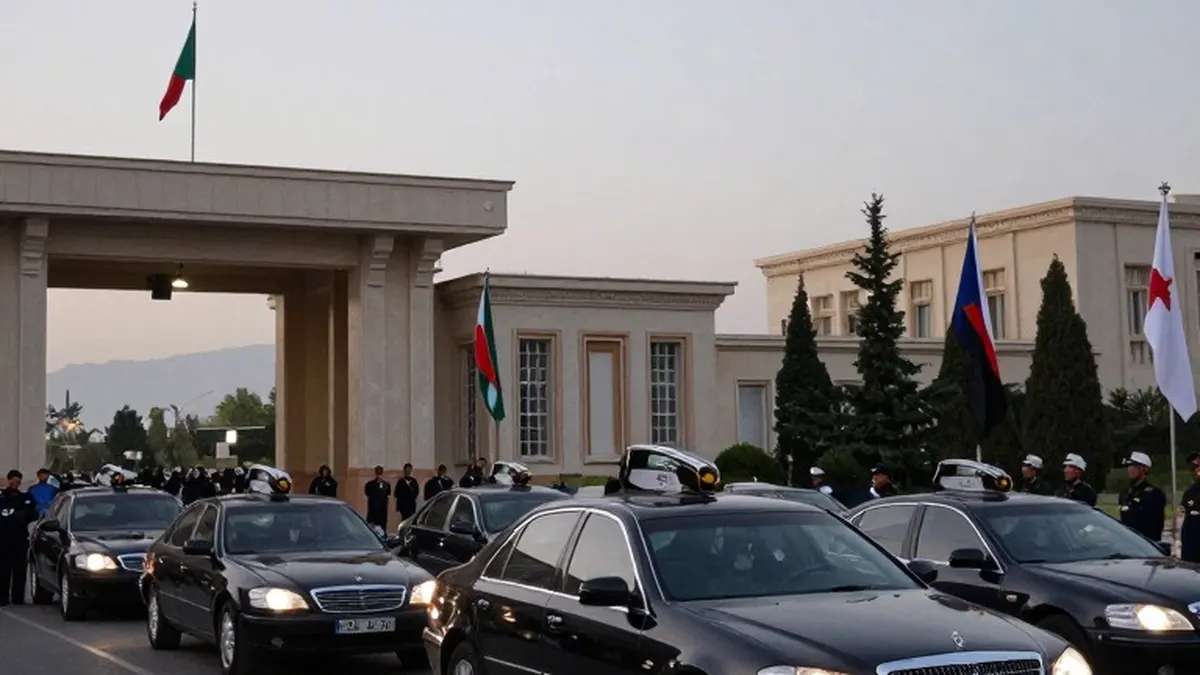
Saudi Defense Minister Khalid bin Salman arrived in Tehran on October 26 for talks between Iran and the countries that belong to the Mecca Joint Defense Agreement, which also includes Turkey and Pakistan. The visit is being treated as an early test of how the new alliance will function in practice.
Pakistan's army chief, Field Marshal Asim Munir, and Turkish intelligence head Ibrahim Kalin are also traveling to Iran. Both are considered heavyweight figures in the region, and Munir has visited Iran recently. Saudi Arabia's deputy minister for public diplomacy, Rayed Krimly, said the delegation will meet Iranian President Masoud Pezeshkian and Mohsen Rezaei, secretary-general of the Supreme National Security Council. Arab News, citing Krimly, reported that Riyadh sees the trip as part of continuing efforts by the pact's members to ease tensions and encourage dialogue.
Iranian Foreign Ministry spokesperson Esmaeil Baghaei said on October 26 that hosting senior military and security officials from the three countries is a key step toward regional diplomacy. He said it could contribute to lasting stability and security in the Middle East, and argued that such stability can only be reached if regional states work together. The message suggests Iran wants the region to resolve its own problems without further US bombing. It is unclear whether Washington and Israel will agree, since both have said publicly that the war with Iran will continue.
The pact was signed in Mecca on August 7, 2026, by Saudi Crown Prince Mohammed bin Salman, Turkish President Recep Tayyip Erdogan and Pakistani Prime Minister Shehbaz Sharif. It contains a collective defense clause under which an armed attack on one member counts as an attack on all three. It also provides for expanded military cooperation, joint exercises, intelligence sharing, defense technology development and cooperation between defense industries. A Strategic Political and Defense Committee is meant to coordinate the work. Turkey published the full text in October as it moved toward parliamentary ratification.
The alliance links three significant military powers, including nuclear-armed Pakistan and Turkey, a NATO member. That could carry weight for the regional balance of power. Still, questions remain about how the agreement would operate. Houthi attacks on Saudi Arabia raised doubts over whether Turkey and Pakistan would come to Riyadh's aid, and skeptics have argued the three states are not giving the pact real teeth.
The Tehran talks may show that the agreement is more about shared interests, diplomacy and consensus-building than about joint battlefield operations. The analysis in the source notes that comparisons to NATO may be misplaced, since NATO has seen few wars in the 77 years since its founding in 1949 and is mainly a grouping of Western democracies whose militaries train and operate together. It describes Saudi Arabia as cautious and conservative, Turkey as more cautious since a more militarily active period from 2016 to 2022, and Pakistan as more cautious than in past decades despite recent clashes with India and Afghanistan.
The visit also comes against a tense backdrop. President Donald Trump has twice endorsed Israel's prime minister to remain in power so the fight against Iran can continue, which has surprised many Israelis who see the US-Israel relationship as broader than one person. Reports also say Jerusalem has ordered the toppling of the Iranian regime, and that the Israeli military was reluctant to carry out strikes right before Israel's elections. The presence of the high-level delegation in Tehran appears to imply that the visiting states believe war can be put off for a few more days.