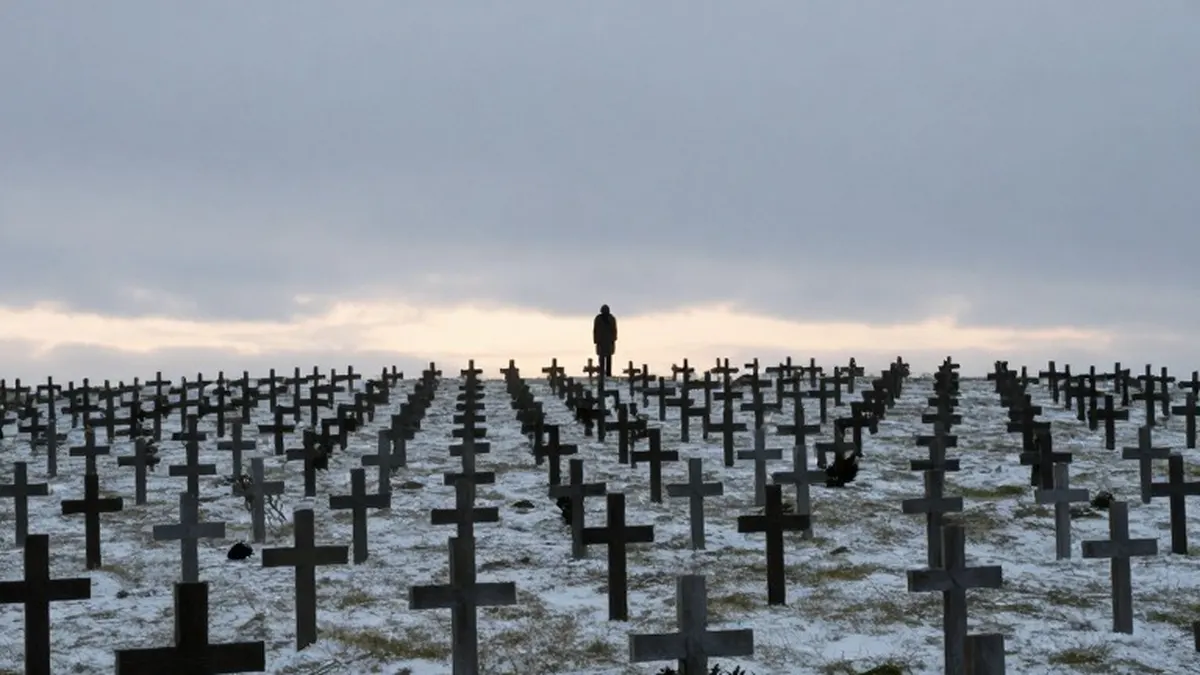
More than 400,000 Russians have been killed in the war in Ukraine since Moscow began its full-scale invasion nearly five years ago, according to leaked data from Rosstat, the state statistics agency.
The information was obtained by Cyber Partisans, a hacker group linked to the Belarusian opposition, and Silent Crow, a Ukrainian hacking collective. It contains more than 11 million death certificates with details including the age, place of residence and location of death of the deceased, and was shared with the Guardian and a small number of other media outlets.
Of the records, 412,576 death certificates explicitly connected the fatalities to the war, either through official cause-of-death codes or written mentions of combat and military operations. The hacking groups announced the breach on 1 November and published the data over the weekend. Rosstat confirmed it had been hacked but denied that sensitive information was obtained.
Moscow has not released a death toll since the early months of the invasion, and military casualty information is treated as a state secret. The Guardian could not independently verify the entire dataset, but the figures are broadly in line with other estimates. British intelligence assessed in September that about 500,000 Russian soldiers had been killed, while the independent Russian outlet Mediazona has identified by name nearly 286,000 dead military personnel and believes the real figure is nearer half a million.
"The data looks authentic, and it's very rich," said Janis Kluge, head of the Russia and Eurasia division at the German Institute for International and Security Affairs. "This is the biggest leak of data when it comes to Russian casualties."
The dataset is likely to understate the true toll because some soldiers remain missing or have never been identified. Kluge also noted a delay of typically about six months between deaths and their entry into official records. "We are probably at this time closer to 500,000 killed Russian soldiers than 400,000," he said.
The figures expose how unevenly the war's burden falls across Russia. In Buryatia, Tuva and Zabaykalsky Krai, three eastern regions, war-related deaths accounted for about a third of all deaths among men aged 18 to 49 between the start of the invasion and mid-2024. In Moscow and St Petersburg, the comparable figure was about 10 percent.
Battlefield deaths also rose sharply as the war continued, with some of the deadliest months in late 2024 and 2025, when monthly tolls exceeded 15,000, or roughly 500 deaths a day. "That's 500 a day, above 500 a day. Certainly shocking," Kluge said. Russian military deaths in Ukraine are estimated to have surpassed by more than eight times the combined toll of all Soviet and Russian wars since the end of the second world war, and to exceed the number of US military personnel who died in that conflict.
Rather than pushing Moscow toward a settlement, the scale of the losses is likely to harden Vladimir Putin's resolve, according to a person familiar with the Russian president's thinking. "Putin understands these numbers, and for him to now settle for anything less than everything he wants would feel like a betrayal of himself and the people," the person said.
Senior Russian and Ukrainian negotiators are due to meet in Abu Dhabi on Tuesday for the first US-brokered peace talks in nine months, with Donald Trump's envoys Steve Witkoff and Jared Kushner expected to take part. Neither Putin nor Volodymyr Zelenskyy will attend. Witkoff said on X that the talks would focus on "post-war security arrangement, de-escalation" and humanitarian issues, while European governments worry the agenda could broaden to include Moscow's demands for a reduced Nato presence near Russia's borders. France's foreign minister said Paris would participate, a claim the Kremlin denied.