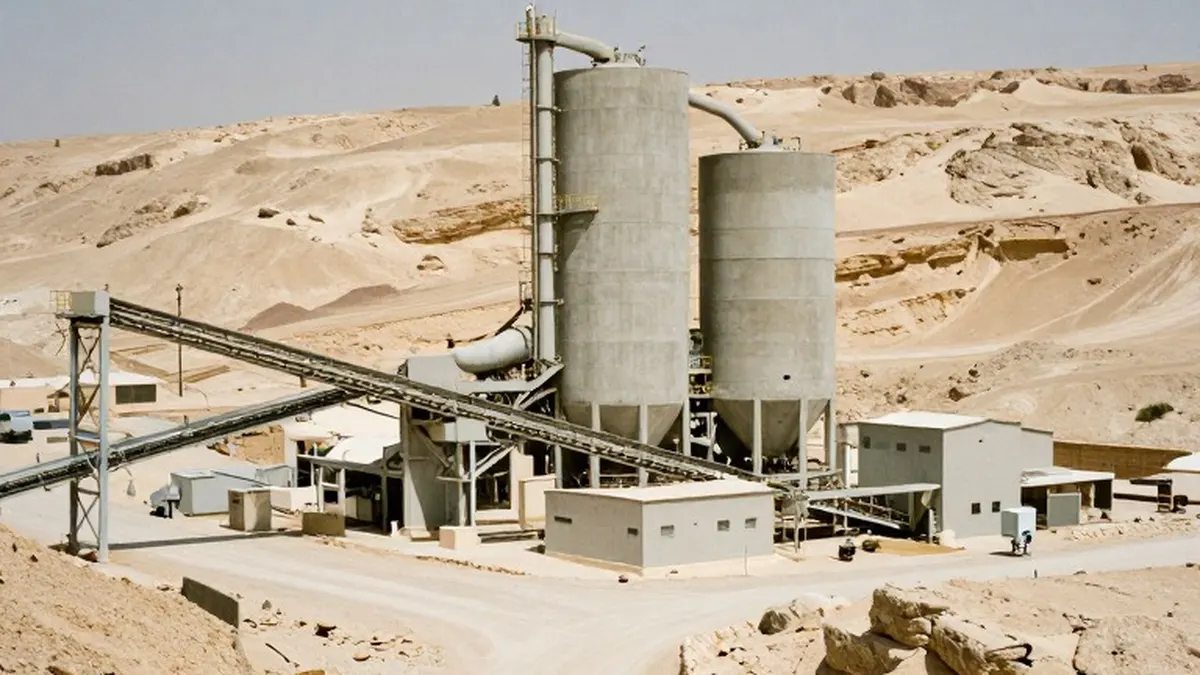
The inauguration of the first Palestinian cement factory in Area A of the West Bank could pave the way for major industrial growth, but it may also carry security implications for Israel, a security expert warned The Jerusalem Post on Tuesday.
Palestinian Authority President Mahmoud Abbas inaugurated the Jericho facility on Monday. It was established through a partnership between the Palestinian Investment Fund and the Issa Khoury Group for Mining and Construction Industries.
The 1994 Paris Economic Protocol placed strict quotas on cement imports from neighboring Arab countries, including Jordan and Egypt, capping them at 400,000 metric tons. Cement was classified under the agreement as a List A1 commodity, leaving Palestinian buyers largely reliant on private Israeli companies for their supplies.
The Jericho Cement Industry Company, a joint venture between the Palestinian Sanad Company and the Jordanian Unifive Company, says it has a production capacity of 1.3 million tons annually and will employ 100 workers to start. The project has been presented as an opportunity to create jobs, reduce reliance on imports and strengthen the Palestinian construction industry.
Lt.-Col. (res.) Maurice Hirsch, director of the Initiative for Palestinian Authority Accountability and Reform at the Jerusalem Center for Public Affairs and a senior legal analyst at Human Rights Voices, warned that unchecked and unmonitored cement production could pose a significant security risk. The main concern is that the cement could be used to build underground infrastructure similar to the extensive tunnel network constructed by Hamas in Gaza, which posed significant challenges for the Israeli military during the recent wars by enabling the movement and concealment of hostages, terrorists and weapons. Such tunnels can be difficult to locate, particularly when relying on aerial intelligence.
The factory's location in Area A also raises questions about the extent of Israeli oversight. Prof. Arie Reich of Bar-Ilan University's Faculty of Law said that under the Oslo II Accord, civil jurisdiction over the area falls to the Palestinian Authority, which issued the factory's permits. "Israel has no say here as long as the cement does not pose a security risk," he said.
Reich noted that the situation would be different if the cement were destined for Gaza, where it is classified as a dual-use material and only limited quantities are permitted, or if there were evidence it could be used for terrorism. He cited Oslo II Annex I, Article II, which requires both sides to cooperate against terrorism and violence and to take preventive measures. If Israel had credible evidence linking particular Jericho cement shipments to an attack tunnel, he said, it could demand a Palestinian investigation, identification of buyers and end users, and action to stop further diversion. "In the absence of such, Israel is likely to take unilateral measures to prevent the security risk," he said.
Despite that obligation to engage, a spokesperson for the Joint Economic Committee, the bilateral body established under the Paris protocol to govern economic relations between Israel and the Palestinian Authority, confirmed that there had been no coordination on the project.
Hirsch argued that the Palestinian Authority has regularly failed to meet its obligations in past agreements with Israel, referencing an article he published in July on its build-up of military forces and the threat it would pose should it carry out an October 7-style attack. "We have a limited amount of intelligence coverage and almost no supervisory jurisdiction. Palestinians can essentially do whatever they want," he said.
"I do believe that the PA poses a constant threat to Israel," Hirsch continued, adding that anything that improves its capabilities is a source of concern, including questions over who stands to benefit from such an industry given corruption in the authority. He described the cement factory as a dual-use industry, calling it "an ostensibly innocent industry that could be very profitable, but can also be used for very nefarious purposes." He also raised concerns about whether the cement might be exported, noting that the large majority of West Bank exports go to Israel and that Israeli purchases would not dissuade the Palestinian Authority from pressing the international community to sanction Israel.