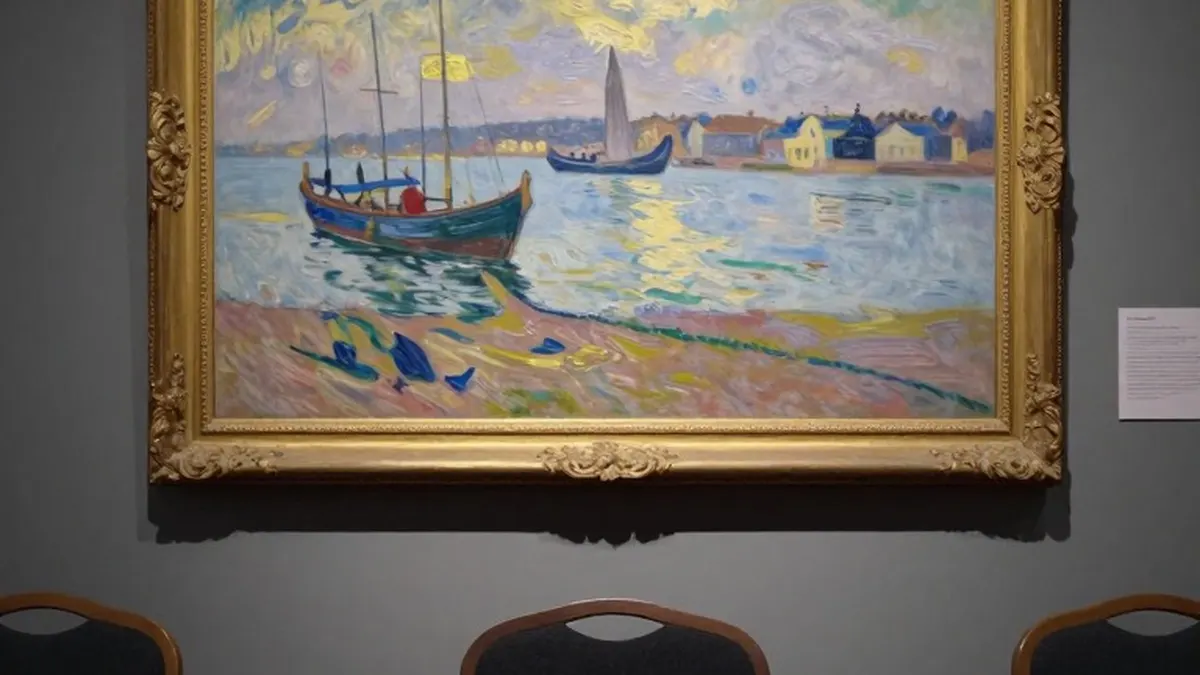
A Paris court has issued a ruling requiring the return of a Camille Pissarro painting to the descendants of Salomon Flavian, a Jewish banker and art collector. According to reports from the French media outlet Le Figaro on Thursday, the decision concludes a long legal battle over the provenance of the work, which was taken by Nazi forces during the Second World War.
The court determined that the Flavian family provided sufficient evidence to prove that the painting, titled The Port of Dieppe, was confiscated from their ancestor in 1941 by Nazi officers. The ruling also highlighted that Salomon Flavian made significant efforts to recover the artwork after the war ended, strengthening the family's claim to restitution.
In its judgment, the court declared that all subsequent sales of the disputed painting since its initial confiscation are null and void. This includes a specific sale that took place in London on June 25, 2024. The order mandates the restitution of the work regardless of where it is currently located or who holds it.
The painting had been largely out of circulation for several years before appearing at a Sotheby's auction in London in 2024. At that time, the work sold for 1.2 million pounds, which is equivalent to 5 million NIS. The court has ordered Sotheby's to disclose the full identity of the 2024 buyer to Flavian's descendants within two months. If the auction house fails to comply by the deadline, it will face a daily fine of 3,550 NIS.
The current owner, who purchased the painting during the 2024 auction, is now required to return the work to the original owner's family. The court statement explained that Sotheby's silence regarding the buyer's identity prevents the heirs from asserting their rights against the subsequent purchaser. This situation was noted as contrary to the primary objective of the April 21, 1945, ordinance concerning the restitution of looted property.
Controversy has emerged regarding the conduct of the legal action. The Art Newspaper reported that the case was not pursued with the consent or involvement of all relevant family members. Instead, the legal proceedings were led by Gilles and Nicholas Flavian, while other family members stated they had not been contacted.
Despite the court's decision, James Palmer, a consultant for Mondex Corporation, indicated that an appeal will be filed immediately. Palmer countered the Flavian family's claim by pointing to archives from dealer Paul Rosenberg and the 1939 Pissarro catalogue raisonné. He argued that these documents clearly identify British artist and collector Edward Le Bas as the owner of the painting from 1939 into the early 1950s.
Palmer also noted that France currently lacks a formal restitution framework, a situation he believes disadvantages both the state and claimants. He told ARTNews that these crucial facts were not commented upon by the court in its initial decision. Palmer expressed confidence that the Court of Appeal will reach a different conclusion once the complex provenance research evidence is properly considered.
The case highlights ongoing challenges in the restitution of art looted during the Second World War, particularly when current owners and auction houses are involved. The next steps in this legal dispute will hinge on the appeal process and the outcome of the provenance arguments presented by the defense.