Investigators from the National Transportation Safety Board have determined that the tail of a small jet that crashed in South Florida over the weekend likely detached from the aircraft before it struck the ground. During a news conference on Tuesday, NTSB member Tom Chapman stated that the discovery of the tail assembly broken into three distinct pieces provides crucial evidence that the plane was disintegrating prior to impact.
The fragments of the tail elevator were recovered over a wide area, ranging from two to six kilometres away from the crater formed by the crash. Chapman noted that it seems implausible for the parts to have separated solely due to the force of the impact. He explained that the separation likely occurred while the aircraft was still in the air, which significantly alters the trajectory of the investigation.
The loss of the tail meant the plane lost its ability to control pitch, making it difficult to pull out of its nosedive. Chapman acknowledged that even if the tail had remained attached, the extreme speed of the descent might have rendered the elevator ineffective. However, he emphasized that knowing the tail was lost is a vital piece of evidence that points investigators toward other potential factors in the crash.
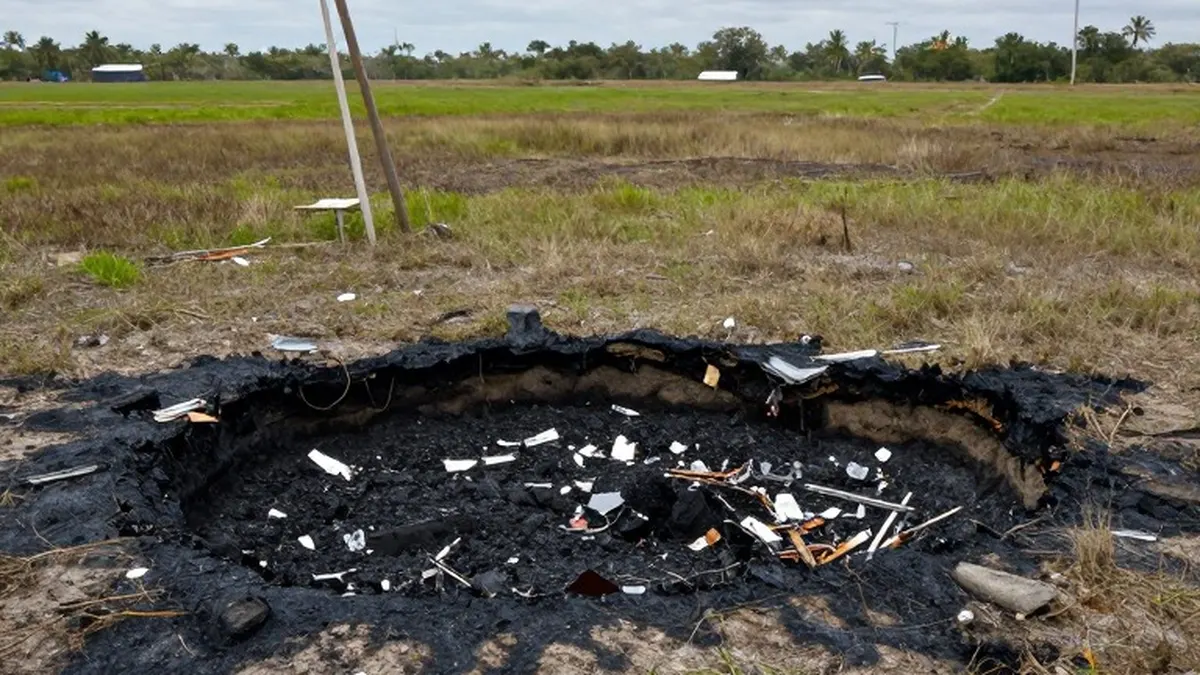
The Learjet 60, which was bound for the Bahamas, encountered bad weather on Sunday. It slammed into the ground approximately eleven kilometres southwest of Palm Beach, creating a crater and bursting into flames. The force of the collision scattered debris across a large area. Before the crash, the co-pilot, Nathalia Gadelha Filgueiras, informed air traffic controllers that the aircraft was experiencing severe turbulence, with movements exceeding two hundred and ten metres, and that ice was accumulating on the plane.
Significant progress has been made in accessing the crash site. Investigators had to remove a utility pole from the area before they could reach the wreckage. Chapman indicated that critical airplane components are expected to be found in the crater, though the impact force likely shattered many elements into smaller pieces. He described the reconstruction process as a large puzzle that investigators are working to solve.
The aircraft departed from Austin, Texas. Among the victims were technology entrepreneur Adam Robinson, his wife Helen Sharp, and their two young children. The family’s nanny was also on board and was included in the list of victims. Relatives confirmed the presence of the family on the flight.
Before the crash, Filgueiras sent a text message to her boyfriend about ten minutes prior to the incident, stating that she had turbulence and ice. These messages were reportedly sent before the situation became critical. In the final two minutes of the flight, her communication with air traffic controllers shifted from calm updates to urgent calls as the plane plummeted.
The Federal Aviation Administration has specific rules regarding cellphone use for pilots. While commercial pilots are prohibited from using phones during any part of a flight, charter flight pilots have slightly more flexibility. They are generally allowed to use cellphones while cruising at altitude, provided their company or the pilot in command does not impose a stricter ban. The rules are stricter during critical phases such as takeoff and landing.
Chapman stated on Monday that weather conditions will be a key focus of the ongoing investigation. A preliminary report describing the events leading to the crash is expected to be released in approximately one month. However, determining the final cause of the accident is anticipated to take more than a year to complete.