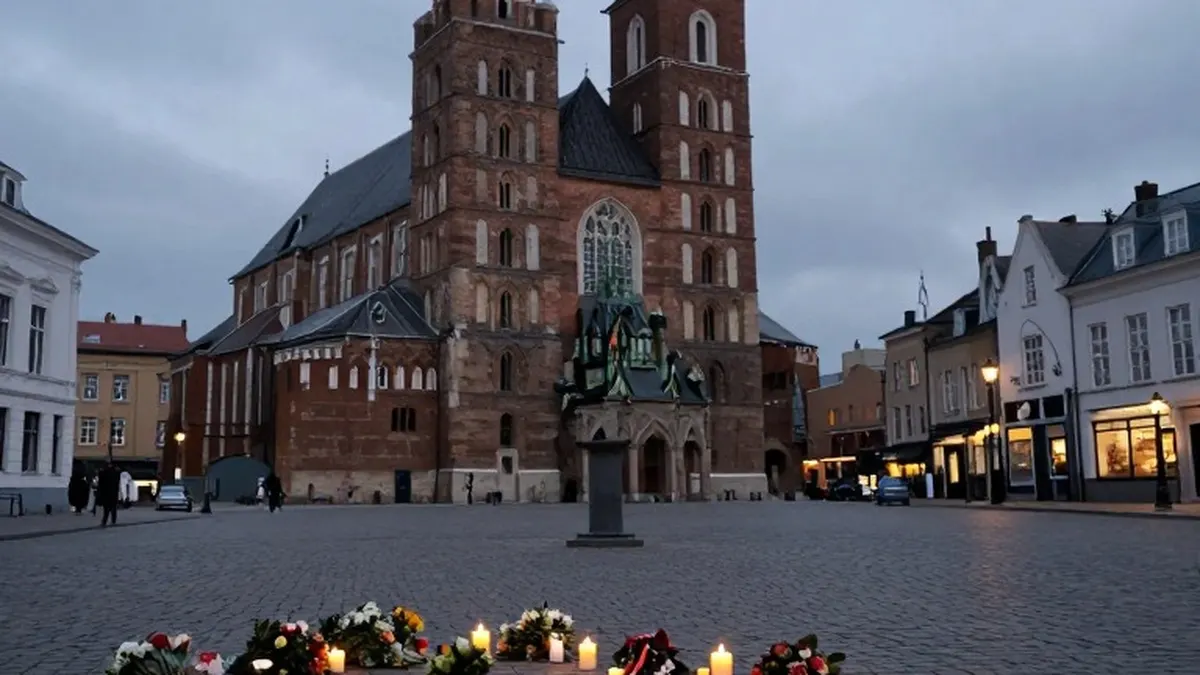
Poland began two days of national mourning on Sunday, one day after a 24-year-old man with far-right views opened fire in Krakow's historic Main Square, killing six people and wounding 15 others in an attack the country's defense minister described as an "act of terror."
The shooting unfolded on Saturday in the heart of the city's Old Town, a major tourist hub. The suspected gunman, a Polish citizen, was shot and wounded by police. Prosecutors said on Sunday they had launched an investigation into the murder and attempted murder of numerous people, including police officers, with the act "constituting a terrorist offense."
Four women and two men were killed in the Main Square shooting, Krzysztof Jan Klęczar, the Malopolska regional governor, said on Sunday. Three of the women and one of the men were Polish, he said, while a man from the United Kingdom and a woman from an unidentified foreign country were also among the dead.
Authorities also discovered the bodies of three people, the assailant's sister, mother and father, at the man's house in Ostrowiec Świętokrzyski, a city about 93 miles northeast of Krakow. Officials said they likely died from gunshot wounds.
Interior Minister Marcin Kierwiński said the suspect held "very radical" and "ultranationalistic" views. "Everything indicates that he was fascinated by far-right ideologies," Kierwiński told a news conference.
The two police officers who stopped the gunman, in actions authorities hailed as heroic, remained in hospital on Sunday. One of them is still in a coma while the other has woken from one, Klęczar said, and officials appealed for blood donations for the most seriously wounded officer. "If it weren't for the efficient and selfless intervention of these two young men, the number of victims could have been significantly higher," Klęczar said.
Klęczar said the attacker's father legally owned more than 10 guns and that the suspect also owned firearms. Local officials in Ostrowiec Świętokrzyski said seven weapons were seized from the family home, bringing the total recovered to 11, including four found in the man's possession in Krakow or in his car.
The square remained partially closed on Sunday morning as the investigation continued. St. Mary's Trumpet Call, the five-note melody played every hour from the highest tower of St. Mary's Basilica overlooking the square, was paused overnight in tribute to the victims, the first time the call has been missed since World War II. Outside the European Commission headquarters in Brussels, European flags flew at half-mast on Sunday.
"I'm absolutely devastated," Weronika Filar, a 27-year-old Krakow resident, told Agence France-Presse. "It's one of the safest places on Earth genuinely .. I did not expect anything like this to happen to us. Our city will never be the same." Krzysztof Stepien, a 28-year-old part-time city guide, told AFP that residents had heard of such incidents elsewhere in Europe. "Nothing like this has ever happened here, and I hope it never will again," he said.
Mass shootings are uncommon in Poland, though in mid-October three attacks at schools in the central province of Mazovia took place within four days, leaving one person dead and many wounded, including children, with the young attackers using knives or other sharp objects. Kacper Rekawek, a senior researcher at the International Center for Counterterrorism in The Hague, said the Krakow gunman's military gear, guns and overall look resembled those of other "extreme right lone actors" behind attacks across Europe. "We have had attempts before, but now we can say that these kinds of attacks have become successful in Poland," Rekawek said.