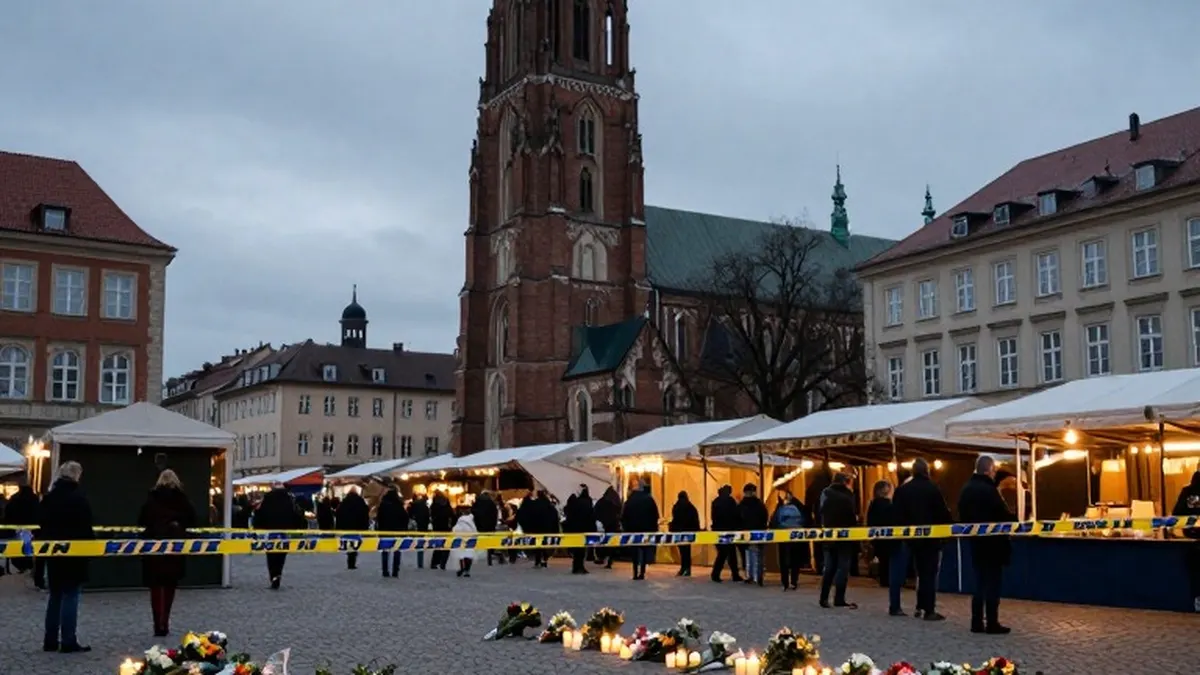
Poland began two days of national mourning on Sunday, a day after a 24-year-old man authorities described as holding far-right views drove into a crowded central square in Krakow and opened fire, killing six people and wounding 15 others before police shot and wounded him.
The attack took place Saturday in the Main Square at the heart of Krakow's Old Town, a major tourist hub in Poland's second-largest city. The country's defence minister called it an "act of terror." By Saturday evening, mourners had left candles in memory of the victims, and the square remained partially closed on Sunday morning as authorities continued their investigation.
Among the survivors was Marie-Ange Collaer, who wrote on Facebook that she and her family escaped the gunfire during a trip to Krakow from Brussels. "We literally ran for our lives and managed to hide from the bullets flying around," she wrote, adding that the family was "quite in shock" after returning to their hotel but grateful to be alive.
In tribute to the victims, St. Mary's Trumpet Call, the traditional five-note melody played every hour from the highest tower of St. Mary's Basilica on the square, was paused overnight. It was the first time the call had been missed since the Second World War.
Krzysztof Jan Klęczar, the Malopolska regional governor, said Sunday that the dead were four women and two men: three Polish women and one Polish man, a man from the United Kingdom, and a woman from an unidentified foreign country. Five non-Poles are among the wounded, coming from the U.K., Portugal, Russia, Germany and Austria.
The two police officers who stopped the attacker remain in hospital, one still in a coma and the other having awakened from one, and officials appealed for blood donations for the most seriously wounded officer. "If it weren't for the efficient and selfless intervention of these two young men, the number of victims could have been significantly higher," Klęczar said. The attacker is in critical condition after undergoing multiple operations.
Prosecutors said Sunday they opened an investigation into the murder and attempted murder of numerous people, including police officers, with the act "constituting a terrorist offense." After confusion on Saturday over whether the gunman was 24 or 25, authorities confirmed he is 24. Police also found three bodies at the man's family home in Ostrowiec Świętokrzyski, a city about 150 kilometers northeast of Krakow, identifying them as his sister, mother and father, who likely died from gunshot wounds.
Interior Minister Marcin Kierwiński said the attacker held "very radical" and "ultranationalistic" views. "Everything indicates that he was fascinated by far-right ideologies," he said at a news conference. Videos posted on social media by witnesses showed people fleeing the square into nearby side streets and first responders trying to resuscitate victims, while one clip showed a police officer repeatedly shooting the attacker, who was lying on the street, before slowly collapsing to the ground himself.
Klęczar said the attacker's father legally owned more than 10 guns and that the attacker also owned firearms. Local officials in Ostrowiec Świętokrzyski said they seized seven weapons from the family home, bringing the total recovered to 11, including four found in the attacker's possession in Krakow or in his car. Around 411,000 people hold gun permits in Poland, a country of 37 million, and interest in gun ownership has been rising, particularly since Russia's invasion of Ukraine fueled fears of regional instability.
Mass shootings are uncommon in Poland, though in mid-October three attacks at schools in the central province of Mazovia occurred within four days, leaving one person dead and many wounded, including children, with the young attackers using knives or other sharp objects. Kacper Rekawek, a senior researcher at the International Center for Counterterrorism in The Hague, said the Krakow attacker's military gear, guns and overall look resembled those of other "extreme-right lone actors" behind attacks around Europe. "We have had attempts before, but now we can say that these kinds of attacks have become successful in Poland," he said.