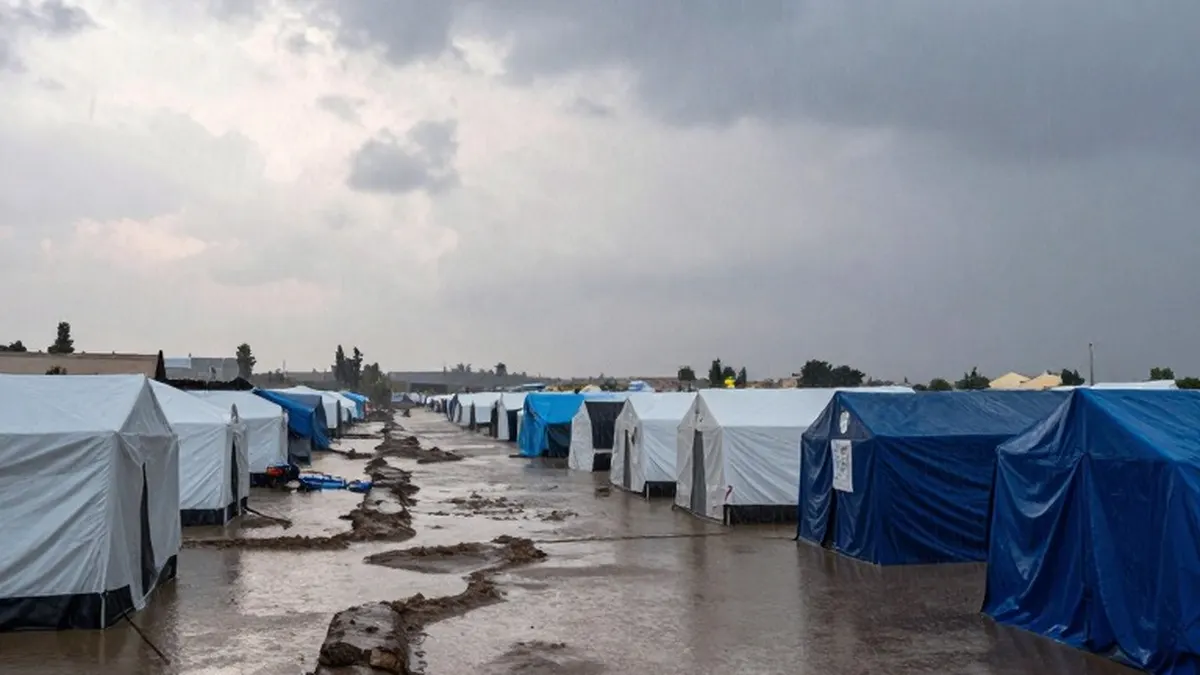
The first significant winter storm of the season swept through the Gaza Strip this weekend, bringing heavy rain and strong winds that flooded thousands of makeshift shelters. The severe weather forced many displaced Palestinian families out into the cold, highlighting the vulnerability of those living in temporary accommodations during the early months of winter.
Gaza's civil defence agency reported receiving approximately 1,500 distress calls within ten hours of the rain beginning on Saturday morning. In several shelter sites, water levels rose by 30 to 40 centimeters, creating hazardous conditions for residents. Spokesperson Mahmoud Basal stated that the feared scenario had materialized, with some shelter centers completely inundated. He noted that occupants were forced out into uncertain conditions, with premature babies, the elderly, and the sick facing the highest risks of illness or death.
The storm caused structural damage to buildings that had already been weakened by the war that began in October 2023. In the central Nuseirat area, rescuers evacuated residents from a building that partially collapsed under the force of the wind and rain. Meanwhile, in northern Gaza, a building wall collapsed due to the heavy rainfall, resulting in two injuries according to the Wafa news agency.
Visual reports from camps in Gaza City, Khan Younis, and Deir el-Balah depicted families wading through ankle-deep water. Many residents were seen with soaked mattresses and blankets, while children stood barefoot in pools of mud and sewage. Al Jazeera correspondent Nour Khaled, reporting from a camp in Gaza City, observed that even permanent houses struggled against the intensity of the rain, making it difficult for open plastic sheeting to provide adequate protection. She highlighted that more than 28,000 widows are facing the winter alone with their children.
In the coastal area of al-Mawasi in southern Gaza, where over 900,000 displaced people are sheltering, rain had been falling since 10 pm on Friday. Correspondent Rami Abu Taima reported that residents woke up to find hundreds or even thousands of tents flooded across the strip. He added that more than 125,000 families living along the coast are at particular risk of having their shelters swept away by the sea.
Gaza's emergency committee stated that more than one million displaced people face the dangers of winter. The territory urgently requires about 200,000 tents along with heating supplies to mitigate the impact of the cold weather. Raed al-Dahshan, the director of civil defence in Gaza governorate, explained that crews often find themselves with limited resources upon reaching flooded families. He remarked that the agency lacks even a single tarpaulin or tent, focusing primarily on saving lives, which he described as insufficient for the current needs.
Aid groups have pointed to Israeli restrictions on the entry of shelter materials as a contributing factor to the crisis. Mohammed Salha, director of the Palestinian NGO Network, noted that only 180 to 200 trucks are entering Gaza daily. This is significantly lower than the 600 trucks agreed upon under the humanitarian protocol of the ceasefire, and only about 40 of those daily arrivals carry humanitarian aid.
Salha emphasized the need for proactive measures rather than reactive ones, stating that the goal is to prevent disasters rather than simply responding after tents flood. He mentioned that 50,000 tents are currently waiting on the Egyptian side of the border. He described the international pressure on Israel to allow more supplies into the territory as timid, underscoring the urgency of the situation.