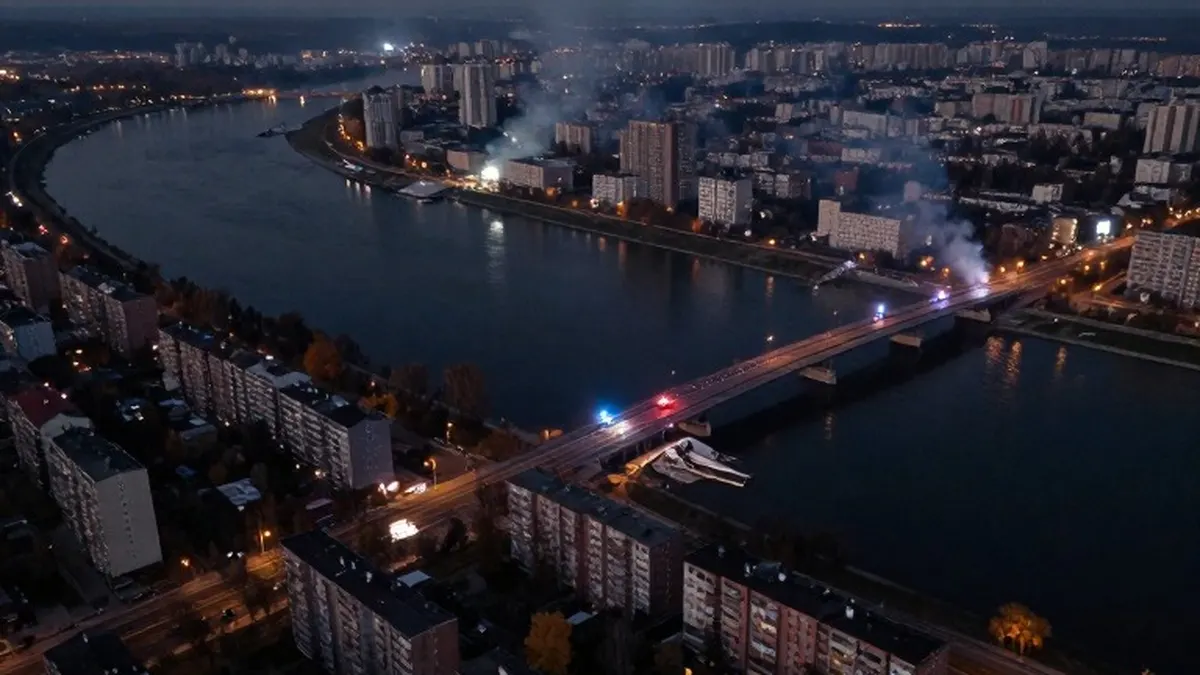
Russia launched a large overnight attack on Kyiv and other Ukrainian regions on November 7, firing 172 attack drones and 36 ballistic missiles that struck energy infrastructure, residential housing, and a major bridge over the Dnipro River, according to Ukraine's Air Force. The strikes left parts of the capital without electricity, heating, and water supplies.
Kyiv Mayor Vitali Klitschko described the situation with the city's energy supply as "extremely difficult" following strikes on infrastructure in the Kyiv and Zhytomyr regions. Several apartment buildings, a kindergarten, and a nonresidential building were damaged in the capital, where five people were injured, including a 14-year-old.
The Northern Bridge, a major crossing over the Dnipro, was struck and temporarily closed in both directions. Klitschko said the attack damaged the road surface, overhead trolleybus power lines, and electricity transmission lines, and that the blast wave damaged five trucks parked nearby. He published a video showing damage to the bridge's roadway and safety barriers and said repair work had begun.
Russia's Defense Ministry confirmed the strike on the bridge, claiming it was used to transport weapons and military equipment for the Ukrainian Armed Forces. Elsewhere in the country, Russian strikes on four districts of the Dnipropetrovsk region overnight killed one person and injured four others, including an 11-year-old girl, according to Ukraine's State Emergency Service.
President Volodymyr Zelenskyy said substations connecting the Rivne and Khmelnytskiy nuclear power plants to Kyiv and Ukraine's central regions were targeted, with additional substations reportedly damaged in the Vinnytsya, Zhytomyr, Rivne, Kharkiv, and Dnipropetrovsk regions. In a Telegram post accompanied by photos of the extensive damage, he appealed to Washington to maintain and increase support for Ukraine, urging greater unity in Congress on security issues, condemnation of Russian aggression, and stronger sanctions pressure on Russian President Vladimir Putin.
"When Russia is trying to plunge Kyiv, a city of millions, and the entire country into a blackout, Ukraine must not be left alone," Zelenskyy wrote, adding that "America's determination and consistency in supporting Ukraine are of great importance in bringing peace closer."
Russia has resisted calls for a partial or total cease-fire, saying fighting would stop when a comprehensive peace deal is reached. It has stepped up strikes on Ukraine's energy infrastructure, along with attacks on civilian sites, as the potentially brutal winter months approach.
Ukraine, meanwhile, continued its own campaign against Russian energy infrastructure and military-industrial facilities overnight on November 6-7. The General Staff said its missile forces used Neptune coastal missile systems to strike JSC Proton-Electrotex in Oryol, an enterprise producing electronic and optoelectronic components used in Russia's Iskander-M ballistic missiles and cruise missile systems. Kyiv said the strike could complicate Russian production of weapons used against Ukrainian cities. Oryol regional authorities reported damage to warehouses and production facilities belonging to commercial enterprises, as well as three private houses.
In Russia's Saratov region, a fire broke out at the Saratov Oil Refinery following a Ukrainian drone attack, according to the independent Russian outlet ASTRA and Ukrainian monitoring channels. Regional Governor Roman Busargin confirmed damage to civilian infrastructure and said there had been preliminary reports of casualties, while several residential buildings were also reportedly damaged. Russia's Defense Ministry claimed its air defense systems shot down 411 Ukrainian drones overnight, a figure that has not been independently verified.
The latest escalation comes just days before planned trilateral negotiations between Ukraine, Russia, and the United States in Abu Dhabi on November 10 and 11. Interfax reported that Russia's delegation will include presidential aide Vladimir Medinsky, Deputy Foreign Ministers Sergey Ryabkov and Mikhail Galuzin, and Igor Kostyukov and Yuri Zhigarlovsky of the Russian Armed Forces' General Staff. Ukrainian media reported that Kyiv's delegation will be led by Rustem Umerov, head of Ukraine's Foreign Intelligence Service and a former defense minister, joined by Presidential Office chief Kyrylo Budanov, Servant of the People parliamentary faction head David Arakhamia, presidential communications adviser Dmytro Lytvyn, and Serhiy Kyslytsia, first deputy head of the Presidential Office.