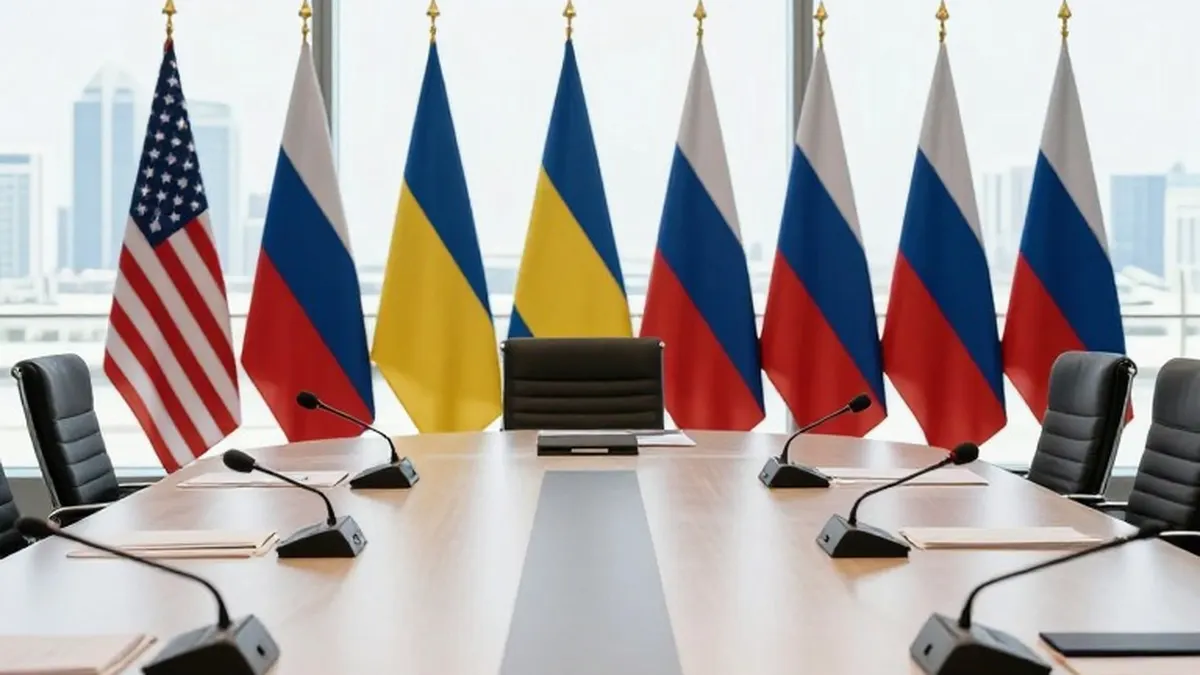
A second day of trilateral talks between Russia, Ukraine, and the United States in Abu Dhabi has concluded without a major breakthrough. The discussions, which are the first of their kind since February, aimed to address the nearly five year long war that began with the Russian invasion. While American officials noted some openings, no definitive agreement was reached to end the conflict.
Davyd Arakhamia, a member of the Ukrainian negotiating team, described the session as one of the hardest he had experienced. He suggested that the Russian delegation arrived with strict directives, making it difficult to soften the tone of the discussions. Despite these challenges, Arakhamia expressed a sense of good momentum and urged that a second round of talks be organized as soon as possible.
Both Moscow and Kyiv confirmed that preparations are underway for a large scale exchange of prisoners of war. This humanitarian effort is expected to be carried out in the near future, offering one of the few immediate tangible outcomes from the recent diplomatic efforts.
Following the conclusion of the Abu Dhabi talks, it was announced that US negotiators Steve Witkoff and Jared Kushner, the son in law of President Donald Trump, would travel to Moscow. There, they will meet with Russian President Vladimir Putin. Subsequently, they are scheduled to visit Dublin to speak with Ukrainian President Volodymyr Zelensky.
The current round of negotiations was primarily focused on the security architecture of Europe. For Kyiv, this framework may include assurances that allies will provide aid if the country faces another attack, even though it is not a member of NATO. Conversely, Moscow is likely seeking limitations on NATO influence in eastern Europe, a concern for the Kremlin since the alliance began its eastward expansion.
US envoy Jared Kushner stated earlier in the week that the goal was to create a new security framework between Ukraine, Russia, and Europe to secure lasting peace. Vladimir Medinsky, a Kremlin negotiator, echoed this sentiment by calling for a new and fair global security system.
European nations, including Britain, NATO representatives, and various EU countries, were present in Abu Dhabi. They held meetings with US and Ukrainian negotiators. However, the Kremlin noted that its delegation did not have direct contact with these European representatives, as the EU does not officially communicate with Moscow.
A significant point of contention remains the sequence of events leading to peace. Europe and Kyiv prefer a ceasefire before finalizing security discussions, while the Kremlin insists that fighting should stop only after an agreement is reached. Kushner acknowledged that any peacetime security framework is contingent on the war ending, which requires an agreement on territory and other bilateral issues.
The status of Ukraine's eastern region of Donetsk remains a core obstacle. Moscow has demanded that Ukraine relinquish the parts of the region it still controls, whereas Kyiv wants to freeze the contact line to maintain its hold on those areas. Kushner admitted that this territorial issue was the hardest part of the negotiation. He noted that trust is currently low between the sides, which is expected following such a prolonged conflict.