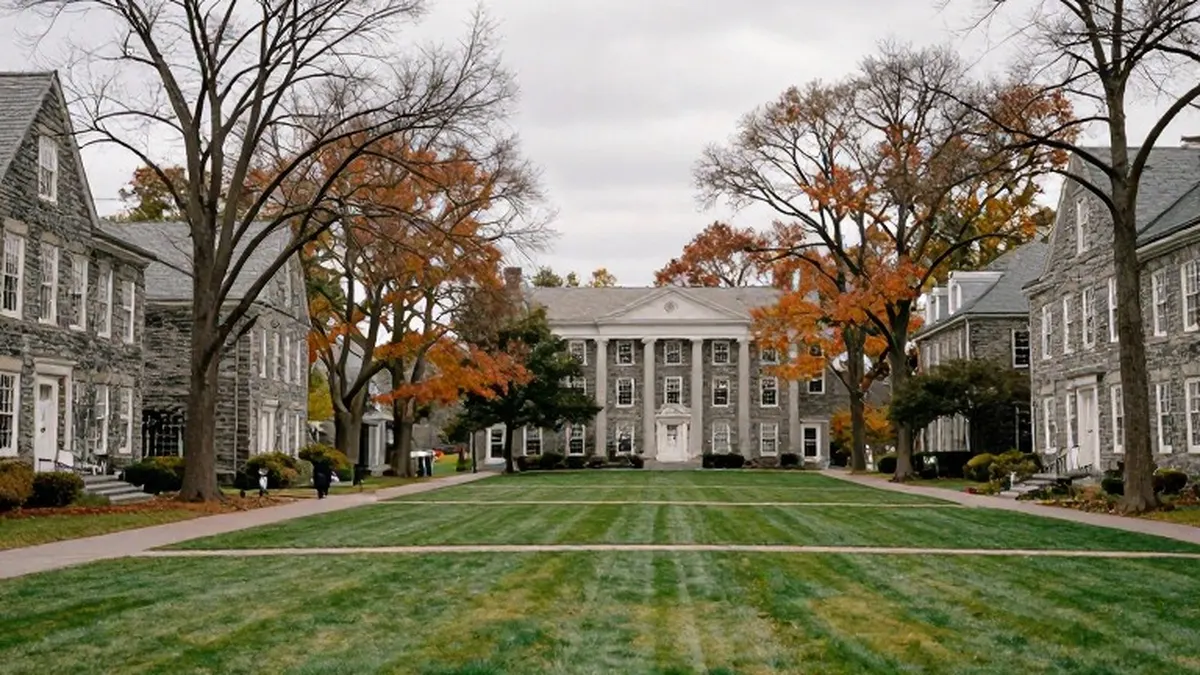
With its stately Vermont limestone buildings and meticulously kept lawns, Middlebury College looks expensive. The school is working to persuade families that it is not, announcing that students from households earning up to $175,000 a year will be able to enroll tuition-free.
The offer sounds like a sweeping expansion of financial aid, since $175,000 is more than double the nation's median household income. But the college says only about 35 to 50 additional families in an incoming class of roughly 630 will benefit, because most students from families at that income level already attend without paying tuition.
Experts say that is largely the point. A growing number of colleges are turning to simple income-based guarantees to confront a problem that has soured many Americans on higher education: how hard it is to figure out what college will actually cost. "Let's make it as non-complicated as possible," said Ian Baucom, Middlebury's president. "If your family income is $175,000 or less, at Middlebury, you don't pay tuition."
The confusion is well documented. Nearly 80 percent of families weighing college eliminated a school based on price, a survey by the student loan company Sallie Mae found. Nearly 70 percent of students and parents call the financial aid process partly or completely confusing, according to the Strada Education Foundation, and a Gallup survey found nearly two-thirds of Americans consider four-year institutions unaffordable.
Much of the problem stems from colleges' own strategy of advertising a high list price that almost no one pays, then offering discounts they call scholarships. At 445 colleges and universities, not a single student pays the advertised price, according to a Hechinger Report analysis of federal data. At private nonprofit four-year schools, fewer than 1 in 5 families pay it.
"The most important problem, I would argue, in college pricing today is the lack of transparency," said Phillip Levine, a Wellesley College economist and author of the book Hidden Tuition. Most schools announcing guarantees are not actually cutting prices, he said. At many of them, "the college was already free for almost all those kids."
Parents touring Middlebury this fall described the maze. Liz Mark of Wisconsin said families often do not learn a final price until after a student is accepted and submits financial documents, which she compared to getting a medical procedure without knowing the cost in advance. Mark Doughty of Massachusetts said a friend in higher education taught him that "the price on the menu is not necessarily what you pay," and that the guarantees at least create "a very clear ceiling."
Middlebury's listed price of attendance is $97,386 a year, and many peers have crossed $100,000, helping drive near-record-low public confidence in higher education. The guarantees do not cover room, board, books, transportation or other expenses, which run $24,462 a year at Middlebury, though other aid is often available. Dean of admissions Nicole Curvin said anxiety about the cost of living and a fast-changing job market have made affordability "the top question that every family is asking us."
Middlebury joins a list that includes Princeton, which guarantees free tuition for most families earning up to $250,000, the University of Chicago at $250,000, MIT, Harvard and Swarthmore at $200,000, and Davidson at $175,000. Most of the plans began for students who enrolled this fall or take effect next year. Others are trying different fixes: the University of Pennsylvania just introduced a calculator that estimates a family's cost before students apply, while Prescott College, the University of Tulsa and Concordia University, St. Paul are simply lowering their list prices.
For Baucom, the stakes go beyond any one campus. "The social contract of American life depends upon the idea that everyone can come into the fullness of what it means to live and think and study and work here. And that's fracturing," he said. His promise to families, he said, is simple: "We want every family, and families of all sorts."