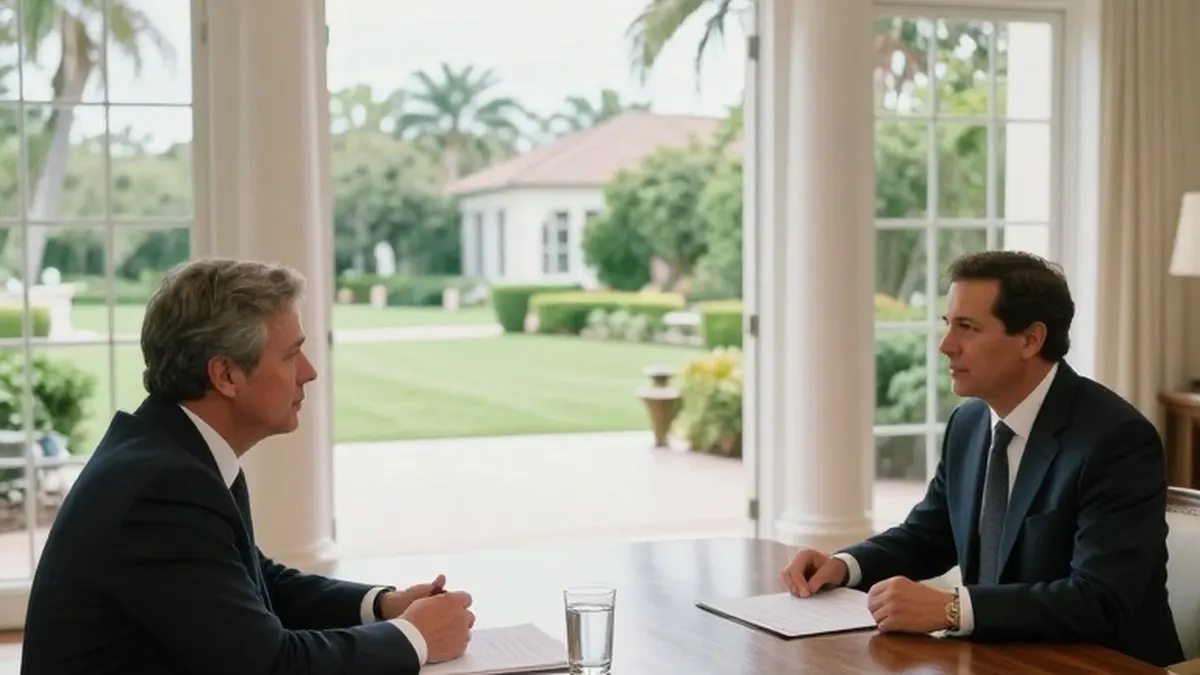
US President Donald Trump and NATO Secretary General Mark Rutte issued a joint appeal to Russia on November 25, 2026, asking the Kremlin to refrain from actions that could widen the conflict in Ukraine. The two leaders met at the US President's Mar-a-Lago estate in Florida, a location frequently described as the Southern White House. The discussions took place behind closed doors, and the final statement characterized the talks as extremely productive.
The primary focus of the meeting was Russia's ongoing war against Ukraine, alongside the conflict in Iran. The leaders also reviewed the collective accomplishments of NATO allies during recent summits held in the Hague and Ankara. A central point of their dialogue concerned the need for Russia to avoid any maneuvers, whether deliberate or accidental, that might extend the war beyond Ukrainian borders.
In a joint statement distributed by the press services of NATO and the White House, the leaders emphasized the urgency of a diplomatic end to the fighting. They stated, 'We also discussed the importance of Russia avoiding any actions that intentionally, or unintentionally, expand the war, and the importance of obtaining a peaceful resolution to the war as rapidly as possible.' This message highlighted a shared desire for a swift and stable conclusion to the hostilities.
Beyond the immediate military conflict, Trump and Rutte addressed the economic dimensions of European security. They discussed the necessity of further increasing defense spending and investing in the industrial base within both the United States and NATO member states. These measures aim to strengthen the long-term capability of the alliance to support its members and maintain deterrence.
The meeting followed a period of active diplomatic engagement between Washington and Moscow. On November 19, ahead of a trilateral meeting in China, President Trump entered a hall in Shenzhen accompanied by Secretary of State Marco Rubio and Treasury Secretary Scott Bessent. As he walked in, Trump smiled, pointed at Russian President Vladimir Putin, and remarked, 'Who is that? He's my friend.' He then shook Putin's hand in a display of cordiality.
During the subsequent press conference, Trump noted that Putin had assured him of his desire to end the war with Ukraine through diplomatic channels. The US President also observed that Putin is 'having a hard time right now' due to the war he initiated against Ukraine. These comments suggest a continued effort by the US to leverage diplomatic channels to pressure the Kremlin toward a negotiated settlement.
NATO Secretary General Rutte has previously defended Trump's approach to dealing with Putin. Rutte described the US President's strategy as a test of the Kremlin leader's intentions. This support for a direct engagement style aligns with the recent productive talks at Mar-a-Lago, which sought to clarify positions and reinforce the alliance's unity.
The joint statement serves as a reminder of the collaborative effort between the US and NATO in managing the geopolitical fallout of the war. By focusing on both immediate restraint and long-term industrial investment, the leaders aim to create a comprehensive framework for peace and security. The outcome of these discussions will likely influence future diplomatic initiatives involving Russia, Ukraine, and other global stakeholders.
As the war enters another phase of diplomacy, the emphasis on avoiding expansion remains a key priority. The leaders' commitment to a rapid peaceful resolution underscores the international community's desire to prevent further regional instability. The upcoming weeks will be critical in determining whether these diplomatic efforts translate into tangible progress on the ground.