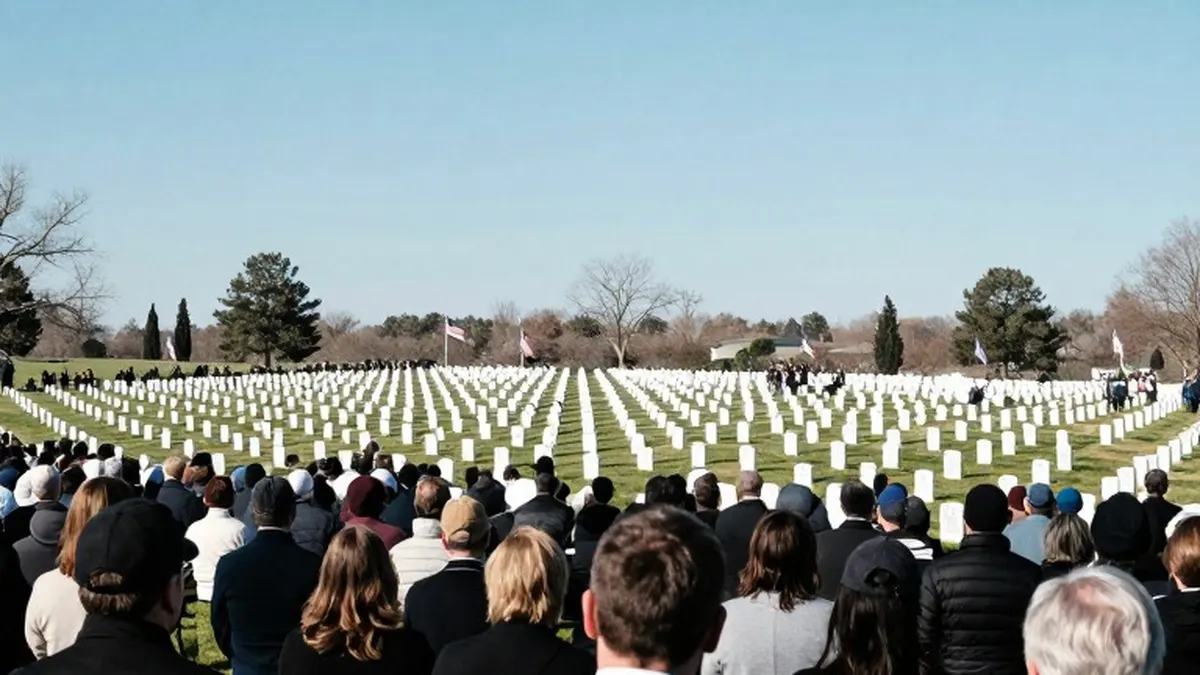
President Donald Trump addressed a gathering of veterans and their families at Arlington National Cemetery on Wednesday to mark Veterans Day. During the ceremony, he offered a defense of the ongoing war in Iran, asserting that the conflict is close to its conclusion. He stated that the war will be over soon, signaling to the assembled crowd that a definitive end is in sight.
The President framed the current military engagement as a long-overdue response to decades of hostilities. He referenced the 1983 bombing of the U.S. Marine Corps barracks in Beirut, which he noted was backed by Iran. Trump argued that the United States did not initiate the conflict but rather had to fight back against an adversary that had been waging war on America since 1979.
"America did not start a war with Iran. Iran has been waging war on America since 1979. They should have been taken care of a long time ago," Trump said. He added that it was time for the United States to fight back and that the nation had succeeded in doing so. He emphasized the need for a total victory, rejecting the idea of a partial or incomplete outcome.
The President acknowledged the human cost of the conflict, noting that while the total duration was roughly seven months, only a few weeks involved active fighting. He paid tribute to the American service members who died, referring to them as beautiful souls. "We lost 18 beautiful souls," he said, expressing the grief of the nation for those who gave their lives in service.
Looking ahead, Trump suggested that the end of the conflict would bring significant benefits to the global community. He predicted that once the war concludes, the world will become a much safer and more peaceful place, free from the specific dangers that the United States had to endure during the campaign.
Secretary of State Marco Rubio has aligned with the President's stance, and both officials have indicated a preference for avoiding a re-escalation of military hostilities following the midterm elections. Instead of focusing on further kinetic action, administration officials have highlighted economic and diplomatic strategies as the primary tools for resolving the dispute.
Speaking to reporters on Tuesday, Rubio explained that military strikes are not necessary if the same objectives can be achieved through economic pressure. He argued that the current measures are effectively targeting Iran's stability without requiring a return to large-scale combat operations.
Rubio rejected the notion that the United States and Iran are stuck in a stalemate. He maintained that the combination of sanctions and a naval blockade is steadily weakening the Iranian government. He described the situation as one of increasing pressure that grows with each passing day.
"They’re bleeding. They’re bleeding economically," Rubio stated. He concluded that the sustained economic strain is a critical component of the broader strategy to secure a favorable outcome for the United States and its allies.
The remarks from both the President and the Secretary of State provide a clear picture of the administration's current approach. By combining a narrative of decisive military victory with a strategy of persistent economic pressure, the leadership aims to bring the conflict to a swift and conclusive end.