In his final pitch to voters before the US midterm elections, Donald Trump repeatedly declared that a new "golden age of America" was under way. The war in Iran was not really a war, he stressed, because "we've done very little fighting", the stock market had hit 88 all-time highs, and "they're saying" the US had become "the hottest country anywhere in the world" on his watch.
In a speech at Washington's Lincoln Memorial reflecting pool on the campaign's last day, he claimed to have "achieved more in less than two years than any administration in American history" and kept "every single promise I made", imploring voters to "pretend I'm on the ballot". As votes were counted on Tuesday night, the constructed reality behind his 2024 comeback had visibly shattered.
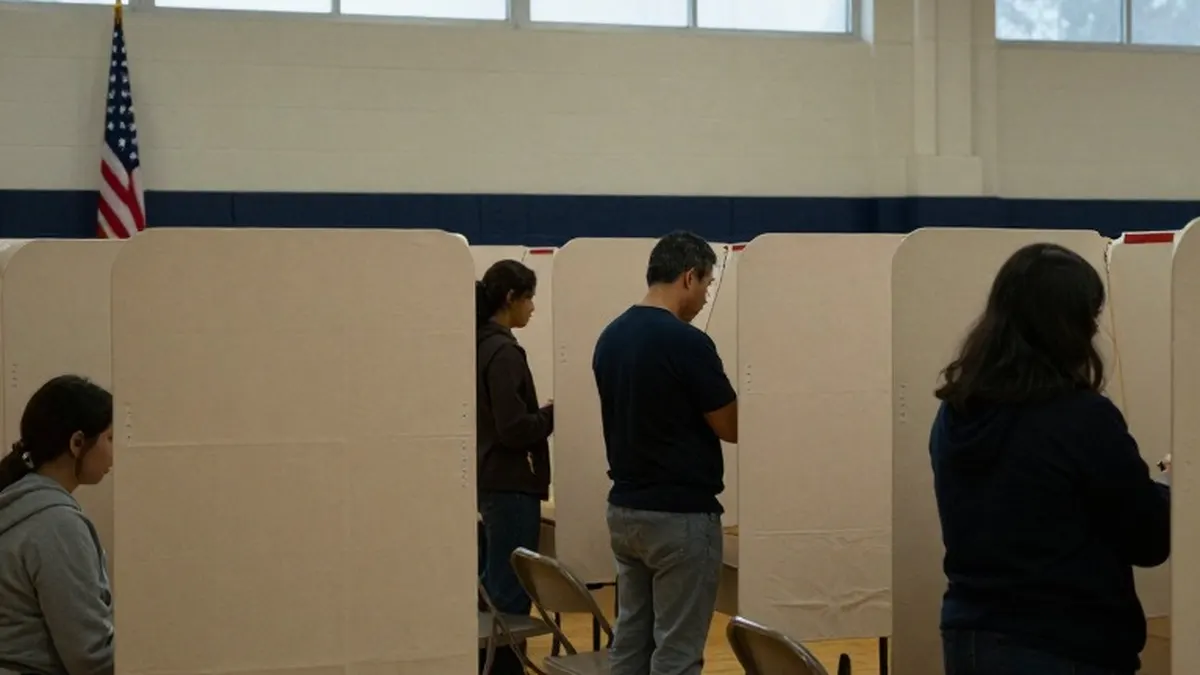
Across the country, voters including past Trump supporters said they felt no golden age at the gas pump or the grocery store. The economy and the cost of living drove their decisions, but corruption, the Iran war, tariffs, datacenters, healthcare costs and the administration's deportation campaign also weighed in. "There's a war that nobody wants right now," said Jim Conrad, a voter in Ohio. Linda Olson, a previous Trump voter in Kansas, said the president was working to "make himself richer instead of really helping the people". "I wanted to vote for no Republicans," said Stacey, a voter in Iowa.
Tom Galvin, a Republican on Arizona's Maricopa county board of supervisors, said the priorities of the coalition that carried Trump back to power in 2024 had fallen by the wayside "one by one". "If you wanted the Epstein files, that didn't happen," he said, also citing inflation, gas prices and the pledge to avoid "foreign wars or senseless wars".
Trump had spent months explaining away such frustrations, calling affordability a Democratic "con job", noting that "the United States oil and gas business is making hundreds of billions of dollars" and warning that towns rejecting datacenters would end up "backwards and poor". "You don't see the stock market on the side of the road. But you drive down a street, you see the gas prices," said Paul Bentz, an independent pollster at the Arizona firm HighGround. A colleague called it the reflecting pool election, a nod to the $14m renovation of the pool where Trump delivered that final speech: "Narcissism 101".
The president was defiant after the losses. He elevated Stephen Miller, among the most controversial figures in his administration, to chief of staff, and wrote Thursday on Truth Social: "I JUST WASN'T ON THE BALLOT. IF I WERE, WE WOULD HAVE WON IN A LANDSLIDE!"
Republicans on the ground described a different reality. Jim Abeler, a Minnesota state senator who lost reelection after visiting about 80 percent of the homes in his district, met "outright hostility" toward Trump over gas prices and the war; one voter who had backed him before told him, "I'm sorry, it's just a bad year to be you." Chris Madel, a Minneapolis attorney who abandoned a Republican primary bid for governor over the Operation Metro Surge deportation crackdown, said he never thought the US would look like "a banana republic with respect to corruption".
Democrats, who campaigned through town halls, county fairs and retail politics, said voters simply wanted to feel heard. Rebecca Cooke, who won a Republican-held district in western Wisconsin, said people "don't feel that the federal government really gives a damn about them". Bob Brooks, who flipped Pennsylvania's 7th congressional district, said voters "felt lied to by the Trump organization". In Arizona, Republicans lost both chambers of the state legislature after polls closed on 3 November, and the Democratic governor won reelection by nearly 13 points.
Galvin said "there is a lane to do the right thing" in the Republican party, while Joe Pitts, who leads Arizona's 1912 Institute think tank, cautioned that "so long as Trump is alive, he will exercise significant influence over the Republican Party". Christine Hunschofsky, the incoming Democratic leader in the Florida House, said officials in both parties should heed the results: "Every elected official has such a responsibility right now to restore that trust."