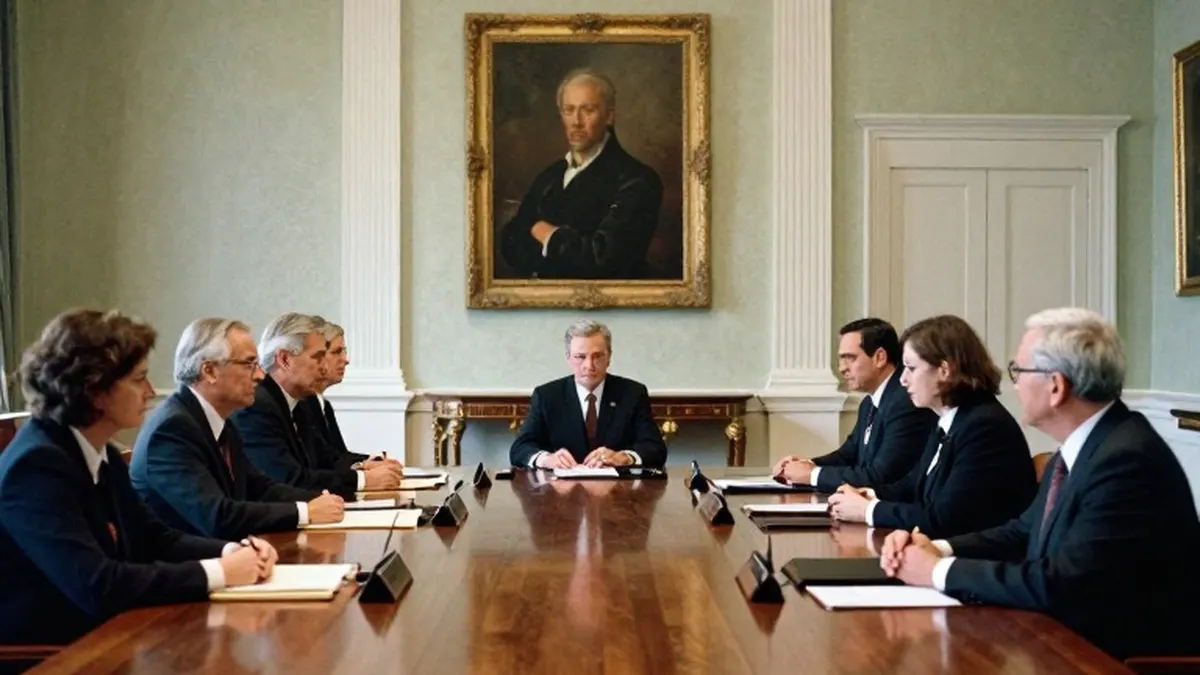
U.S. President Donald Trump's special envoys met with Russian President Vladimir Putin at the Kremlin on Thursday. This high-level meeting followed two days of intense, U.S.-mediated negotiations between Russian and Ukrainian delegations in Abu Dhabi, the capital of the United Arab Emirates. The envoys, Steve Witkoff and Jared Kushner, who is also the president's son-in-law, had just concluded their work in the Gulf city. These discussions marked the first direct talks between representatives of Moscow and Kyiv in nine months, offering a potential path forward as peace efforts had previously stalled.
The two-day session in Abu Dhabi concluded on Wednesday without a major breakthrough, although the parties did agree to swap a significant number of prisoners. The exact figure for this exchange remains to be announced. Following their return from the talks, Kushner and Witkoff proceeded directly to Moscow to brief the Russian leader. Their meeting lasted approximately two hours before the envoys were scheduled to fly to Dublin, Ireland, to meet with Ukrainian President Volodymyr Zelenskyy as the conflict approaches its five-year mark.
A primary objective of the Kremlin meeting was to secure Putin's approval for European representatives to join the negotiation table. The U.S. and Ukraine want Europe to appoint a single negotiator to engage with Moscow regarding the continent's broader security arrangements. However, Moscow has resisted European involvement in direct talks, arguing that European nations are financing and supplying Ukraine's military effort. European leaders are concerned about Russia's broader intentions on the continent and view the inclusion of Moscow in postwar security discussions as a significant concession to Putin, who has long cited NATO's eastward expansion as a key threat.
Kushner stated in Moscow that while the delegations in Abu Dhabi agreed on many principles, they remain divided on the specific methods to achieve peace. Putin reaffirmed to the U.S. envoys that the presence of European troops in Ukraine after a ceasefire would be absolutely unacceptable. He warned that Russia would view such a deployment as a security threat and a legitimate target, stating that the war would likely resume immediately. Additionally, Putin indicated that Russia regards its border with Ukraine under a potential peace deal as extending to include the four Ukrainian regions that Moscow annexed in 2022 but never fully controlled.
In Dublin, President Zelenskyy is attending a meeting with more than 40 European countries, which also includes NATO Secretary-General Mark Rutte. Rutte noted that the U.S., Europe, and Ukraine are closely aligned on the structure of security guarantees following a recent meeting in Paris. However, he emphasized the urgent need for a peace deal or at least a ceasefire. Zelenskyy suggested that upcoming political changes, such as Democrats taking control of the U.S. Congress in January and elections in France next year, could create a window of opportunity for a settlement. He described the proposed prisoner exchange as a positive step but maintained that Ukraine would not surrender Russian-occupied territory in exchange for peace.
Fighting continues along the 1,200-kilometer front line as another winter approaches. Russian forces have maintained pressure through drone and missile strikes on Ukraine's energy infrastructure, disrupting heat and electricity supplies. Kyiv has termed this strategy the weaponization of winter. Russia's Defense Ministry reported that its air defenses downed 71 Ukrainian drones overnight and struck several facilities in and around Kyiv, including a drone-manufacturing plant and sites producing missile fuel. The Ukrainian air force stated that Russia launched missiles and 123 drones, with hits recorded at 17 locations.
Ukraine has also reported technical issues with the Starshield satellite internet system, a military-grade version of SpaceX's Starlink service. Zelenskyy announced on social media that military units are experiencing significant disruptions, including speed restrictions that limit Ukrainian drones to 161 kilometers per hour. A military investigation indicated these restrictions were not random errors. Elon Musk previously acknowledged that SpaceX had throttled the service for about a week, stating it should not be used for offensive strikes. Zelenskyy noted that these limits affect operations in Russian-occupied areas and said Kyiv is seeking clarification from U.S. officials.
In a separate incident, a Russian serviceman was killed in St. Petersburg early Thursday when his vehicle exploded. Russia's Investigative Committee confirmed the death but did not initially identify the victim or the attackers. The Fontanka news outlet reported that the victim was a colonel and that a bomb in his car detonated as he was driving. This incident follows a series of bombings and attacks that have claimed the lives of several senior Russian military officers in recent months.